

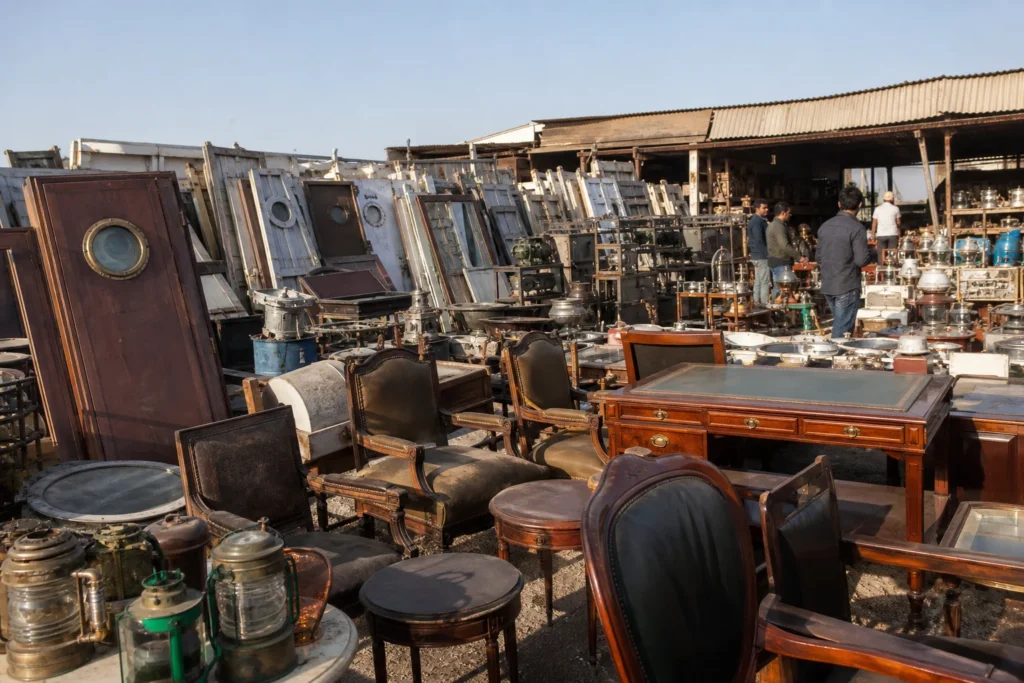

Stand on the Bhavnagar coastline on a clear morning and the horizon tells you something strange is happening here. Massive steel hulls sit beached at intervals along the shore, some partially dismantled, some still intact enough to read the names on their bows. Behind them, stretching for roughly six miles, a strip of second-hand shops has grown up to receive everything those ships once contained. The Alang Shipyard Market is not a flea market in any conventional sense. It is a salvage ecosystem built directly onto one of the world's most active shipbreaking yards.
Alang has operated as a major shipbreaking site since 1983, and the market exists entirely because of that industrial activity. Cargo ships, tankers and cruise liners arrive at the beach, and teams of workers break each vessel down with speed and thoroughness. As each ship reaches the end of its working life, its contents pass to the line of shops along the shore. The two operations — yard and marketplace — are now so intertwined that one would not make sense without the other.
The merchandise resists easy categorisation, and that is much of the point. Buyers with an eye for interior design find mahogany doors, first-class dining furniture and ocean liner lighting rigs that would stop a room cold. Navigation enthusiasts sift through compasses, maritime charts and instruments that once guided vessels across open ocean. Prop hunters and curiosity seekers land dartboards, ice cream machines and branded tableware from ships whose names most people never knew. The objects are specific and strange, and they tend to make you reconsider how you think about salvage.
What keeps the inventory genuinely unpredictable is the way stock changes hands. When a ship has been stripped down, storekeepers receive an invitation to inspect whatever remains. They then compete in a silent auction, with the highest bidder taking their chosen goods. That competitive mechanism gives the market a curated edge that passive accumulation never could. A collector who visits in one season may find entirely different objects waiting in the same shop a few months later.
The scale of throughput drives this constant renewal. Hundreds of vessels pass through Alang each year, which means the flow of salvage rarely pauses. Objects that crossed oceans for decades arrive here and begin a second life — a ship's door becomes a design statement, a liner's chair finds a garden, a navigation lamp ends up in a dining room. The market rewards imagination as much as bargain-hunting.
Access deserves serious attention before travel. Alang sits in Bhavnagar district in Gujarat, roughly within reach of Bhavnagar city, which has rail and air connections to Ahmedabad and other major centres. The shipyard itself is an active industrial site, and visitor access arrangements are not standardised. Researching entry requirements in advance is strongly advisable. Shops along the strip generally operate during daytime hours, though individual stalls set their own schedules.
This is a destination that suits a particular kind of visitor well: collectors of maritime and industrial objects, set designers, interior architects sourcing unusual pieces, and anyone drawn to the point where heavy industry and commerce meet. For that audience, the Alang Shipyard Market offers something genuinely hard to find anywhere else — a working shipbreaking yard that doubles as one of the most unusual markets on earth.
Frequently Asked Questions
Q: What kind of goods can buyers actually find at the Alang Shipyard Market?
A: Stock divides into a few broad collector categories. Design and interiors buyers turn up mahogany doors, first-class dining furniture and ocean liner lighting rigs. Navigation and instrument enthusiasts find compasses, maritime charts and seafaring instruments. Curiosity seekers land objects like branded tableware, dartboards and ice cream machines from vessels that crossed oceans for decades. The range is genuinely eclectic — the appeal is often in the unexpected.
Q: Why does the inventory change so dramatically between visits?
A: When a ship has been stripped down at the yard, storekeepers are invited to inspect the remaining goods and compete in a silent auction. The highest bidder takes what they want to stock. That competitive process means inventory is curated by commercial selection rather than passive accumulation, and because hundreds of vessels pass through Alang each year, the turnover is constant. Objects found in one season may be entirely gone — or replaced by something stranger — a few months later.
Q: Is Alang easy to reach as a day trip?
A: It is not a casual drop-in destination. The market sits within Bhavnagar district in Gujarat, roughly accessible from Bhavnagar city, which has rail and air connections to Ahmedabad. The shipyard itself is an active industrial site, so access arrangements for visitors need advance research before travel. Check current entry requirements with local contacts or the relevant authorities before making the journey.
Q: Is this a good destination for interior designers or prop hunters specifically?
A: Unusually so. Ship salvage at this scale produces objects rarely found together elsewhere — first-class furniture, industrial lighting rigs, navigational instruments and purpose-built maritime fittings. The silent-auction mechanic that governs stock acquisition means a determined buyer with a specific brief may need more than one visit, but the rewards for those with patience and imagination tend to be considerable.
Marketplace Highlights








Add a review