


Region
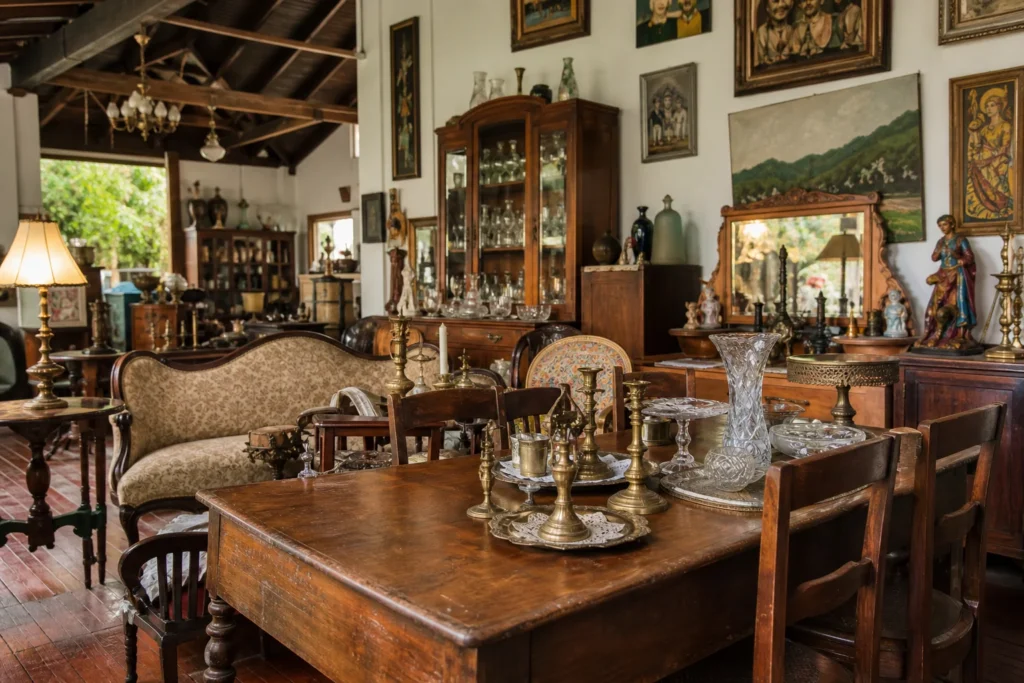
Antigüedades Imperio sits in the Guadalupe district of San José, and it is one of very few antique shops in Costa Rica with genuine curatorial depth. The owner sources pieces both locally and through buying trips to Europe and the United States. That dual sourcing gives the stock an unusual range — and a coherent historical logic.
Two distinct historical currents explain why European antiques ended up in this small Central American country at all. The coffee boom of the late nineteenth century made a generation of Costa Rican families wealthy enough to send their children to study in Europe. Those students came home with furniture, ceramics and decorative objects acquired abroad. A second wave arrived in the years before the Second World War, when European refugees settled in Costa Rica and brought their possessions with them. Antigüedades Imperio draws directly from that inheritance. The pieces here carry social history that the country rarely makes visible elsewhere.
The inventory concentrates on the first half of the twentieth century and spans several collecting categories. Furniture forms the primary draw — European-influenced chairs, tables and cabinets that arrived by those historical routes. Ceramics, decorative objects and curiosities fill the surrounding space. The breadth suits browsers who arrive without a fixed target as much as focused collectors hunting one specific genre.
Pricing is worth flagging for visiting collectors. Because the local antique market in Costa Rica is small, competition for stock is limited. Pieces tend to sell at considerably more modest prices than equivalent objects would fetch in North American or European auction rooms. A mid-century chair or piece of imported porcelain that might command a serious price elsewhere can be had here at a fraction of that figure. Low local demand also means the ratio of genuine collectibles to filler remains high. Visitors rarely waste time sorting through indifferent stock to reach something worthwhile.
The shop opens Monday through Friday from 09:00 to 17:30. Saturday hours run from 09:00 to 15:00, so weekend visitors should plan to arrive with time to spare — a mid-afternoon arrival on a Saturday cuts the visit short. The shop is closed on Sundays.
For getting there, the Parada Calle Blancos bus stop sits approximately 400 metres from the shop and offers the most direct local access. The Calle Blancos train station, served by Train line 2, is roughly 1.2 kilometres away. Visitors travelling from the city centre may find Atlántico station useful — Train lines 1, 2 and 4 call there, at approximately 1.6 kilometres distant.
Antigüedades Imperio suits two kinds of visitor particularly well. Collectors hunting European-influenced pieces with a documented Latin American provenance angle will find the depth of stock rare in this region. Travellers looking for an object that carries real social history — rather than a standard souvenir — will find that almost anything in the shop has a more interesting backstory than it first appears. In a country where dedicated antique spaces are genuinely scarce, this shop earns its reputation simply by existing and by stocking what it does.
Frequently Asked Questions
Q: What kinds of antiques does Antigüedades Imperio stock?
A: Furniture is the primary draw — European-influenced chairs, tables and cabinets that entered Costa Rica through coffee-era families returning from study abroad and pre-war European refugees who settled here with their possessions. Ceramics, decorative objects and curiosities fill out the rest of the space, covering roughly the first half of the twentieth century. The breadth suits browsers without a fixed target as well as collectors hunting a specific category.
Q: Are prices competitive compared with buying similar pieces in Europe or North America?
A: Generally yes. Because the antique market in Costa Rica is small, demand is limited and prices tend to be considerably more modest than equivalent pieces would fetch in North American or European auction rooms. Visiting collectors often find that mid-century furniture or imported porcelain can be had here at a fraction of comparable prices elsewhere.
Q: What are the opening hours, and is there anything to watch out for on Saturdays?
A: The shop is open Monday through Friday from 09:00 to 17:30, and Saturday from 09:00 to 15:00. It is closed on Sundays. Saturday visitors should plan to arrive well before 15:00 — a mid-afternoon arrival leaves little browsing time. Confirming hours directly before a special trip is always worth doing.
Q: How do I get there by public transport?
A: The most direct option is the Parada Calle Blancos bus stop, approximately 400 metres from the shop. The nearest rail access is Calle Blancos train station on Train line 2, roughly 1.2 kilometres away. Visitors coming from the city centre can use Atlántico station, served by Train lines 1, 2 and 4, at approximately 1.6 kilometres distant.
Q: Does the stock come with documented provenance?
A: Pieces do not typically arrive with formal paperwork, so expect to engage with provenance as part of the browsing experience rather than receiving neat documentation. The historical context — coffee-era imports and pre-war European arrivals — gives the shop's inventory a traceable cultural logic, but working out individual object histories is part of the pleasure for collectors who enjoy that process.
Marketplace Highlights







Add a review