

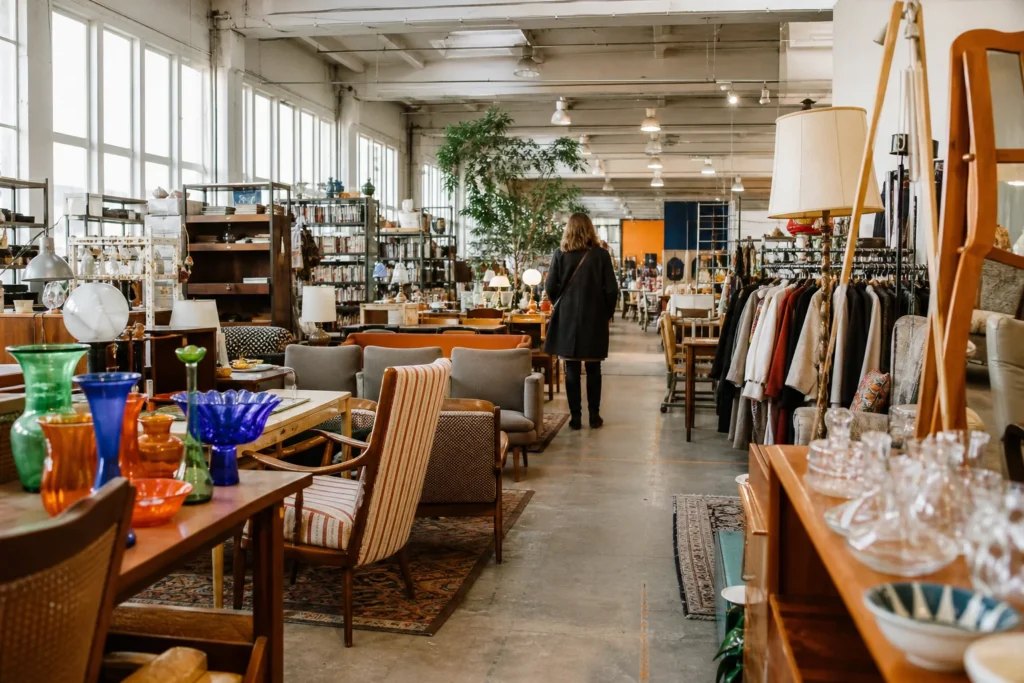

Tucked into Vienna's 5th district at Mittersteig 10, Carla Mittersteig is one of those places that takes a moment to fully absorb. Run by Caritas Austria, it operates as a second-hand megastore on a scale that feels almost implausible. The floor stretches far enough that you can genuinely lose your bearings between the furniture section and the racks of coats. It is not a boutique. It is not curated in any polished sense. It is something more interesting than that.
The stock spans an impressive range of donated goods. Retro furniture sits alongside mid-century lamps, art nouveau mirrors, Murano glass, and shelves of vintage books. Everyday finds appear too — porcelain dishes, wool coats, Italian espresso cups, retro coffee pots, and kitchen items in quantities that reward patience. Because the donations come from across the city, the selection shifts constantly. Return visits rarely feel repetitive. One week might yield a Scandinavian chair; the next, a boxy leather armchair from the sixties that fits your living room perfectly.
That unpredictability is part of the appeal. Serious vintage hunters come for the collectibles. Practical shoppers come for reliable household basics at reasonable prices. Browsers come for the atmosphere alone. All three leave satisfied more often than not. The chaotic warmth of the place — slightly disorganised, never pretentious — makes browsing feel genuinely relaxed rather than pressured.
The store's mission runs deeper than the merchandise. Caritas channels the sales revenue into its wider aid projects. Beyond that, a significant portion of the workforce is made up of people re-entering employment after long-term unemployment, supported by social workers within a structured programme. Shopping here connects you, without any ceremony, to something purposeful. The sustainability angle reinforces this: donated goods extend their useful lives rather than ending up in landfill. That chipped vase still holds flowers. That wool coat still keeps someone warm.
Carla Mittersteig opens Monday through Friday from 09:00 to 17:30, and on Saturdays from 09:00 to 14:30. The store is closed on Sundays. The schedule suits working-week visits as well as a Saturday morning browse, which has a slightly quieter, more leisurely feel. There is no dress code, no hustle, and no pressure. Come with time and an open mind.
Getting there is straightforward. The closest bus stop is Leibenfrostgasse, approximately 150 metres from the store, served by bus 13A. Johann-Strauß-Gasse sits around 250 metres away and offers a broader range of connections: tram line 1, the WLB light rail, and bus lines 13A, 303, and N62. For those travelling by metro, Pilgramgasse on U4 is approximately 600 metres away, with additional bus services including the 12A, 13A, 14A, and night lines N60 and N71.
Frequently Asked Questions
Q: How big is Carla Mittersteig, and what kind of stock can I expect to find?
A: It's a large-scale second-hand megastore — the floor runs to around 4,000 square metres. Stock includes mid-century furniture, Murano glass, art nouveau mirrors, retro lamps, wool coats, porcelain, vintage books, and everyday kitchen items. Because everything is donated, the selection turns over constantly, so repeat visits often yield completely different finds.
Q: When is Carla Mittersteig open?
A: The store opens Monday to Friday from 09:00 to 17:30, and Saturday from 09:00 to 14:30. It is closed on Sundays. Check the Caritas website before visiting in case hours have changed around public holidays.
Q: How do I get there by public transport?
A: The closest bus stop is Leibenfrostgasse (bus 13A), around 150 metres from the store at Mittersteig 10. Johann-Strauß-Gasse, about 250 metres away, is served by tram 1, the WLB light rail, and buses including the 13A and 303. For metro access, Pilgramgasse on U4 is approximately 600 metres away.
Q: Is there a social or charitable purpose behind the store?
A: Yes. Carla Mittersteig is run by Caritas Austria, and revenue from sales funds its wider aid projects. A significant part of the workforce is made up of people re-entering employment after long-term unemployment, supported by social workers within a structured programme. Shopping here also keeps donated goods out of landfill.
Q: Is it worth going if I'm looking for specific collectibles rather than general household items?
A: It can be, but the stock is unpredictable by nature. Serious vintage hunters have found mid-century Scandinavian chairs, art nouveau pieces, and Murano glass here, but there's no guarantee on any given day. The store rewards patience and return visits more than a single targeted trip.
Marketplace Highlights








Add a review