


Region
Clitheroe’s Giant Flea Market is permanently closed. The market is retained as an editorial archive of the venue and its distinctive character.
The market is retained as an editorial archive of the venue and its distinctive character.
Few northern English markets earned their place on the regional circuit the way Clitheroe's Giant Flea Market did. From 1975, with Hoyles Promotions at the helm from the very beginning, it built a reputation rooted in consistency — a rare quality in a trade where markets often appear and disappear within a season or two. In the broader landscape of Lancashire's secondhand economy, that kind of continuity meant something.
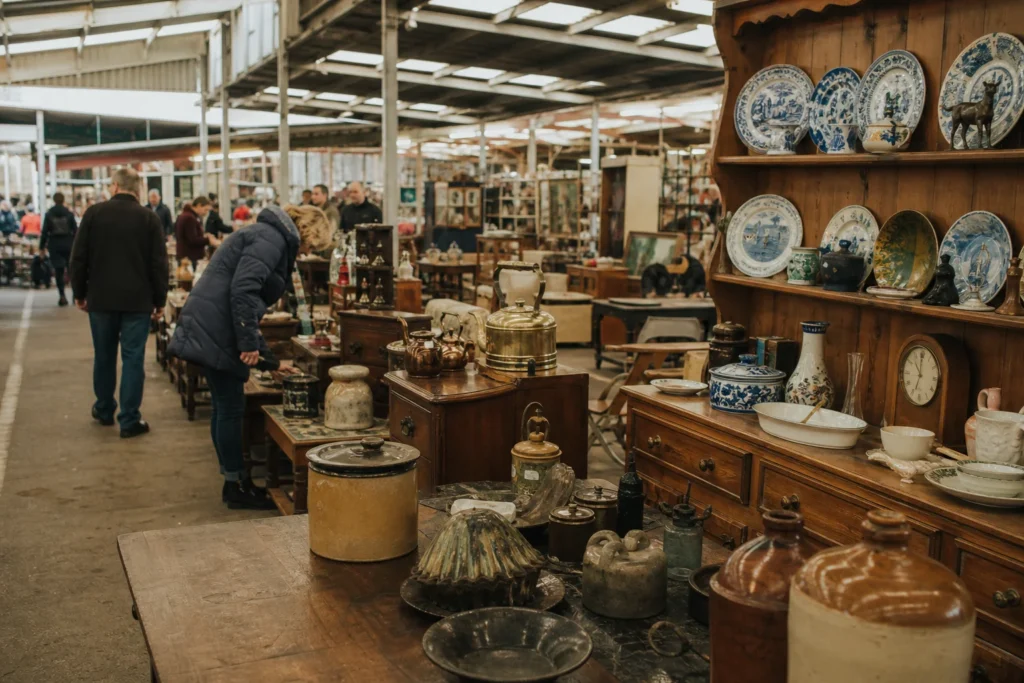
The market ran in two distinct formats, each with its own character. The weekly flea market brought out professional and semi-professional dealers alongside regular traders, filling the floor with old furniture, vintage toys, antique curiosities, secondhand clothing and the kind of domestic oddities that resist easy categorisation. It had the focused energy of a proper trading day. The monthly car boot carried a different mood entirely — more unpredictable, more spontaneous, with house clearances and private collections arriving beside seasoned stall-holders. The two formats complemented each other well, giving the site a rhythm that rewarded repeat visits across the calendar.
The seller mix was part of what kept the browsing genuinely varied. No obvious hierarchy separated professional antique dealers from someone clearing out a spare room. Both set up alongside each other, both found buyers, and both contributed to a floor that felt alive rather than curated. First-come, first-served stall allocation kept the arrangement open and the stock unpredictable — the kind of system that favoured early arrivals on either side of the table.
The market's physical setup made it a practical proposition in Lancashire's climate. A significant number of stalls operated under cover, which meant a worthwhile day out regardless of what the sky was doing over the Ribble Valley. Northwest England's weather gave no reliable guarantees, and markets that failed to account for that tended to empty quickly when conditions turned. Clitheroe's covered layout gave it a resilience that purely outdoor events lacked. On clearer days, the Forest of Bowland rising to the north added something — a sense of landscape that made the drive itself feel worthwhile, not just the destination.
What made a full day there genuinely comfortable was the practical infrastructure. Free parking removed a common friction point. On-site catering meant visitors could browse at length without rushing off elsewhere. Stall access remained low-cost by design, keeping the seller base broad and the stock varied rather than narrowing toward the higher-end trade.
In northern England's secondhand market history, Clitheroe's Giant Flea Market held a distinctive position. Its longevity under consistent management, its dual-format structure and its reliable covered trading environment set it apart from one-off fairs and seasonal events. It was, by the standards of the regional circuit, the kind of market that collectors and casual browsers alike came to depend on — a fixed point in Lancashire's trading calendar for decades.
Frequently Asked Questions
Q: Is Clitheroe's Giant Flea Market still open?
A: No. Clitheroe's Giant Flea Market is permanently closed. It is retained here as an editorial archive of a market that held a notable place on Lancashire's secondhand circuit for decades.
Q: What kind of stock did the market typically carry?
A: The weekly flea market brought out old furniture, vintage toys, antique curiosities, secondhand clothing and general household goods. The monthly car boot added a more unpredictable layer — house clearances and private collections turning up alongside seasoned traders, which kept the browsing genuinely varied.
Q: Was the market suitable in bad weather?
A: A significant portion of the stalls ran under cover, which made it a practical day out regardless of conditions. Northwest England's weather being what it is, that covered layout gave the market a reliability that purely outdoor events in the region rarely matched.
Q: What was the seller mix like — trade or private?
A: Both. Professional antique dealers set up alongside people clearing out a spare room, with no obvious hierarchy between them. Stall spaces were allocated first-come, first-served, which kept costs low and the floor unpredictable in the best sense — arriving early gave buyers the best chance at anything worthwhile.
Marketplace Highlights








Add a review