


De 10 Geboden is permanently closed. The market is retained as an editorial archive of the venue and its distinctive character.
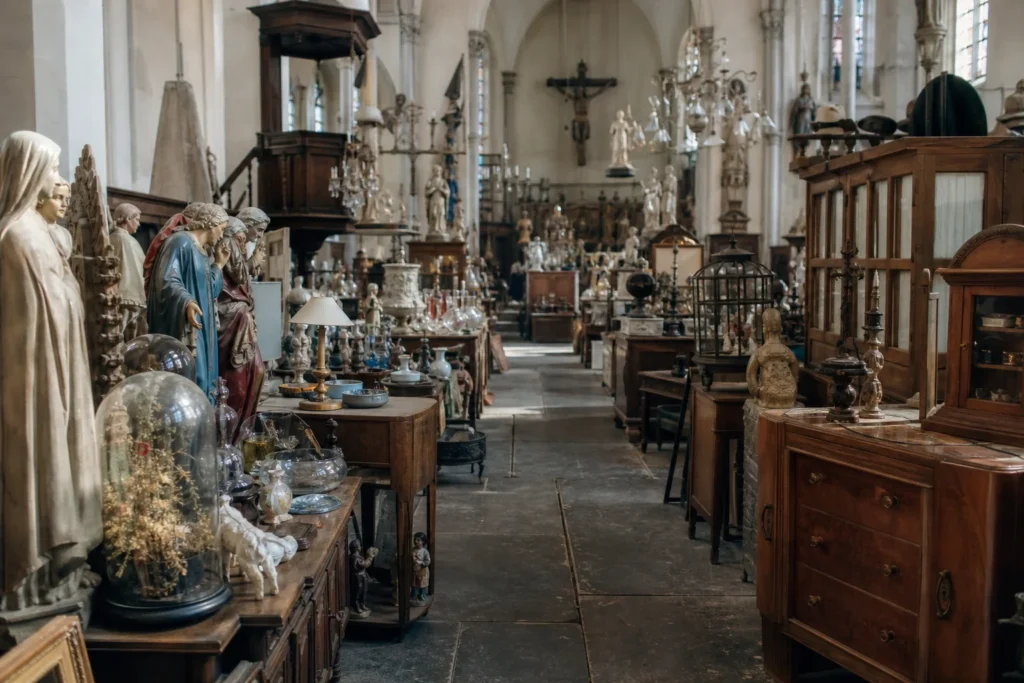
Vaulted stone ceilings arch overhead. Pews still hold their cargo — not worshippers, but objects. Carved saints lean against pillars, vintage suitcases crowd the windowsills, and the scent of old wood and accumulated things fills the nave. De 10 Geboden occupied a real working church in Belgium, and the building never let you forget it.
The space grew out of one collector's lifelong habit. Kristof Moenaert acquired the church around 2012 and, as his personal collection expanded to fill the building, opened it to visitors around 2015. He lived on the premises throughout. The name translates from Dutch as "The 10 Commandments," and the sacred architecture gave that title its full weight. No converted warehouse or repurposed barn could have produced the same effect.
The stock divided naturally into two distinct currents. On one side sat the ecclesiastical and devotional — images of saints, carved wooden statues, stone busts and ornate religious objects that felt entirely at home in their surroundings. On the other sat the secular and eclectic: furniture, lamps, glassware, vintage luggage and the kind of curious finds that accumulate when a committed collector works without a fixed brief. Miniature Hergé cars surfaced somewhere among the shelves — a detail that anchored the whole enterprise unmistakably in Belgian culture.
Nothing inside followed a retail logic. Objects stacked into corners, balanced on original pews and spilled out through the front doors into the garden before visitors had even crossed the threshold. That density was deliberate in spirit if not in plan. Patience rewarded the careful browser. The person who slowed down and looked twice tended to find things they had not expected, which was precisely the pleasure the place offered.
Kristof himself shaped the experience as much as the stock did. His decades of collecting gave him knowledge that added value to almost any object a visitor picked up. A conversation with him rarely ended without context that sharpened what you were looking at. Spaces built from this kind of personal obsession are rare. The shop reportedly drew interest from the British television programme Salvage Hunters, which has long gravitated toward exactly this kind of owner-led, architecturally distinctive venue — though that connection remains unconfirmed in formal records.
De 10 Geboden held a character that institutional antique markets cannot manufacture. Its significance rested on the convergence of sacred architecture, a singular Belgian collecting sensibility and one person's decision to stop keeping it all to himself. Spaces like it leave a particular kind of absence when they close.
Frequently Asked Questions
Q: What kind of place was De 10 Geboden?
A: It was an antique and curiosity shop occupying a real working church in Belgium, owned and inhabited by collector Kristof Moenaert. The sacred architecture — vaulted stone ceilings, original pews, carved pillars — was inseparable from the experience of browsing there.
Q: What sort of stock did the shop carry?
A: The collection divided between the ecclesiastical and the eclectic. Religious carvings, saints' images, stone busts and ornate devotional objects shared space with vintage furniture, glassware, old luggage and secular curiosities. Miniature Hergé cars were among the finds — a detail that grounded the whole enterprise in distinctly Belgian collecting culture.
Q: Was De 10 Geboden a conventional antique shop?
A: Not at all. Objects covered every surface — stacked into corners, balanced on pews, crowded onto windowsills and spilling out into the garden. The density reflected a lifetime of genuine accumulation rather than retail staging. Browsers who took their time tended to surface things they hadn't expected.
Q: Is De 10 Geboden still open to visit?
A: No. De 10 Geboden is permanently closed. It is retained here as an editorial archive of the venue and its distinctive character.
Marketplace Highlights







Add a review