

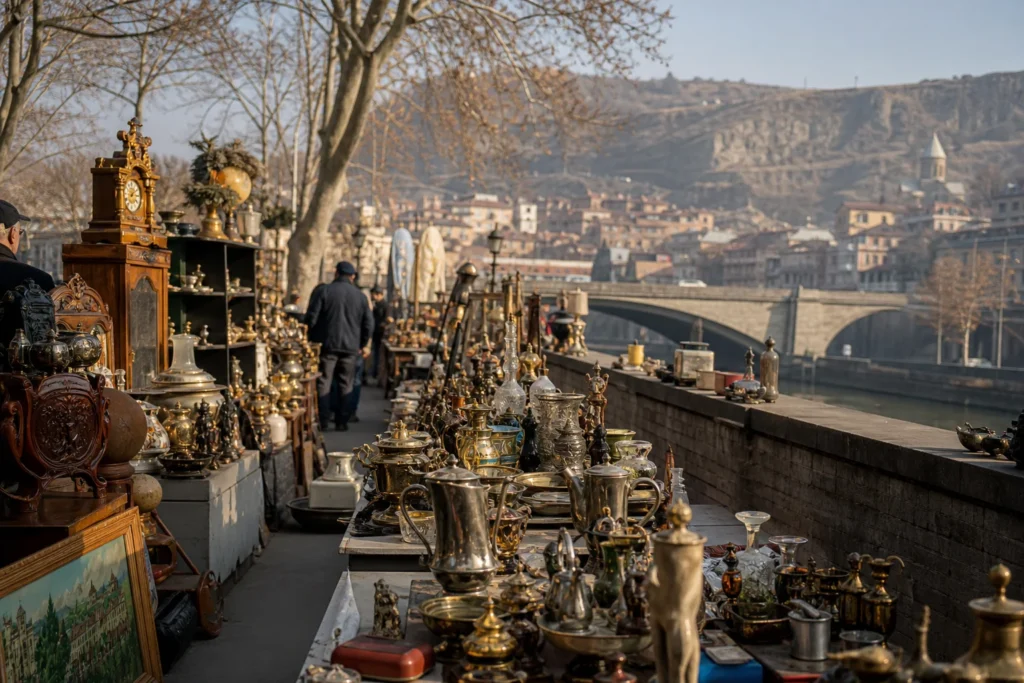

Spend an hour at Sukhoi Most and you get a compressed version of Tbilisi's last century. Soviet-era badges and military medals share space with Georgian silverware, hand-painted oil canvases and wind-up clocks. Porcelain figurines sit beside stacks of second-hand books, vintage cameras and tattered maps that predate half the borders they show. Few places in the Caucasus concentrate this much Soviet domestic material in one browsable space — and fewer still do it in a setting with the Mtkvari river visible below and the rooflines of the historic district framing everything above.
The market spreads across and around the Dry Bridge itself, with sellers lining the railings and continuing down toward the riverbank. Some run deliberate, curated stalls with organised stock and clear pricing. Others arrive with a bag of objects from a relative's attic and price by instinct. That contrast is where the market becomes genuinely interesting. The gap between a seasoned trader who knows the value of every piece and a casual seller who simply wants to clear space is where patient shoppers make real finds.
Moving slowly through the stalls pays off far more than a quick scan. Items reward close attention — a box that looks like junk often contains something specific and worth having. The vendors who know their stock are usually happy to talk, and those conversations tend to open up more of what they have. Approach with curiosity rather than urgency and the market gives back accordingly.
Pricing follows a dual logic that is useful to understand before you start picking things up. Recognisably tourist-facing items — Soviet memorabilia, Georgian handicrafts, items with obvious souvenir appeal — tend to carry a higher markup. Everyday functional goods and household objects attract less. Haggling is standard and widely expected. A calm, reasonable counter-offer rarely causes offence and often lands somewhere workable. Locals shopping for practical second-hand finds operate in a different part of the market economy, and it is worth noticing that distinction as you browse.
The market opens daily at 11:00 and runs until 17:00. Saturday and Sunday draw the largest crowds, which means more vendors and more stock but also more competition for the better pieces. Weekday mornings offer a quieter, more unhurried experience — worth considering if you want space to look carefully and talk to sellers without the weekend press.
Getting there is straightforward. Ghrmaghele Metro station on Line 1 sits approximately 100 metres from the market — the most direct public transport connection. Two bus stops, Liakhvi Street and M/S Ghrmaghele, are both roughly 150 metres away and served by multiple routes including buses 308, 317, 360, 362, 370, 381, 386, 394, 395, 431, 504 and 507. The market's position in Tbilisi's historic centre also makes it easy to pair with a morning in the old town.
Dry Bridge suits committed collectors of Soviet material, travellers looking for a cultural encounter that goes beyond a souvenir shop, and anyone who finds Tbilisi's more curated antique dealers a step too polished. The stock changes daily, the vendors are unpredictable in the best sense, and the finds here are the kind that rarely surface anywhere else.
Frequently Asked Questions
Q: What kinds of items can you find at Dry Bridge Flea Market?
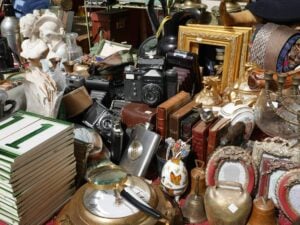
A: The market splits broadly into two areas of interest. Soviet material culture is well represented — military medals, pins, badges, wind-up clocks, old coins and propaganda-adjacent everyday objects that rarely appear in Western antique shops at this density. Alongside that sits Georgian and craft material: hand-painted oil canvases, silverware, vintage cameras, porcelain figurines, tattered old maps and stacks of second-hand books.
Q: Should I haggle, and how do prices vary across the stalls?
A: Haggling is standard and widely expected. A calm, reasonable counter-offer rarely causes offence. It is worth knowing that recognisably tourist-facing items — Soviet memorabilia, Georgian handicrafts — tend to carry a higher markup than everyday household goods, which attract less. Noticing that distinction as you browse helps calibrate what to push back on.
Q: When is the best time to visit?
A: The market runs daily from 11:00 to 17:00. Saturday and Sunday draw the largest crowds, which means more vendors and more stock but also more competition for the better pieces. Weekday mornings are quieter and give you more room to browse carefully and talk to sellers at your own pace.
Q: How do I get there by public transport?
A: Ghrmaghele Metro station on Line 1 is approximately 100 metres from the market and is the most direct connection. Two nearby bus stops — Liakhvi Street and M/S Ghrmaghele — are both roughly 150 metres away and served by multiple routes including buses 308, 317, 360, 362, 370, 381, 386, 394, 395 and 431.
Q: How should I approach browsing to get the most out of it?
A: Moving slowly pays off far more than a quick pass. The vendor mix ranges from career traders with deliberate, curated stock to casual sellers who arrive with a bag of items from a relative's attic and price by instinct. That gap between the two is where patient shoppers tend to make real finds. Boxes that look like junk often contain something specific — close attention and a willingness to ask questions open up more than a surface scan will.
Marketplace Highlights







Add a review