

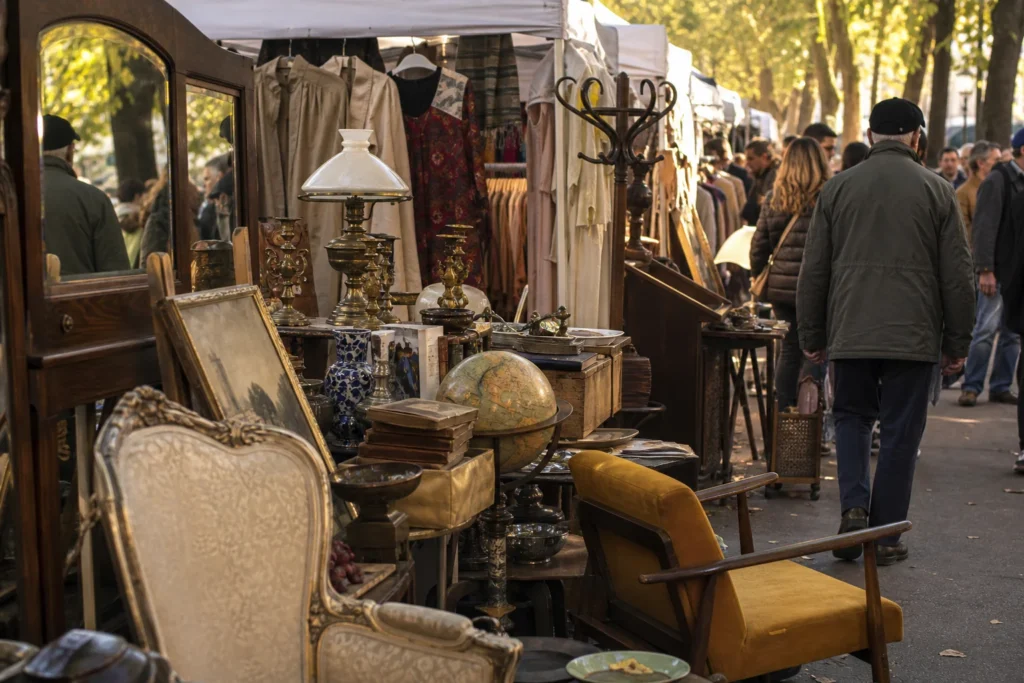

By eight on a Saturday morning, the stalls along the Navigli waterfront are already busy. Traders unpack crates, regulars exchange nods with vendors they've known for years, and the canal light catches the chrome of a coffee maker somebody pulled from a cupboard thirty years ago. This is Fiera di Sinigaglia — and in a city that often presents its most polished face to visitors, it offers something genuinely different.
The market traces its origins to the 1800s, making it the oldest flea market in Milan. That history isn't just a headline. It means long-serving traders who know their stock with real precision, and a regulars' culture that keeps the market grounded in the neighbourhood rather than pointed at passing tourists. The Saturday rhythm feels habitual rather than performed.
Clothing draws a serious crowd. Affordable secondhand pieces fill rack after rack, but Sinigaglia has a reputation for the occasional designer find surfacing at a fraction of its original value. Shoppers who slow down and go through things properly tend to be the ones who leave with something worth talking about. The range spans decades — it rewards patience far more than speed.
Collectors work the stalls methodically. Vinyl is a particular draw, and crate-diggers treat the market as a regular stop, returning week after week on the chance that something new has come in. Books sit alongside coin collections and ethnic goods; curiosities and decorative objects appear without warning. If you collect something specific, this market is worth checking before you assume Milan won't have it.
Household finds appear throughout — kitchen tools, decorative pieces, shoes, toys and objects that resist easy categorisation. Stalls selling cacti, herbs and potted plants bring an unexpected softness to the browsing. The overall atmosphere is cheerfully unstructured, which suits the kind of shopping where the find you didn't know you wanted turns out to be the best one.
Sinigaglia runs every Saturday from 08:00 to 18:00. That consistency — no seasonal breaks, no second-guessing the schedule — makes it a reliable anchor for a Milan weekend rather than a maybe. Locals treat it as part of the week's rhythm. Visitors from further afield tend to realise quickly why it keeps pulling people back.
Getting here is straightforward. Porta Genova metro station, served by line M2, sits approximately 250 metres away and is the easiest approach from central Milan. The stop at Via Valenza - Alzaia Naviglio Grande is roughly 50 metres from the market, with tram line 2 and bus route 74 both stopping there. Visitors arriving by regional rail can use Milano Romolo station, served by lines R31, S9 and S19, approximately 800 metres away.
Sinigaglia suits vinyl hunters, secondhand clothing enthusiasts, coin and book collectors, and anyone who wants a market that feels embedded in a real neighbourhood rather than staged for Instagram. The Navigli setting and the long Saturday hours make it an easy full-morning commitment — and most people who arrive intending to spend an hour end up staying considerably longer.
Frequently Asked Questions
Q: When does Fiera di Sinigaglia run, and does it close for holidays or seasonal breaks?
A: The market runs every Saturday from 08:00 to 18:00. It operates weekly without seasonal breaks, which makes it a dependable fixture rather than a once-in-a-while event. Confirm the schedule on the organizer's official page before travelling specifically for the market.
Q: What is the easiest way to reach the market by public transport?
A: Porta Genova metro station on line M2 is around 250 metres away and the most straightforward approach from central Milan. Tram line 2 and bus route 74 both stop at Via Valenza - Alzaia Naviglio Grande, roughly 50 metres from the market. Visitors arriving by regional rail can use Milano Romolo station, served by lines R31, S9 and S19, approximately 800 metres away.
Q: What kinds of things can I realistically expect to find?
A: Affordable secondhand clothing is one of the most consistent draws, and patient shoppers occasionally surface designer pieces at secondhand prices. Vinyl records draw dedicated crate-diggers who return week after week. Beyond that, the market carries coins, books, ethnic goods, kitchen objects, toys, curiosities and stalls selling cacti, herbs and potted plants — a range broad enough that collectors of almost anything consider it worth a regular look.
Q: What time is best to arrive if I'm hunting for specific finds?
A: Traders begin setting up early and the stalls along the Navigli waterfront are already busy by eight in the morning. Arriving early gives you the best pick before serious regulars have worked through the stock, particularly at the clothing racks and vinyl stalls.
Q: Is this market primarily for tourists or does it have a local following?
A: Sinigaglia has a strong local character. Milanese regulars treat it as part of their Saturday routine, and many vendors have long-standing relationships with returning customers. Tourists visit too, drawn by its reputation as Milan's oldest flea market, but the social texture of the place is rooted in the neighbourhood rather than oriented toward passing visitors.
Marketplace Highlights











Add a review