


Region
Finnegan’s Market – Marché Finnegan is permanently closed. This listing is retained as an editorial archive of the venue and its distinctive character.
This listing is retained as an editorial archive of the venue and its distinctive character.
Before Hudson, Quebec had leash laws, an Irish setter named Finnegan roamed the town's west end as though he owned it. He did, in spirit at least. That dog's name eventually found its way onto a market sign, and the fit was perfect — both the animal and the event had an easy, unruly sociability that no amount of planning could manufacture.
Barbara Aird and her late husband David started Finnegan's Market in 1972. Their original motivation was refreshingly modest: a chance to clean out the barn. What began as a family experiment grew into a decades-long institution, eventually managed by three generations of Airds. The family kept the market's roots visible — Barbara herself continued selling Quebec pine antiques from her barn, and charitable vendor booths, many supporting dog-related causes, were a regular feature. The community that sustained the market received something back each season.
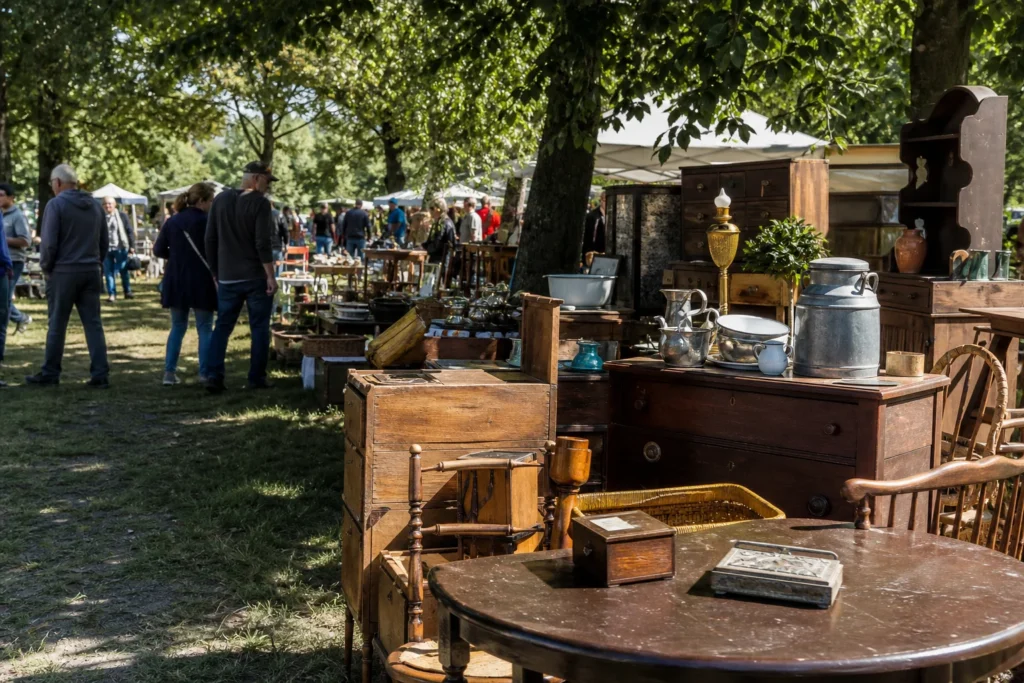
The physical setting gave Finnegan's much of its character. Six acres of vendor space spread across a country property about fifty kilometres west of Montreal, with picnic tables, a pond and open views toward the Lake of Two Mountains. The landscape did quiet but important work. It turned shopping into an occasion, slowing visitors down enough to actually talk to one another. The first Saturday in May traditionally marked a reunion as much as a market day, and Hudson locals treated a trip to Finnegan's as something close to a civic obligation.
The antiques vendors at Finnegan's were, in many cases, fixtures across decades. Ron Trudeau spent twenty-nine years selling pine mirrors built from salvaged window frames — a weekend craft that outlasted most trends. Jack Eccles accumulated twenty-six years of presence at the market, his space dense with wall-to-wall antiques. Michel Gendron brought his experience as an antique shop owner to the stalls, while Les Cloake offered a handmade counterpoint with twig furniture of genuine craft quality. This depth of tenure signalled something real about the market — it was not a pop-up, but a place where sellers and buyers returned year after year.
Food at Finnegan's reflected an unexpected cosmopolitanism for a rural Quebec setting. Wawel, a Polish bakery, drew its own loyalists. Worke Bogale offered Ethiopian food. Tutti Frutti brought biscotti and strudel. The range felt less like a curated food hall and more like the natural result of a genuinely diverse vendor community. Among them, the McCaig family stood out for their honey — reportedly ten-time champions at Toronto's Royal Winter Fair — a detail that captured the market's quietly serious commitment to quality alongside its casual atmosphere.
What Finnegan's ultimately offered was a particular combination difficult to replicate: family stewardship across generations, long-serving vendors with genuine expertise, a countryside setting that encouraged lingering, and a community function that went well beyond buying and selling. Markets can be events; Finnegan's became a habit for the people of Hudson and the many visitors who made the drive from Montreal. That kind of loyalty takes years to build and, once gone, tends not to transfer anywhere else.
Frequently Asked Questions
Q: What kind of market was Finnegan's, and what could shoppers typically find there?
A: Finnegan's was a sprawling outdoor market set on six acres of country property in Hudson, Quebec. Its roughly one hundred vendors covered a broad range: Quebec pine antiques, collectibles, handmade furniture, vintage and salvage pieces, and a diverse food offer that included a Polish bakery, Ethiopian food, biscotti and strudel, and prize-winning honey.
Q: Was Finnegan's Market mainly a seasonal event or open year-round?
A: The market operated seasonally, with the first Saturday in May serving as its traditional opening day — treated by Hudson locals as something close to a community reunion rather than just a shopping trip. Check archival sources if you are researching its full seasonal calendar.
Q: How significant was the antiques offer compared to general flea market goods?
A: Antiques were a genuine strength. Several dealers held pitches for over two decades — pine mirrors made from salvaged window frames, wall-to-wall antique stalls, and vendors with backgrounds running antique shops. The depth of long-tenured dealers gave the antiques section more consistency than a typical weekend flea market.
Q: Is Finnegan's Market still operating?
A: No. Finnegan's Market is permanently closed. This listing is maintained as an editorial archive of the venue's history and character.
Q: Where was Finnegan's Market located relative to Montreal?
A: The market was situated in Hudson, Quebec, approximately fifty kilometres west of Montreal, on a country property with views toward the Lake of Two Mountains.
Marketplace Highlights








Add a review