

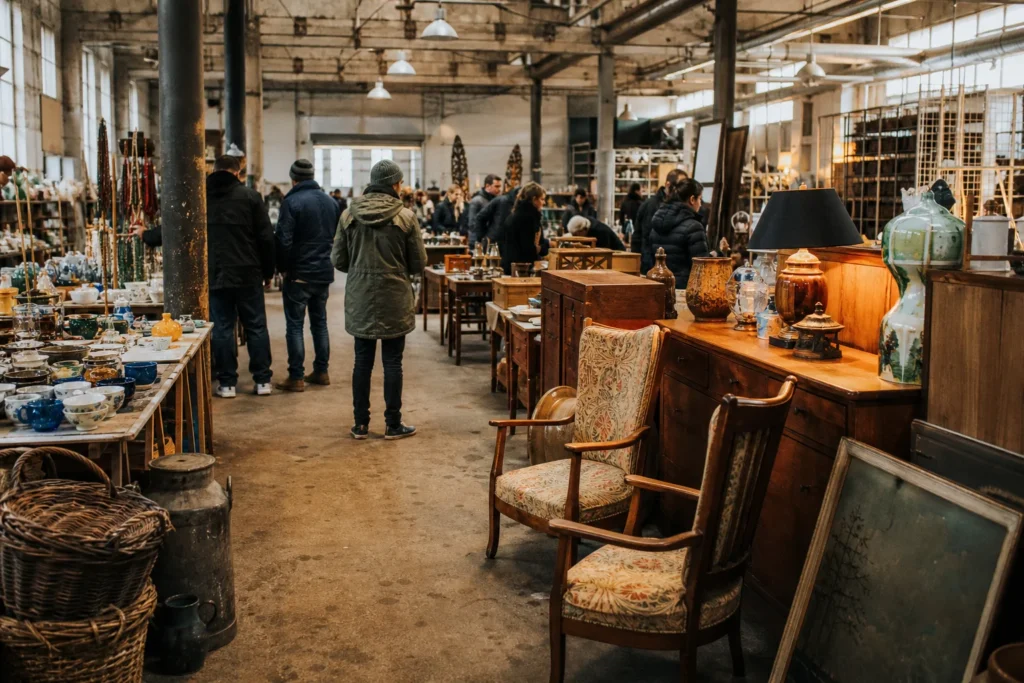

Inside a pair of decommissioned cattle slaughter halls on Neuer Kamp, the Antik- und Flohmarkt Flohschanze has been running since spring 2000. That industrial setting gives the market a character no purpose-built venue can manufacture. Raw brick, high ceilings and the faint echo of footsteps on concrete set the mood before a single stall comes into view.
What makes Flohschanze editorially distinctive is a strict house rule: no new goods. Antiques, art and genuine secondhand pieces are the only items permitted. Organisers enforce this consistently, which keeps the quality of browsing honest and the finds real. Visitors are not sifting through surplus stock or import-bought novelties — they are moving through curated personal collections and traded vintage pieces.
The floor space runs to roughly 1,200 square metres, generous enough that the market never feels claustrophobic even when foot traffic builds. Private sellers dominate the stall mix, many arriving after a spring clean with boxes of household finds they no longer need. That seller profile matters: it means the objects carry actual history rather than a rehearsed sales story. Furniture and larger antiques anchor one end of the browsing experience; clothing, jewellery and crockery form the domestic and wearable strand; and bicycles appear with enough regularity to count as a Flohschanze signature.
The market runs on Saturdays only, from 08:00 to 16:00. Arriving before 09:00 gives the clearest run at standout pieces, before the Schanzenviertel crowd and passing tourists fill the halls. Spring and early summer bring the heaviest attendance, and on peak weekends genuine bargains become scarce by mid-morning. Haggling is expected and welcome, but sellers tend to have firm anchors on price. Some negotiations stretch longer than anticipated. Patience, a relaxed tone and a realistic opening offer tend to produce better outcomes than aggressive countering.
Even without a specific find on the agenda, Flohschanze rewards a casual Saturday visit. Chatting with sellers, photographing the objects and the light inside the old halls, or simply letting the morning unfold — these are part of what the market offers. It suits dedicated collectors, Hamburg visitors who want a locally rooted experience, and anyone who prefers a market with clear editorial rules over a sprawling all-comers event.
Getting here is straightforward. The U3 subway stops at Feldstraße (Heiligengeistfeld), approximately 150 metres from the market — the most direct option from central Hamburg. Bus lines 3, 17, 607 and X3 also serve the same stop under the name U Feldstraße, roughly 75 metres away, which is useful for journeys from parts of the city not on the U3. The U2 stops at Messehallen, around 600 metres distant, and offers a walkable alternative that passes through the edge of the Schanzenviertel on the way in.
Frequently Asked Questions
Q: Is this a genuine antique and secondhand market, or do sellers also offer new goods?
A: New goods are explicitly prohibited. Organisers enforce a strict no-new-goods rule, so every stall carries only antiques, art or genuine secondhand pieces. That policy is one of the market's defining features and keeps the browsing honest.
Q: When does Flohschanze run, and what time should I arrive?
A: The market runs Saturdays only, from 08:00 to 16:00. Arriving before 09:00 gives you the clearest run at standout pieces before foot traffic builds. On busy spring and early summer Saturdays, real bargains can be scarce by mid-morning.
Q: What kinds of things can I expect to find?
A: The mix leans toward furniture, antiques, clothing, jewellery and crockery, with bicycles appearing often enough to count as something of a Flohschanze signature. Private sellers dominate, many clearing genuine household collections, so the objects tend to carry real history rather than a rehearsed sales story.
Q: Is haggling expected, and how should I approach it?
A: Haggling is expected and welcome, but sellers often have firm price anchors, so some negotiations run longer than you might anticipate. A relaxed tone, patience and a realistic opening offer tend to produce better results than aggressive countering.
Q: How do I get there by public transport?
A: The U3 to Feldstraße (Heiligengeistfeld) is the most direct option, around 150 metres from the market. Bus lines 3, 17, 607 and X3 also serve U Feldstraße, about 75 metres away. The U2 stops at Messehallen, roughly 600 metres distant, and offers a walkable alternative through the edge of the neighbourhood.
Marketplace Highlights







Bastian Schön
22nd January 2016 at 00:16Zu jedem Hamburg-Besuch an einem Wochenende gehört für uns ein Abstecher zur Flohschanze. Hier kann man auf charmante Weise durch die Zeit reisen und findet jede Menge KrimsKrams, RetroDesign, Silberbesteck, Fahrräder, Büchern, Haushaltswaren, Antiquitäten und SecondHand-Klamotten. Der Markt ist MultiKulti besucht wie besetzt. Es gibt immer viel zu Gucken und zu entdecken…. Uns gefällt es!
Dianne Barber
2nd April 2016 at 03:13One man’s trash is another man’s treasure… One of the best flea markets in Hamburg. Start your Saturday mornings with a stroll through this great flea market before heading off to brunch.
Margie Stephens
25th April 2016 at 09:49A great Saturday outdoor flea market in the Sternschanze/St. Pauli area, close to the fun (and funky) Karoviertel. From antique items, second hand clothes, to household goods, books, handmade jewelry, to many other random stuff, you’ll find so much here and can easily spend hours on a nice sunny Saturday morning/afternoon. A cool place for locals to go find some bargains, but it’s also a fun stop for visitors, even it’s just for walking around, people-watching, and enjoying the atmosphere.