

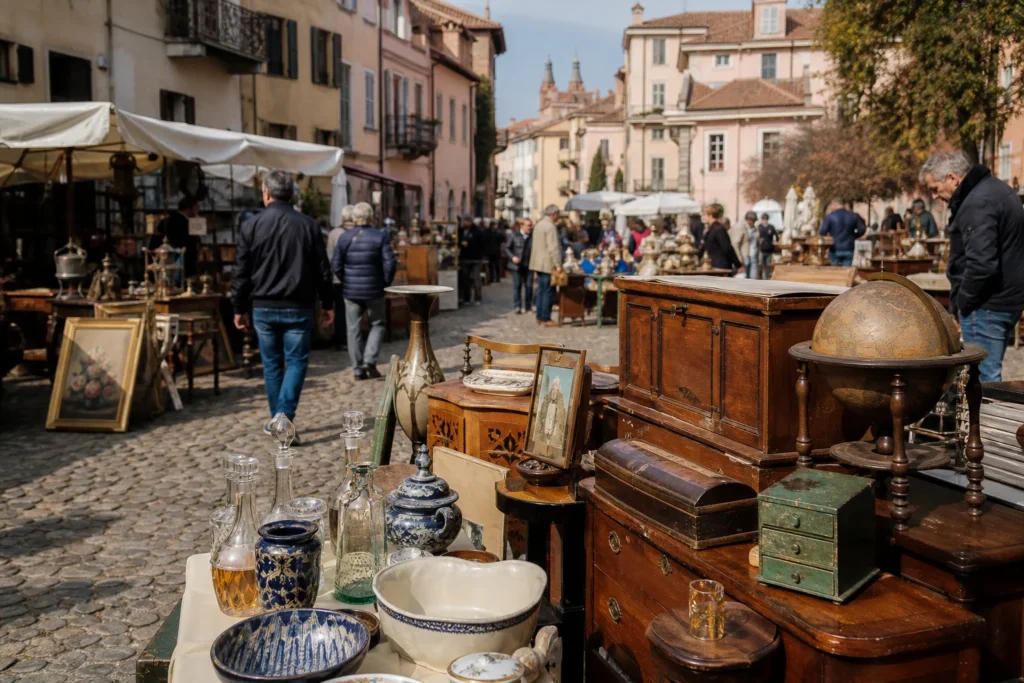

Since at least 1917, Cherasco has hosted one of northern Italy's most enduring antique fairs. That founding claim alone sets I Grandi Mercati dell'Antiquariato e del Collezionismo apart from the many weekend markets that have come and gone across Piedmont. A century of continuity has given the event a particular gravity — dealers return, collectors plan ahead, and the town itself seems to expect the whole thing as a natural rhythm.
The market runs up to five times a year, usually on the first or second Sunday of April, May, June, October and December. Editions open at 09:00 and run through to 19:00, giving browsers a full day to cover the ground. That ground is considerable: vendors reportedly occupy a route of around five kilometres through Cherasco's historic centre, with approximately 600 dealers setting up at each edition. The layout stretches through stone streets, beneath arcaded buildings and into the town's principal piazzas, giving the fair a physical texture that no purpose-built exhibition hall can match.
The furniture on offer rewards serious attention. Credenzas, armoires, painted chests and large mirrors line the pavements alongside mid-century pieces and restored retro furnishings. Dealers present full room-scale objects in the open air, which gives buyers a genuine sense of proportion — something photographs rarely convey.
Smaller collectables fill the piazzas and quieter lanes. Ceramics, silverware and vintage textiles sit alongside books, garden ironwork and decorative arts. Vintage toys and lace appear with some regularity, drawing collectors who might otherwise skip the furniture-heavy stands. Specialist themed fairs occasionally run alongside the main editions, adding a sharper focus for buyers with particular categories in mind.
The five-edition rhythm suits collectors who visit repeatedly. Each edition tends to bring a fresh rotation of vendors, so a return visit in June can yield entirely different finds from April. Cherasco reportedly draws around 25,000 visitors per edition — a figure that reflects the fair's pull across the regional circuit rather than just local footfall.
Cherasco itself is compact and walkable. When the stalls need a break, the medieval centre offers its own reasons to linger. For visitors travelling from Turin or Alba, the market provides a natural anchor for a day in the Langhe — the fair and the landscape complement each other well.
By bus, the stop named CHERASCO sits just under 50 metres from the market area and is served by bus line 083. A short distance away, approximately 250 metres, the CHERASCO – VIALE SALMATORIS stop connects bus lines 080, 083 and 415. No direct rail service runs into Cherasco itself, so bus or car remains the practical option for most visitors. Confirm current Sunday service details locally before travelling, as rural timetables can vary by season.
Frequently Asked Questions
Q: How many times a year does the market take place, and when does it typically run?
A: I Grandi Mercati di Cherasco runs up to five times a year, with editions typically held on the first or second Sunday of April, May, June, October and December. Each edition opens at 09:00 and closes at 19:00, giving visitors a full day to cover the ground. Check the organizer's official channels before travelling to confirm the exact date for each edition.
Q: How large is the market, and what kinds of things will I find?
A: Around 600 dealers set up at each edition, spreading across an approximately five-kilometre route through Cherasco's stone streets, arcaded passages and main piazzas. Large furniture dominates the wider stretches — credenzas, armoires, painted chests and mirrors among them — while the piazzas and quieter lanes fill with ceramics, silverware, vintage textiles, books, lace, garden ironwork and decorative ephemera. Specialist themed fairs occasionally run alongside the main market, adding sharper focus for collectors with particular categories in mind.
Q: Is it worth returning to more than one edition in the same year?
A: Yes. The vendor rotation means each edition tends to bring a fresh set of dealers, so finds in June can differ entirely from what appeared in April. Collectors who visit repeatedly often treat two or three editions as a planned annual circuit rather than a single one-off trip.
Q: How do I get to Cherasco by public transport?
A: No direct rail service runs into Cherasco, so bus or car is the practical choice for most visitors. The CHERASCO bus stop, served by line 083, sits just under 50 metres from the market area and is the most convenient option. Roughly 250 metres away, the CHERASCO – VIALE SALMATORIS stop connects lines 080, 083 and 415. Visitors travelling from Turin or Cuneo most commonly drive. Confirm current schedules with the relevant regional transport authority before your visit.
Q: Is Cherasco itself worth exploring beyond the market stalls?
A: Very much so. The medieval centre is compact and walkable, and the arcaded streets and piazzas that host the market are themselves part of a well-preserved historic town. The surrounding Langhe landscape makes Cherasco a natural anchor for a longer day out, pairing the fair with the wider pleasures of that corner of Piedmont.
Marketplace Highlights








Add a review