


Region
Klementinum Antique Market is permanently closed. The market is retained as an editorial archive of the venue and its distinctive character.
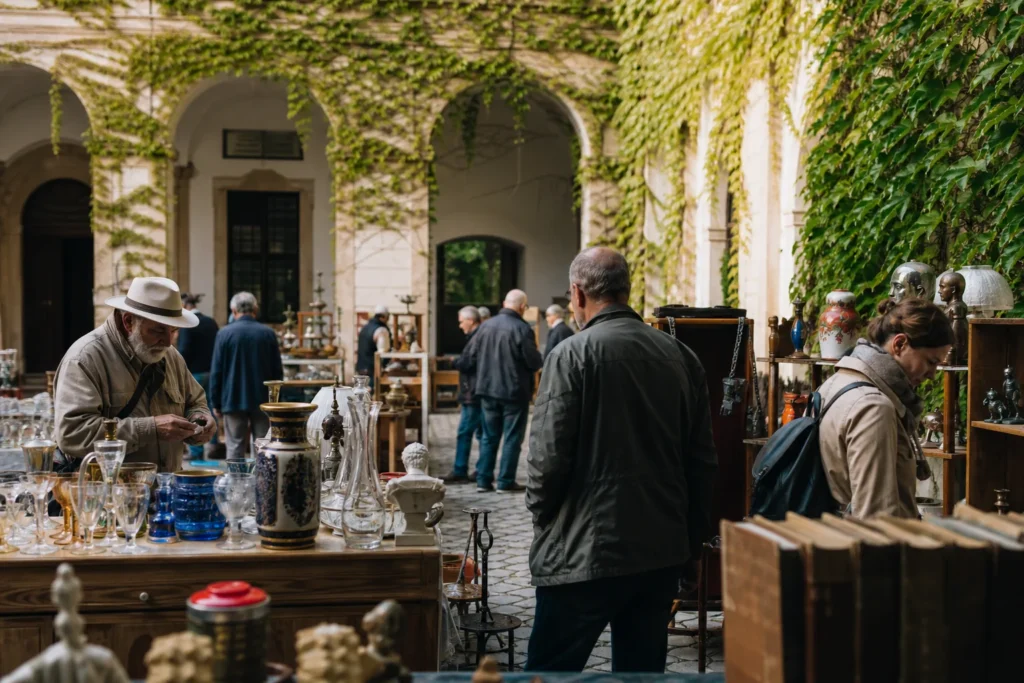
What set the Klementinum Antique Market apart from most of Prague's outdoor trading was the calibre of the people behind the stalls. These were not occasional sellers or weekend hobbyists clearing attic clutter. The vendors were professional antique dealers — owners of established local shops who chose to trade outdoors on market day. That distinction shaped everything. Stock arrived already selected, priced with genuine knowledge, and presented with the quiet confidence of people who understood exactly what they were selling.
Conversations with dealers tended to go somewhere. Ask about a piece and you were likely to get a real answer — provenance, period, condition, context. That kind of informed exchange was rare at larger, more anonymous flea markets. The professional character of the seller community made the Klementinum market feel closer to a curated trade fair than a casual open-air browse, even if the courtyard setting kept things relaxed and human in scale.
The stock reflected the range you would expect from experienced dealers working Central European material. Antique glassware and Bohemian ceramics appeared regularly. Costume jewellery, small works of art, and antique books occupied table space alongside Soviet-era memorabilia — the kind of objects that carried Cold War history in their design and manufacture. The selection rewarded focused collectors and unhurried browsers in equal measure. Arriving early gave the best chance of finding something specific; arriving later still offered plenty to examine.
Bargaining was part of the culture, and dealers engaged with it naturally. Opening prices were generally fair rather than inflated for tourist consumption, which meant negotiation felt collaborative rather than performative. A small entry fee of 30 Kč — roughly one euro — applied for adults, while children entered free. That charge functioned as a quiet filter, keeping the event oriented toward genuine interest rather than passing foot traffic. The enclosed courtyard amplified this atmosphere. Stone walls and a contained space gave the market a character that an open field simply could not produce.
The Klementinum complex provided an architectural backdrop unlike almost anything else in European urban antique trading. One of Central Europe's great baroque ensembles, the complex housed a celebrated historic library visited by scholars and tourists from around the world. The Vltava ran close by, and the lanes connecting the courtyard to Charles Bridge and the Old Town's squares were short. A morning at the market fitted naturally into a broader exploration of this dense, historically layered part of the city.
Among Prague's antique markets, the Klementinum stood apart for the convergence of three things rarely found together: a genuinely expert seller community, an architecturally extraordinary setting, and a scale small enough to feel personal. It occupied a specific and credible place in the city's antique scene — not a general flea market, and not a grand antiques fair, but something quietly in between, defined by knowledge, quality and a sense of place.
Frequently Asked Questions
Q: Was the Klementinum Antique Market open to casual visitors, or was it aimed at trade buyers?
A: It was open to anyone with an interest in antiques. A small entry fee applied for adults, with children admitted free. The market attracted both focused collectors and unhurried browsers, and the atmosphere was relaxed rather than trade-formal.
Q: Who were the sellers, and how did that affect what was on offer?
A: The stalls were run by professional antique dealers — owners of established local shops who traded outdoors on market day. That meant stock arrived already selected and priced with genuine expertise, quite different from the mixed-quality offerings typical of larger flea markets.
Q: What kinds of antiques and collectables typically appeared at the market?
A: The range included Bohemian glassware and ceramics, costume jewellery, antique books, small works of art, and Soviet-era memorabilia — badges, medals, and Cold War ephemera. The mix suited collectors with a specific focus as well as browsers happy to see what surfaced.
Q: Was bargaining expected, or were prices fixed?
A: Bargaining was part of the culture and dealers engaged with it naturally. Opening prices were generally fair rather than padded for negotiation, so the process felt collaborative rather than performative.
Q: What made the Klementinum courtyard an unusual setting for an antique market?
A: The market occupied a courtyard within one of Central Europe's major baroque complexes, home to a celebrated historic library. The enclosed stone space gave the event an atmosphere that open-field market sites simply could not replicate, and the Old Town's lanes, the Vltava, and the Charles Bridge approaches were all within easy walking distance.
Marketplace Highlights







Anthony Deicmanis
8th July 2018 at 10:14I am at klementinian right now. There is no market? Has it closed down?