


La Soffitta Sotto I Portici is permanently closed. This listing is retained as an editorial archive of the venue and its distinctive character.
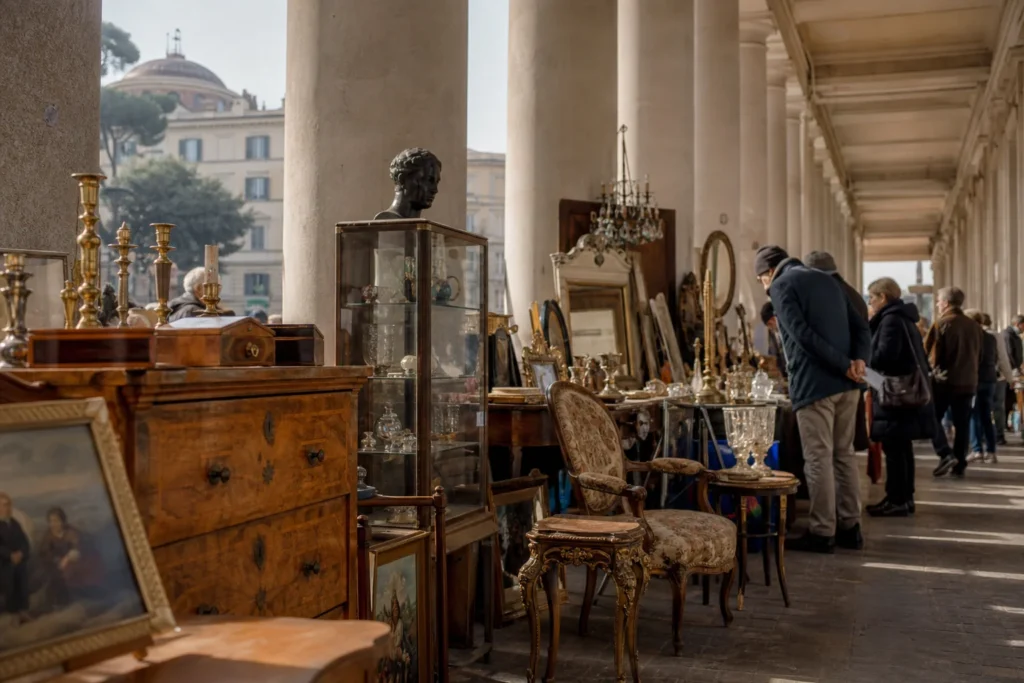
La Soffitta Sotto I Portici — "the attic under the arcades" — occupied one of Rome's most architecturally commanding outdoor spaces. The market gathered beneath the broad stone portico of Piazza Augusto Imperatore, a monumental square flanked by the remains of the ancient mausoleum of Augustus, just off Via del Corso. Positioned roughly midway between the Spanish Steps and Piazza del Popolo, the setting alone gave the market a character that few flea markets anywhere in Europe could match.
The crowd it drew reflected that distinction. Roman collectors arrived with focused intent, scanning stalls for pieces that fitted a specific gap in a collection. Alongside them came a younger, style-conscious contingent drawn as much by the atmosphere as by any single find. That mix of expertise and casual curiosity gave the market a particular social energy — purposeful but relaxed, knowledgeable but welcoming to the uninitiated.
Because it ran only a few times per month rather than every weekend, each edition carried a mild sense of occasion. Regulars planned around it. The periodic rhythm meant stalls tended to turn over fresh stock, and browsers rarely saw exactly the same spread twice. Around sixty stalls filled the space — compact enough to cover thoroughly in a morning, varied enough to reward a slow second pass.
The merchandise ranged across a generous span of collecting interests. Leather flying helmets from the First World War sat near trays of turn-of-the-century coins and stamps. Antique lace, crystal beads and delicate pottery occupied one corner while framed prints, small paintings and decorative furniture claimed another. Second-hand jewellery and vintage clothing appeared alongside kaleidoscopes, books and ornate picture frames. The selection rewarded collectors who arrived with a clear eye as much as browsers who simply wanted to be surprised.
Entry was free, which contributed to the unhurried, democratic atmosphere. Nobody felt pressure to buy. Visitors drifted between stalls, handled objects, talked with vendors who often knew their stock's provenance in considerable detail. Afterward, the neighbourhood itself extended the experience — the Augusteo district offered quiet streets, good cafés and, famously, the restaurant 'Gusto nearby, which many market regulars made their post-browse destination.
What distinguished La Soffitta Sotto I Portici as a place in Rome's collector culture was precisely that combination: a serious, well-stocked antiques market operating inside one of the city's great historic public spaces, free to enter and shaped by a community of buyers and sellers who returned regularly. Very few markets managed to be genuinely embedded in both the physical and social life of a neighbourhood the way this one was. It remains a notable part of Rome's flea market history.
Frequently Asked Questions
Q: Is La Soffitta Sotto I Portici still operating?
A: No. The market is permanently closed. This listing is kept as an editorial archive of the venue.
Q: Where was the market located?
A: It occupied the portico of Piazza Augusto Imperatore, just off Via del Corso in central Rome, roughly midway between the Spanish Steps and Piazza del Popolo — with the ruins of the Mausoleum of Augustus as a backdrop.
Q: What kind of things were sold there?
A: Stock ranged across wearable vintage such as jewellery, antique lace and clothing; curiosity objects including WWI leather flying helmets and turn-of-the-century kaleidoscopes; and decorative pieces covering prints, small paintings, coins, stamps, pottery and frames. The roughly sixty stalls gave it a genuine attic-clearance breadth.
Q: Was there an entrance fee?
A: Entry was free.
Q: How often did the market run?
A: It operated a few times per month rather than every weekend, which gave each edition a mild sense of occasion and meant stalls tended to turn over fresh stock between visits.
Marketplace Highlights








Add a review