

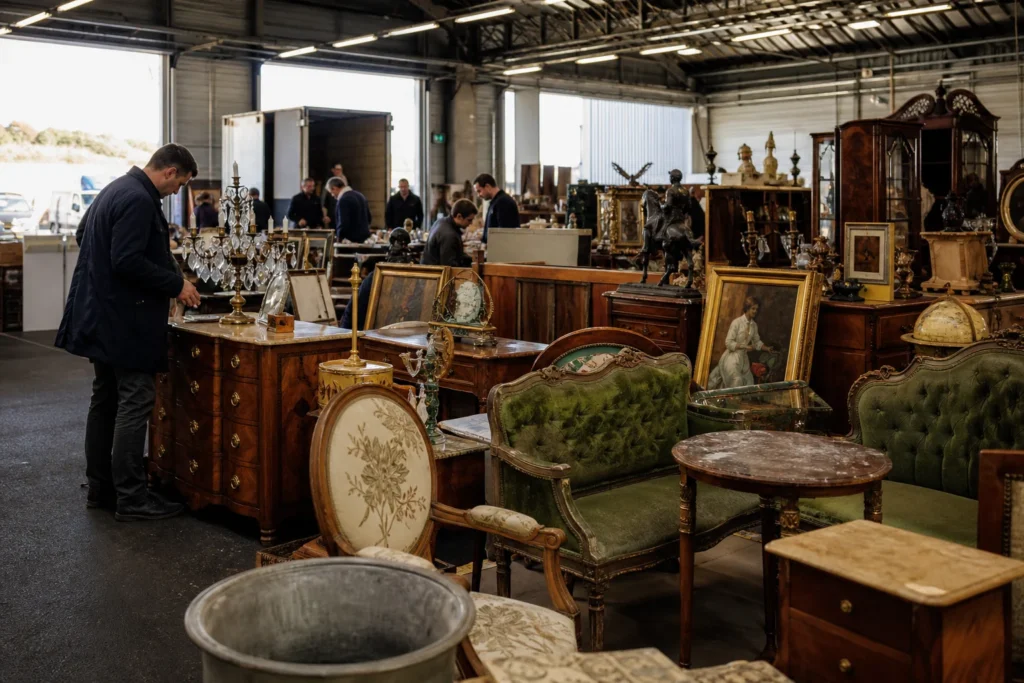

At exactly 08:00, the trucks unseal. Every dealer on the floor starts unpacking at the same moment, and 25,000 square metres of European antiques become simultaneously available to thousands of professional buyers. That ritual — déballage au cul du camion in its most authentic form — is the defining experience of the Déballage Marchand du Mans. The fair runs six times a year at the Centre des Expositions du Mans, each session lasting from 08:00 until 13:00.
This is a trade event, not a public market. Entry requires proof of professional buyer status, and that condition shapes everything about the atmosphere inside. Dealers negotiate with dealers. Pricing reflects market reality rather than retail expectation. The Déballage Marchand du Mans sits within the broader Déballages Professionels Marchands circuit — a series of professional antiques fairs held at intervals across France — and Le Mans stands as one of the major events on that national calendar.
The scale of what arrives at Le Mans draws buyers from across Europe and beyond. European antique furniture, old paintings, fine art objects and decorative pieces fill the exhibition halls in concentrated quantity. The efficiency argument for attendance is compelling: a professional buyer can cover sourcing ground in a single five-hour morning that might otherwise require weeks of travel across the continent. That compression of supply makes the fair genuinely useful rather than merely impressive.
On-site shipping services add another practical dimension. Specialist international freight companies operate throughout the fair, offering collection, packaging, customs handling and worldwide delivery from a single point. A buyer can acquire a collection of pieces in the morning and arrange door-to-door shipping before the fair closes. For dealers restocking inventories or sourcing for international clients, that logistical completeness is a meaningful advantage.
The fair also functions as a professional education environment. Buyers earlier in their careers use the event to sharpen their eye — comparing antique furniture grades, calibrating prices for art objects and learning how experienced dealers read and move through a floor of this scale. The concentration of knowledge and merchandise in one venue on one morning makes that learning unusually dense.
The Centre des Expositions sits at 1 Avenue du Parc des Expositions in Le Mans. The nearest bus stop is Madon, approximately 250 metres away, served by bus lines 10A and 10B toward Oasis. The Oasis – Centre des Expositions stop, roughly 390 metres away, offers a wider range of connections including bus routes 5, 10A, 10B and 21. Le Mans does not have a metro network, so local bus services are the primary public transport option for reaching the venue.
Frequently Asked Questions
Q: Is this fair open to the general public?
A: No. Entry requires proof of professional buyer status — the Déballage Marchand du Mans is a trade-only event. If you are not a verified professional buyer, you will not be admitted.
Q: What is the déballage ritual and why does it matter for buyers?
A: At 08:00 precisely, every truck on the floor unseals and all dealers begin unpacking simultaneously. No buyer gets early access or advance pick. That equal-start format is central to the fair's character and is why serious trade buyers arrive at opening.
Q: How often does the fair run, and how long does each session last?
A: The fair runs six times a year at the Centre des Expositions du Mans. Each session opens at 08:00 and closes at 13:00 — a five-hour window. Check the organizer's official page for the current schedule before making travel arrangements.
Q: Can I arrange shipping for purchases at the fair itself?
A: Yes. Specialist international freight companies operate on-site throughout each session, offering collection, packaging, customs handling and worldwide delivery. A buyer can complete acquisitions and arrange door-to-door shipping within the same morning.
Q: What categories of antiques does the fair typically cover?
A: The 25,000-square-metre exhibition floor draws European stock broadly — antique furniture, old paintings, fine art objects and decorative pieces are the main categories represented across the floor.
Marketplace Highlights









Add a review