

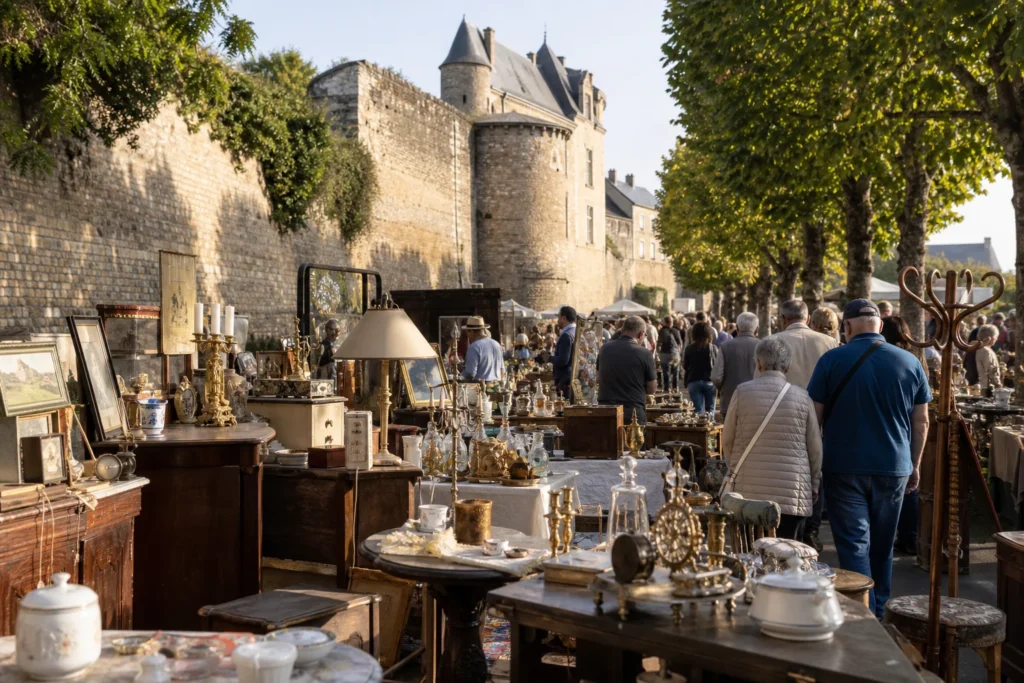

By five in the morning, the streets of Durtal are already alive. Dealers claim their pitches in the pale September light, laying out tables along the ancient stone walls of the town's castle. Long before most French towns have opened a café, the Rendez-Vous International de la Curiosité et de la Brocante de Durtal is underway — and serious hunters know that the best finds disappear early.
This is one of the last outdoor antiques fairs of its scale and quality in western France. Around 450 exhibitors set up across the site, and some 20,000 visitors make their way to Durtal for the occasion. Those visitors travel from across Europe — Spain, Italy, Germany, Belgium, the Netherlands and the UK — and from as far as the United States and Japan. That international reach reflects something real: Durtal has a reputation for merchandise that feels genuinely fresh, not recycled from the circuit of professional dealers.
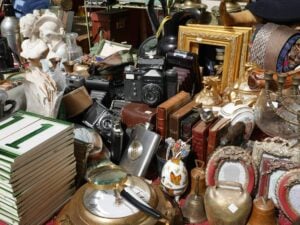
Much of what appears on the tables comes directly from local attics and estates in Maine-et-Loire. The range is broad — old coins, silverware, ceramics, porcelain, books, jewellery, furniture, paintings, vintage clothing, and objects that defy easy categorisation. Sellers are passionate rather than merely professional, and conversations drift naturally toward shared memory. It is not unusual to hear someone recognise an object their grandmother once used, or to pause over something they once owned and gave away too soon. The atmosphere across the stalls is warm and unselfconscious, which is part of what has given Durtal its distinctive character among French brocante events. A Channel 4 programme reportedly filmed an episode at the 2013 edition — a detail that points to the fair's reach beyond the French antiques world.
The fair runs for fourteen hours, from 05:00 to 19:00. Early arrivals have the clearest run at the choice pieces; those who arrive later find the market more relaxed and easier to browse without purpose. Both approaches work. Dealers come to source stock. Collectors pursue specific categories. First-timers simply wander. The fair functions for all of them, which is unusual for an event at this scale.
No specialist knowledge is required to enjoy a day here. The setting does much of the work — the castle perimeter, the narrow streets, the density of objects from another era. Many visitors arrive without anything particular in mind and leave with something they did not know they were looking for. For anyone drawn to genuinely sourced French provincial antiques in an atmospheric historic town, Durtal offers the kind of event that has largely disappeared from the French antiques calendar.
The fair takes place on one Sunday in September, either on the second or fourth full weekend of the month. Readers should confirm the exact date for the current year directly with the organisers or via Maine-et-Loire tourism resources, as the precise weekend can vary. Durtal is a small town, and most visitors arrive by car. For those travelling without one, the bus stop Centre Rue du Maréchal Leclerc is approximately 250 metres from the Place des Terrasses site. A second bus stop, Clémenceau, sits roughly 450 metres away. Check local bus schedules for connections from La Flèche or Sablé-sur-Sarthe before travelling.
Frequently Asked Questions
Q: When does the Brocante de Durtal take place?
A: The fair runs on one Sunday in September, either on the second or fourth full weekend of the month. Check the organizer's official page to confirm the exact date before you travel, as it varies from year to year.
Q: What time does the fair open and close?
A: The fair runs from 05:00 to 19:00 — a full fourteen hours. Serious hunters arrive early; the best pieces tend to go before most visitors have even had breakfast.
Q: What kinds of items can I expect to find?
A: The range is broad: silverware, ceramics, porcelain, furniture, paintings, old coins, books, jewellery and vintage clothing, alongside objects that are harder to categorise. Much of the stock comes directly from local attics and estates in Maine-et-Loire, which gives the merchandise an unusually fresh feel compared to events dominated by professional dealers.
Q: Is this fair suitable for first-time visitors with no specialist knowledge?
A: Completely. Dealers arrive to source stock and collectors pursue specific categories, but plenty of visitors simply wander. The setting along the castle walls does much of the work, and many people leave with something they weren't looking for when they arrived.
Q: How do I get to Durtal if I'm not travelling by car?
A: Most visitors arrive by car. If you're travelling without one, there are bus stops within 250 to 450 metres of the fair site, with connections possible from La Flèche or Sablé-sur-Sarthe. Check local Maine-et-Loire public transport schedules before you travel to confirm current routes and times.
Marketplace Highlights








Add a review