

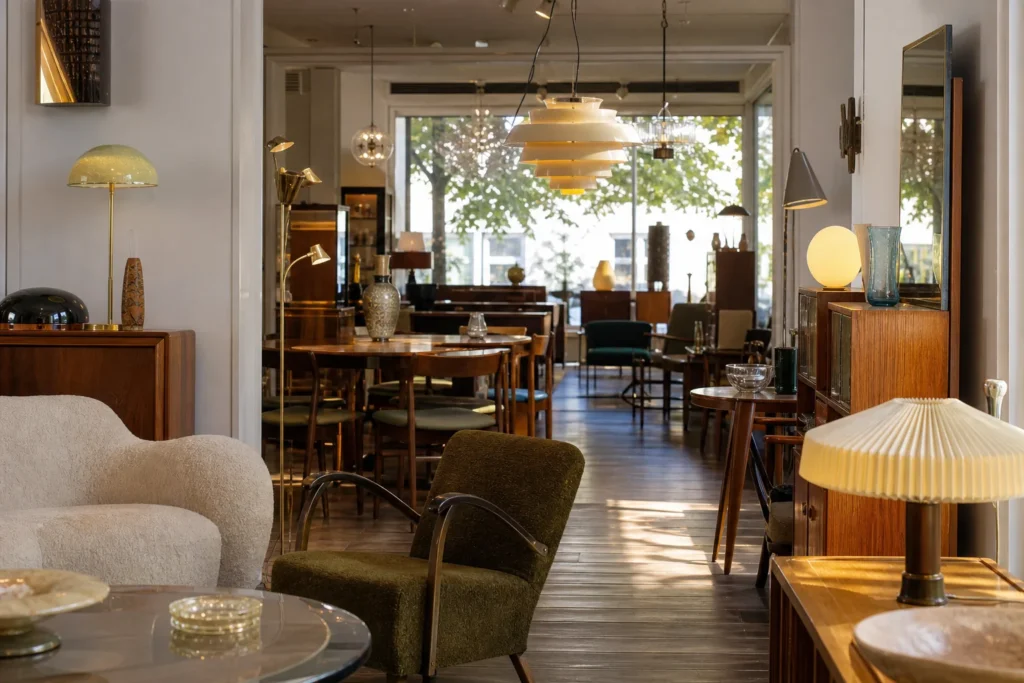
Some antique shops present a finished version of the past. Lichterloh on Gumpendorfer Straße does something more interesting: it preserves the past as it actually arrived. Pieces here are cleaned, rewired where necessary, and lightly refinished when the structure demands it — but the patina stays. Worn edges, faded veneers, and the honest marks of decades of use remain visible, valued, and deliberately kept. Opposite Café Sperl in Vienna's 6th district, the shop treats those imperfections as evidence of quality rather than arguments for a lower price.
That philosophy shapes every corner of the showroom. The space stretches across more than 400 square metres, and the stock moves across Art Deco, Jugendstil, and Mid-Century Modern — Austrian and international design sitting comfortably side by side. Curved wood, brass hardware, statement lighting, and the occasional rug or ceramic fill the floor. A compact teak side table might stand near a large lacquered wardrobe. A rewired vintage lamp might catch light beside a gilded mirror. The scale varies widely, but the editorial eye behind the selection stays consistent throughout.
What makes the curation feel coherent is that Lichterloh sources and presents objects as a specialist rather than a generalist. The stock spans the 19th century through to the mid-20th, yet nothing feels arbitrary. Each piece earns its place on the floor through material, construction, and character — not simply age or category. Buyers who want authenticity alongside craft will find that focus immediately apparent.
Accessories fill the quieter corners of the room and offer natural entry points for visitors who are browsing rather than sourcing major furniture. Candlesticks, glassware, ceramics, and smaller decorative objects reward slow attention. The density of the space means pieces reveal themselves gradually. Something overlooked on a first pass often earns a second glance from a different angle. Pricing reflects the specialist positioning without excluding collectors working within a modest budget — the range accommodates both a considered investment and a smaller, unexpected discovery.
The shop opens Tuesday through Friday from 1 pm to 6 pm, and on Saturdays from 11 am to around 3:30 pm. It stays closed on Sundays and Mondays. Those hours suit a deliberate visit rather than an impulse stop, which fits the stock well. Saturday morning works naturally alongside a visit to the nearby Naschmarkt — the two sit comfortably in the same half-day. Staff approach the space with knowledge rather than pressure, making it easy to explore at your own pace and think rather than simply buy.
Getting here is straightforward. Laimgrubengasse bus stop, served by bus 57A, sits approximately 110 metres away — the closest public transport option. Kettenbrückengasse is roughly 320 metres away and connects to the U4 subway line as well as night bus N60. Museumsquartier station, approximately 350 metres in the other direction, serves the U2 subway and bus routes 57A, N46, and N49. Trams and additional bus services on Burgring and Resselgasse extend the connections further for those arriving from across the city.
Lichterloh earns its place on any Viennese itinerary built around design, antiques, or twentieth-century decorative arts. It suits collectors who value imperfect beauty over showroom perfection, and it rewards visitors who arrive with curiosity and leave with more to think about than they expected.
Frequently Asked Questions
Q: What periods and styles does Lichterloh specialise in?
A: The showroom covers roughly a century of design history, from the late 19th century through to the mid-20th. Art Deco, Jugendstil, and Mid-Century Modern sit alongside each other, with both Austrian and international pieces represented. Curved wood furniture, brass hardware, statement lighting, rugs, and ceramics all appear on the floor.
Q: How does Lichterloh approach restoration — are pieces stripped back or left original?
A: The shop's philosophy is deliberate: pieces are cleaned, rewired where safety requires it, and lightly refinished where the structure genuinely needs it, but patina and honest wear are kept intact. Worn surfaces and faded veneers are treated as markers of quality and longevity, not flaws to be erased. Buyers looking for character alongside craft will find that ethos immediately apparent.
Q: Is it worth visiting if I'm not planning to buy large furniture?
A: Easily. Accessories — candlesticks, glassware, ceramics, and smaller decorative objects — fill the quieter corners of the 400-square-metre space and offer natural entry points for browsers. The stock accommodates both modest budgets and more considered investments, and the density of the showroom rewards slow looking; pieces often reveal themselves on a second pass from a different angle.
Q: When is Lichterloh open, and what's the best time to visit?
A: The shop opens Tuesday through Friday from 1 pm to 6 pm, and on Saturdays from 11 am to around 3:30 pm; it is closed Sundays and Mondays. Weekday afternoons tend to be quieter. Saturday morning works well combined with a visit to the nearby Naschmarkt. Confirm current hours on the shop's own published schedule before travelling.
Q: How do I reach Lichterloh by public transport?
A: The closest stop is Laimgrubengasse, served by bus 57A, roughly 110 metres away. Kettenbrückengasse (U4 subway) is approximately 320 metres, and Museumsquartier (U2 subway, also served by bus 57A) is approximately 350 metres. The shop is on Gumpendorfer Straße in Vienna's 6th district, directly opposite Café Sperl.
Marketplace Highlights








Add a review