


Region
Marché aux puces de Sainte-Foy is permanently closed. the market is retained as an editorial archive of the venue and its distinctive character.
the market is retained as an editorial archive of the venue and its distinctive character.
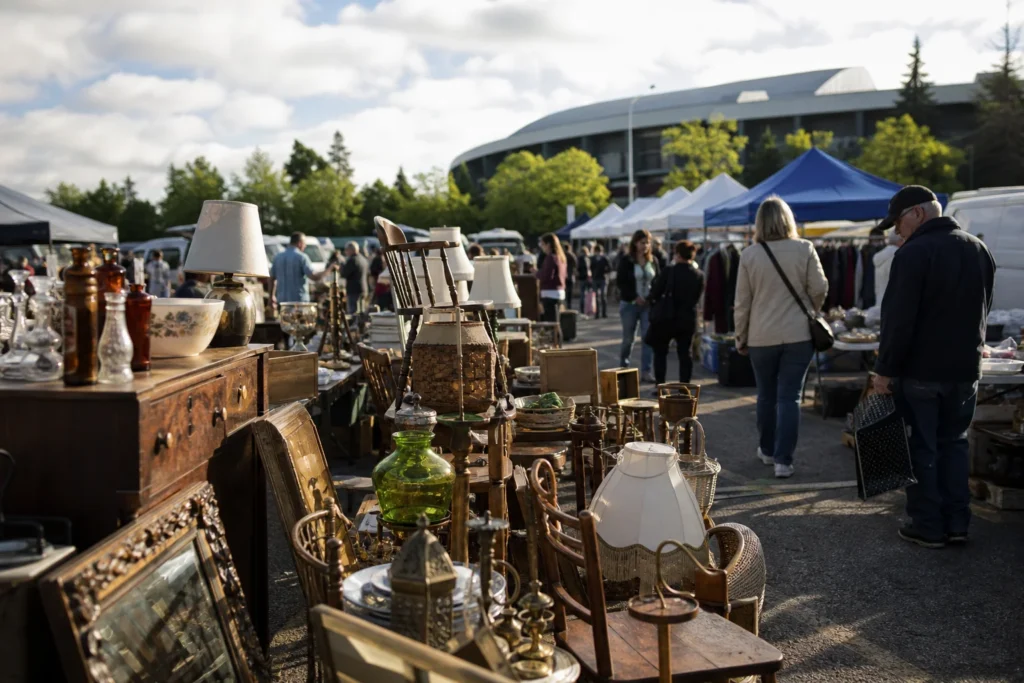
On a summer Sunday at ExpoCité, the P3 car park along the corner of Soumande and Avenue du Colisée transformed into something far removed from asphalt and painted lines. Tables appeared before dawn, crates were unstacked in the half-light, and racks of clothing went up while the rest of Québec City was still asleep. By the time casual visitors arrived, the Marché aux puces de Sainte-Foy was already a fully inhabited world of accumulated objects — domestic, decorative, peculiar, and occasionally extraordinary.
The market occupied this ExpoCité site after relocating from the Sainte-Foy neighbourhood, bringing its long-established reputation with it to the new setting. It ran weekly through the warmest months, typically from mid-May into early September, outdoors in all but the harshest weather. The open air made the experience distinctly different from the covered halls and permanent arcades found elsewhere in the region. Daylight caught the surfaces of glassware and gilt frames. Space between stalls gave room to step back and actually look.
Claimed as Québec City's largest outdoor flea market, the site filled with a density of goods that rewarded slow, methodical movement. Vinyl records drew dedicated collectors early, often stacked in milk crates that required patience to work through. Vintage clothing hung in quantity — coats, knitwear, printed shirts from several decades back. Furniture and larger decorative pieces appeared near the ends of rows, the kind of finds that demanded a car and a commitment made before the morning was old. Smaller objects filled every gap: framed paintings, costume jewellery, retro toys, kitchen tools, ornaments and the kind of bric-a-brac that resists any single category.
Sellers typically began setting up around five in the morning, and the first arrivals knew exactly why they came early. The culture of bargaining ran through the whole site. Prices were understood to be starting points, and a respectful offer was rarely turned away. As the morning progressed, the crowd shifted — serious pickers gave way to families, tourists and browsers with no particular agenda who found the sheer volume of objects reason enough to stay. One pass through the aisles was rarely enough. The stalls pressed close, and inventory changed from table to table in ways that made doubling back worthwhile.
For collectors and secondhand enthusiasts across the region, the Marché aux puces de Sainte-Foy held a particular place in the warm-weather calendar. Its scale, its outdoor setting and its long summer season gave it a character that smaller or indoor markets could not replicate. It was a place where a focused collector and a completely unprepared visitor could both leave with something they hadn't expected to find — which, in the end, is the only thing a flea market really needs to be.
Frequently Asked Questions
Q: Is the Marché aux puces de Sainte-Foy still operating?
A: No. The market is permanently closed. the market is maintained as an editorial archive of the venue and its history.
Q: Where was the market held, and when did it run?
A: The market was held outdoors in the P3 car park at ExpoCité, at the corner of Avenue du Colisée and Soumande in Québec City. It ran weekly on Sundays from roughly mid-May through early September, after relocating from the Sainte-Foy neighbourhood in 2019.
Q: What kinds of goods could buyers find there?
A: The mix was genuinely broad — vinyl records, vintage clothing, costume jewellery, retro toys, framed paintings, small furniture pieces, kitchen tools and general bric-a-brac. Serious collectors worked the aisles early for the strongest finds, while browsers with no fixed agenda still had plenty to discover later in the morning.
Q: Was bargaining expected at this market?
A: Yes. Haggling was a normal part of the culture. Prices were understood to be starting points, and a polite offer was rarely refused. Early arrivals had the advantage of first pick as well as sellers still in an accommodating mood at the start of the day.
Marketplace Highlights









Add a review