

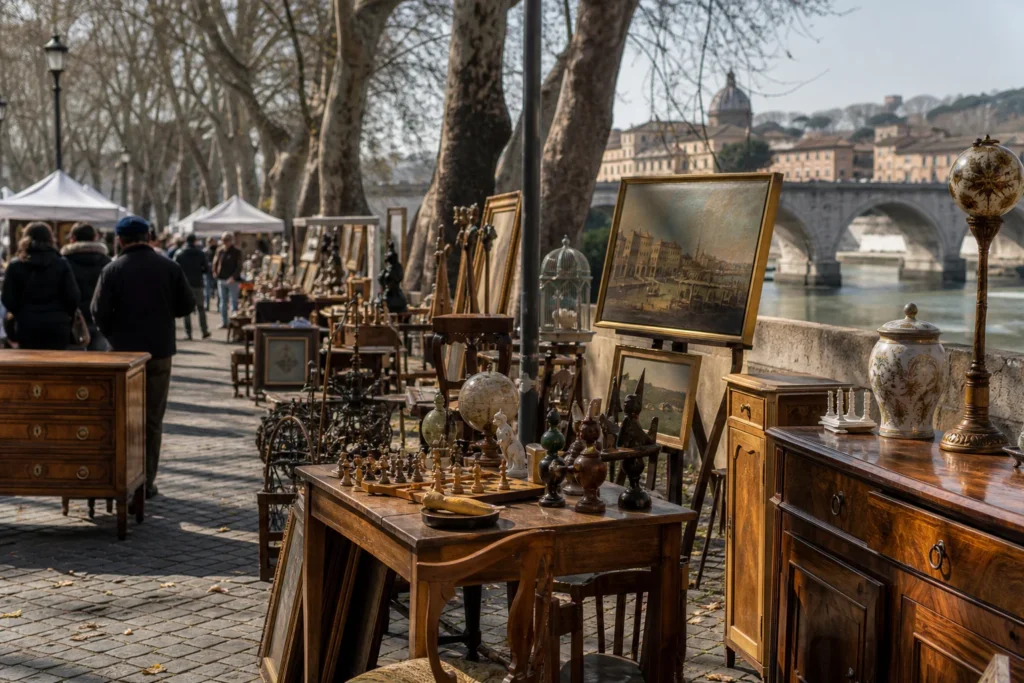

Mercatino di Piazzale delle Belle Arti a Roma is permanently closed. The market is retained as an editorial archive of the venue and its distinctive character.
The Piazzale delle Belle Arti occupies a quiet and culturally weighted corner of northern Rome. Bordered by Viale delle Belle Arti, Viale Titiano, Via Fratelli Archibugi and Via Flaminia, the piazzale sat beneath the slopes of Parioli Hill with the Tiber running close by through the neighbourhood. This was not the chaotic centre of the city but a more composed, architecturally considered quarter — the kind of Roman address that carries its associations lightly but insistently.
The garden adjacent to the clearing served as the market's home. It gave the event a settled, almost domestic quality that separated it from the bustle of larger Roman fairs. Stalls arranged among the greenery drew browsers rather than bargain-hunters, and the atmosphere reflected the neighbourhood's predominantly artistic character. The location alone shaped expectations before a single object changed hands.
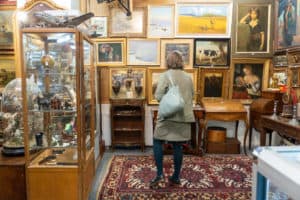
At its scale, the market was a serious affair. More than eighty professional sellers came together across upward of a hundred stalls, offering a concentrated mix of Italian and European antiques, vintage furniture, clothing, accessories and original artwork. The professional composition mattered. Unlike a general secondhand market, where chance and volume dominate, this one carried the quieter authority of sellers who knew exactly what they were presenting and to whom.
The artistic dimension gave the market its editorial centre of gravity. Among the exhibitors were painters and draughtsmen reportedly associated with the Via Margutta School — a tradition rooted in the street long synonymous with Rome's studio culture, and linked in popular memory to the city's mid-century artistic life. Whether a visitor came to buy or simply to look, the presence of working artists grounded the market in something living rather than merely archival. It offered a plausible encounter with Rome's ongoing creative culture, not just its accumulated past.
The audience that gathered here reflected all of this. Collectors with specific interests, art lovers drawn by the Via Margutta connection, and curious visitors who had wandered north from the more familiar tourist circuits all found something to hold their attention. The professional seller profile meant that conversations tended toward the knowledgeable end of the spectrum. Browsing here rewarded patience and a degree of genuine interest.
What made the Mercatino di Piazzale delle Belle Arti editorially distinctive was the coherence of its parts. The setting, the seller community, the artistic affiliations and the audience formed an unusually consistent whole. Few Roman markets could claim a location so specifically tied to the city's cultural geography, or a seller mix so clearly oriented toward collectors and art enthusiasts. The archive record of this market preserves something worth understanding: a monthly gathering that earned its place through character rather than size.
Frequently Asked Questions
Q: What kind of market was the Mercatino di Piazzale delle Belle Arti?
A: It was a professional antiques and vintage fair held in the garden adjacent to Piazzale delle Belle Arti in northern Rome. More than eighty sellers and over a hundred stalls brought together Italian and European antiques, vintage furniture, clothing, accessories and original artwork — a more curated and knowledge-driven gathering than a typical secondhand or flea market.
Q: What made this market stand out from other Roman antiques fairs?
A: Its combination of setting and seller community was unusual. The garden space in a quiet, architecturally considered quarter beneath Parioli Hill gave it a calm, unhurried character, while the presence of artists reportedly associated with the Via Margutta School — long the heart of Rome's studio culture — gave it a living artistic dimension rather than a purely archival one.
Q: What was the Via Margutta connection?
A: Some of the contemporary artists who exhibited paintings and drawings at the market were said to be members of or associated with the Via Margutta School, the artistic tradition rooted in Rome's most famous studio street. This meant visitors could encounter original work by active Rome-based artists alongside antique and vintage objects.
Q: Is the market still running?
A: No. The Mercatino di Piazzale delle Belle Arti is permanently closed. It is retained here as an editorial archive of a market that played a distinctive role in Rome's antiques and arts scene.
Marketplace Highlights






Add a review