


Mercatino dell’ antiquariato di Porta Pia is permanently closed. The market is retained as an editorial archive of the venue and its distinctive character.
The market is retained as an editorial archive of the venue and its distinctive character.
On a monthly Sunday in Rome's Salario district, the Mercatino dell'Antiquariato di Porta Pia offered something rarer than a good bargain: a genuine neighbourhood ritual. Locals treated the market as a social fixture — a reason to leave the house early, to wander without urgency, and to move naturally from browsing stalls to a late-morning aperitif. Serious collectors and curious passers-by shared the same piazzale, and that easy coexistence gave the market much of its warmth.
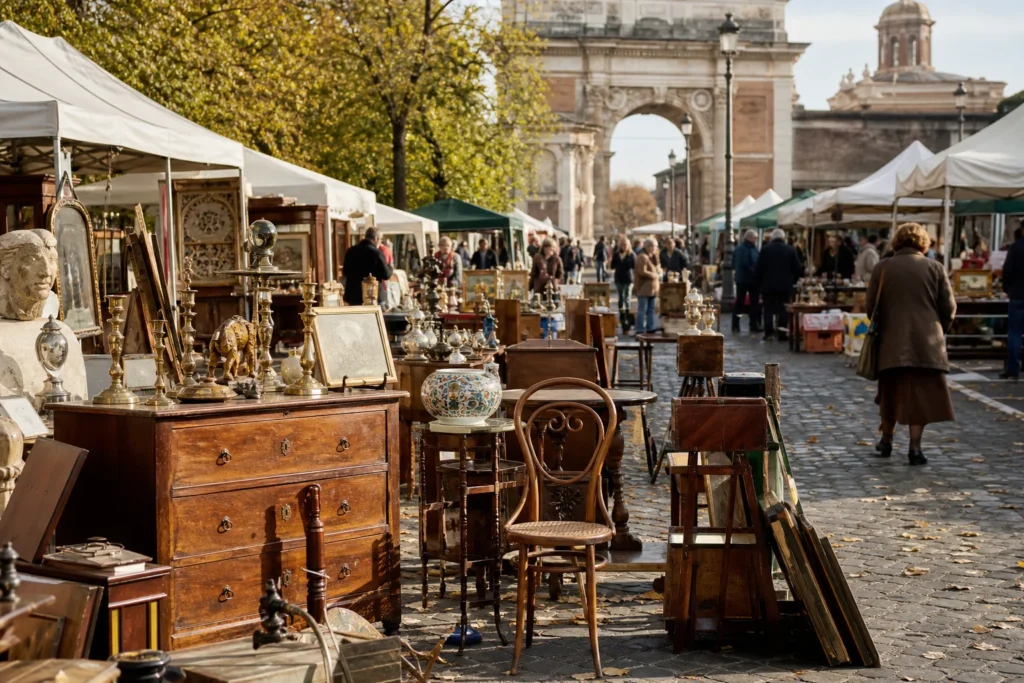
The setting was Piazzale di Porta Pia, a broad open space in the Salario district positioned between Via Nomentana and Corso d'Italia. This part of Rome sits just inside the ancient Aurelian Wall, and the piazzale's scale gave the market room to breathe. More than sixty stalls spread across the space, enough to reward a slow circuit without becoming overwhelming. The location was convenient for Romans arriving from several directions, and it attracted a steady mix of neighbourhood regulars and visitors from further afield.
The print and paper offerings were among the most distinctive draws. Old books, original prints and vintage comics attracted a particular kind of collector — patient, knowledgeable, and liable to spend a long time at a single stall. These were not generic flea market paperbacks. The selection reflected decades of private libraries and personal collections finding their way back into circulation. For anyone interested in Italian illustration, mid-century graphic design or simply the texture of old printed matter, the market rewarded careful looking.
Alongside the paper goods, dealers brought furniture, small antiques and decorative objects in a range of conditions and periods. The mix leaned toward the genuinely old rather than the merely vintage, though second-hand clothing also had a presence. The atmosphere was closer to a specialist antiques fair than a generalist boot sale — sellers tended to know their stock, and transactions often came with a little provenance, or at least a story.
The monthly cadence shaped everything. Because the market appeared only once a month, it carried a sense of occasion. Regulars planned around it. The day ran from morning into the afternoon, long enough to allow the kind of unhurried browsing that antiques collecting demands. Many visitors folded the market into a wider Sunday: a walk through Salario, a stop at the stalls, then lunch somewhere nearby before the afternoon faded.
Among Rome's many periodic markets, the Mercatino dell'Antiquariato di Porta Pia held a particular place. It combined the discipline of a collector's market with the ease of a neighbourhood pastime. That balance — between the hunt and the stroll, between specialist intent and casual pleasure — was what made it a reference point for flea market enthusiasts in the city.
Frequently Asked Questions
Q: What kind of market was the Mercatino dell'Antiquariato di Porta Pia?
A: It was a monthly antiques and collectors' market held in Rome's Salario district, with more than sixty stalls offering furniture, small antiques, old books, original prints, vintage comics and second-hand clothing. The atmosphere leaned toward a specialist antiques fair rather than a generalist flea market — sellers generally knew their stock well.
Q: Where did the market take place?
A: The market was held at Piazzale di Porta Pia in Rome's Salario district, a broad open space positioned between Via Nomentana and Corso d'Italia, just inside the ancient Aurelian Wall.
Q: Is the Mercatino dell'Antiquariato di Porta Pia still running?
A: No. The market is permanently closed. The market is kept as an editorial archive of the venue and its character.
Q: What were the strongest categories for collectors?
A: The print and paper stalls were among the most distinctive. Old books, original prints and vintage comics drew patient, knowledgeable collectors and reflected decades of private Italian libraries and personal collections coming back into circulation — notably stronger in that respect than a typical Sunday market.
Marketplace Highlights







Enzo Molinari
30th January 2016 at 04:29Ogni seconda domenica del mese c e questo delizioso mercatino dell antiquariato, oggettistica, abbigliamento, accessori, libri a Porta Pia.Il mercatino non é grandissimo pero è ideale per una passeggiata sbirciando tra una bancarella e l altra. Piacevoli e molto socievoli i commercianti degli stand.