

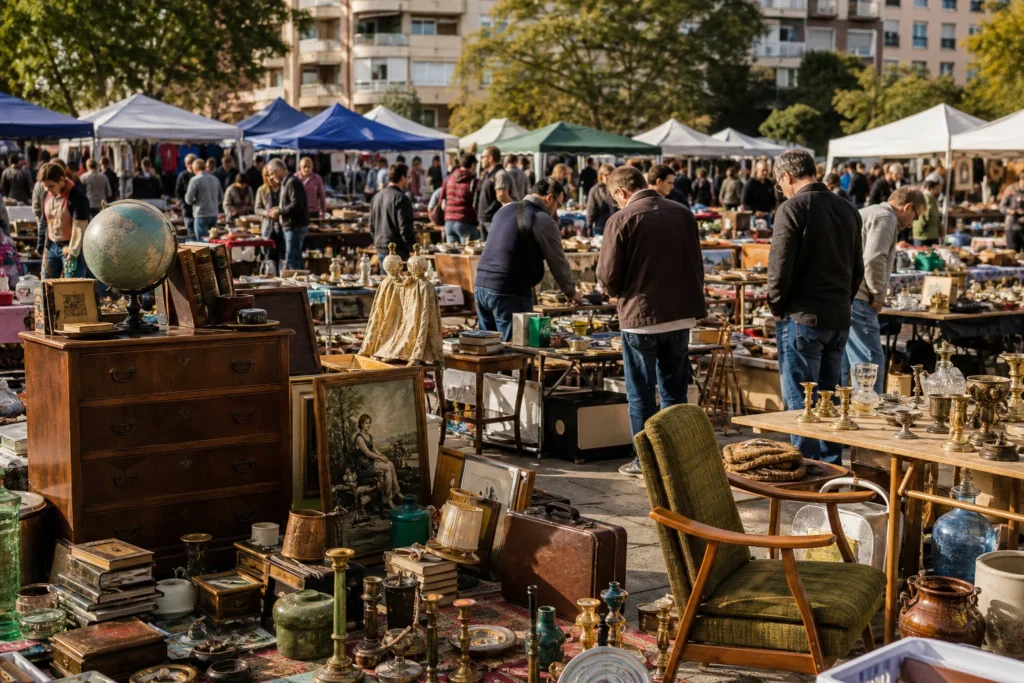

By nine on a Sunday morning, the streets around Valencia's Mestalla district are already filling. Vendors stake out their pitches, unfold trestle tables and spread out goods that range from carefully arranged antique prints to cardboard boxes stuffed with cassette tapes. This is Rastro de Valencia — also widely known as Rastro de Mestalla — and it runs every Sunday from 09:00 to 14:30.
Around 500 vendors show up each week, making this one of the largest Sunday flea markets in Spain. The scale is immediately apparent, but the market never feels like a trade fair. It feels like a neighbourhood habit. Local accounts trace its roots to the area around Valencia's Central Market, where scrap dealers, booksellers and antique traders first gathered when the second-hand economy was a matter of necessity rather than nostalgia. The instinct to turn up every week has outlasted the original circumstances by decades.
Serious collectors come here with specific targets. The vinyl section rewards patience — 1980s Spanish and international pressings turn up regularly, often at prices that would embarrass any record shop. Old books and antique prints cluster in the more settled stalls, alongside ceramics, picture frames and decorative objects that feel genuinely domestic rather than styled for resale. Vintage clothing also appears in quantity, and the prices stay low enough to encourage real browsing rather than cautious calculation.
A distinct layer runs beneath the more organised stalls. Some vendors simply lay a blanket on the ground and pile it with whatever they have brought that week. These floor stalls look chaotic, but they reward a slow look. The prices reflect the informal setup, and occasionally something worth finding sits right on top. Haggling connects both layers of the market. Stallholders expect it and most welcome the exchange. The atmosphere stays unhurried even on busy mornings, and a significant number of visitors are clearly regulars — people who come to talk as much as to buy.
Arriving early is practical advice, not a cliché. The most interesting stock moves in the first hour. The market also draws pickpockets, as any large open-air event in a busy city can. Keep valuables secure and stay aware in the denser sections near popular stalls.
Getting here is straightforward. The closest stop is Lluís Peixò - Comte Melito, served by bus lines 98 and 99, approximately 50 metres away. Tram lines 4 and 6 stop at Beteró, roughly 150 metres from the market. For visitors travelling from further across the city or arriving by regional train, Estació de València - Cabanyal serves lines C-5, C-6, ER-02 and L-50 at approximately 650 metres away.
Rastro de Valencia suits collectors hunting vinyl, ceramics or prints, budget vintage shoppers who prefer genuine variety over curated selections, and anyone who wants to spend a Sunday morning somewhere the same people have been coming back to for years. The market's appeal is its straightforwardness — no entrance fee, no theming, no performance. Just half a kilometre of stalls, an unhurried pace, and the specific pleasure of not knowing what you will find until you look.
Frequently Asked Questions
Q: When does Rastro de Valencia take place, and what are the hours?
A: The market runs every Sunday from 09:00 to 14:30 in Valencia's Mestalla district. It is a weekly fixture, not a seasonal event, so any Sunday morning works — though arriving closer to opening time gives you the best pick of stock.
Q: What kinds of things can you find there?
A: Around 500 vendors spread across a mix of organised stalls and informal blanket pitches. Collectors tend to target 1980s vinyl, antique prints, old books and ceramics. Vintage clothing, jewellery, picture frames and decorative objects from private homes also appear regularly, usually at genuinely low prices. The selection rotates each week, which makes repeat visits worthwhile.
Q: Is haggling acceptable at Rastro de Mestalla?
A: Yes, and it is expected throughout the market. Stallholders at both the more organised tables and the informal floor pitches are generally happy to negotiate. The atmosphere stays relaxed, and many regulars come as much for the social exchange as for the buying.
Q: How do you get there by public transport?
A: Bus lines 98 and 99 stop at Lluís Peixò - Comte Melito, approximately 50 metres away. Tram lines 4 and 6 serve Beteró, around 150 metres from the market. Visitors arriving by regional train can use Estació de València - Cabanyal on lines C-5, C-6, ER-02 and L-50, roughly 650 metres away.
Q: Any practical tips before visiting?
A: Arrive early — the most interesting stock moves in the first hour of trading. Like any large open-air market in a busy city, Rastro de Valencia attracts pickpockets, so keep valuables secure and stay aware in the busier sections near popular stalls.
Marketplace Highlights








Add a review