

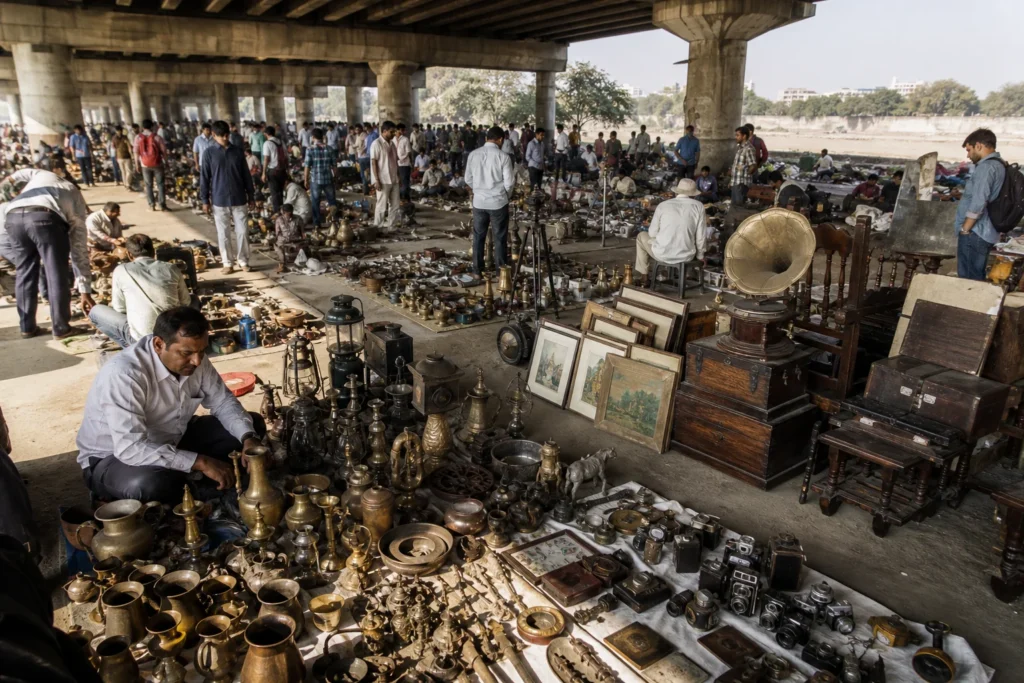

Spread across roughly 32,000 square metres of Sabarmati riverbank beneath Ellis Bridge, Ravivari Gujari Bazar is one of the largest open-air flea markets in India. It runs every Sunday from 8 am to 8 pm, giving visitors a full twelve hours to cover the site. That scale alone sets it apart from almost any comparable market in the region.
The dominant layer is working and everyday goods. Agricultural tools, spare parts, bolts of fabric, cycle rickshaws, household utensils, raw produce and electronic components fill enormous stretches of the ground. Domestic animals appear, so do loose nuts and bolts by the kilogram. The market functions as a genuine commercial exchange for Ahmedabad and its surrounding towns, not a curated experience aimed at visitors.
The antiques section earns separate attention entirely. Dealers lay out antique brassware, carved jewellery boxes, cast iron pieces and rugs that carry the heavy, worked quality of Mughal-era craft. Old books, period furniture and gramophone records surface alongside rare stamps, old coins and antique posters. Photographs from an entirely different era turn up in stacks that reward slow and patient sorting.
For collectors and designers, this corner of the market functions as a working resource. The finds are specific enough to justify serious research visits. Mughal-era metalwork, ephemera and period objects appear here at a concentration that is difficult to match elsewhere in Gujarat. The unpredictability from Sunday to Sunday keeps regular visitors coming back.
The market's origins are rooted in the early history of Ahmedabad itself, with local accounts tracing its presence to the city's founding period in the fifteenth century. Whatever its precise age, it has clearly shaped the city's weekly rhythm across many generations. It draws buyers and sellers from Ahmedabad as well as from villages and towns throughout the surrounding region.
Ravivari Gujari Bazar rewards early arrival. The best finds in the antiques section tend to move before the crowds thicken mid-morning. Bargaining is standard across the site, and patience is more useful than urgency. There is no organised signage and no curated layout, which suits serious pickers far better than any polished antiques fair would.
The Lal Darwaja AMTS Bus Stop sits approximately 600 metres from the market in a straight line, connecting the riverbank site to Ahmedabad's city bus network. Lal Darwaja is a busy central hub, and several routes serve it from across the city. For visitors staying in or around the old city, this makes Ravivari Gujari Bazar straightforward to reach on a Sunday morning without needing private transport.
The market is at its most distinctive for collectors hunting Mughal-era metalwork, rare Indian ephemera and period objects of the kind that rarely surface in conventional antiques shops. Its integration into Ahmedabad's real commercial life — loud, dense and entirely unsanitised — is what separates it from anything the region's polished heritage circuit can offer.
Frequently Asked Questions
Q: When does Ravivari Gujari Bazar take place, and how long does it run?
A: The market runs every Sunday from 8 am to 8 pm, giving visitors a full twelve hours on site. Sunday is the only day it operates.
Q: What is the best time to arrive if you are hunting antiques or vintage pieces?
A: Early arrival pays off. The antiques section — where dealers lay out Mughal-era brassware, carved jewellery boxes, old coins, gramophone records and period photographs — tends to move its best stock before the crowds thicken mid-morning. Being there at or close to the 8 am opening gives you the clearest run at the finds.
Q: How do I reach the market using public transport?
A: The Lal Darwaja AMTS Bus Stop is approximately 600 metres from the riverbank site and connects to Ahmedabad's city bus network via multiple routes. For visitors staying in or near the old city, this makes the market straightforward to reach on a Sunday morning without private transport.
Q: Is bargaining expected, and what approach works best here?
A: Bargaining is standard across the site. Patience is more useful than urgency — vendors are accustomed to negotiation, and rushing the process rarely helps. There is no curated layout or fixed pricing structure, so flexibility and a willingness to browse widely tend to produce better outcomes.
Q: What scale and atmosphere should I expect compared with a typical antiques fair?
A: Ravivari Gujari Bazar covers roughly 32,000 square metres of open Sabarmati riverbank, making it one of the largest open-air flea markets in India. The dominant volume is everyday working goods — agricultural tools, spare parts, fabric, electronic components — alongside the collector-focused antiques section. There is no organised signage and no curated layout, which suits serious pickers far better than a polished fair environment would.
Marketplace Highlights








Add a review