

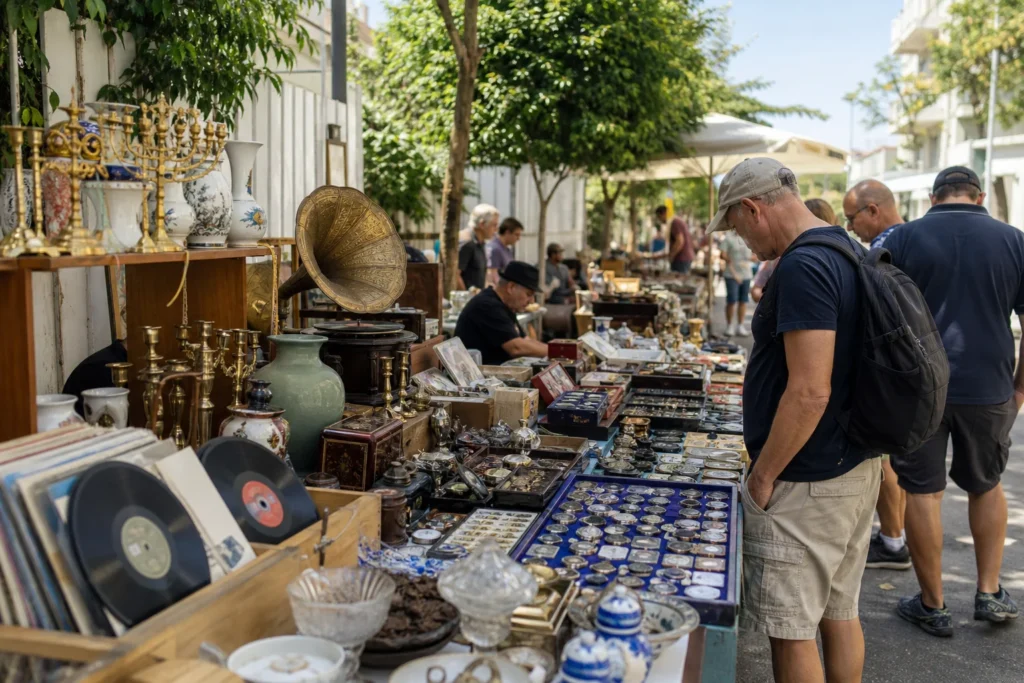

By seven on a Friday morning, the stalls along Gibeon Street are already open and the serious collectors are already moving. That early start is one of the Tel Aviv Antiques Market's quiet advantages — the best picks go fast, and the vendors who arrive at dawn know it. The market runs twice weekly, on Tuesdays from 10:00 to 18:00 and on Fridays from 07:00 to 16:00, giving it a rhythm that suits both the weekend morning hunter and the midweek browser with a free afternoon.
Gibeon Street is a pedestrian promenade in central Tel Aviv, running between HaArba Street and HaHashmonaim Street. The market settled here in 2018 after relocating from Dizengoff Square, and most regulars regard the move as an improvement. Natural light falls evenly across the stalls, vendors have real room to lay out their stock, and the open-air setting gives the whole market an unhurried pace that a tighter urban square rarely allows.
The inventory pulls in a wide range of collectors. Paper and printed ephemera form one strong thread — old banknotes, coin collections, postcards, historical documents and vintage magazines surface regularly across different stalls. Alongside these sit more tactile finds: bronze figures, wooden pieces, antique porcelain, carpets and decorative objects that reward close handling. Militaria hunters tend to linger longest, working through war medals, vintage weapons and military ephemera. Vinyl collectors, jewellery buyers and anyone drawn to old toys, used books or secondhand clothing will each find their own corners worth returning to. No two stalls carry the same mix, which is precisely what makes the market worth more than a single pass.
The atmosphere here earns its reputation. Vendors banter freely between stalls and know their regulars by sight. Experienced sellers read browsers quickly — they give careful attention to those who linger with real intent and leave window shoppers entirely undisturbed. That balance makes the market feel like a shared space rather than a sales floor. Buying is welcome, but it is never demanded.
Compared with Shuk Hapishpeshim in Jaffa — Tel Aviv's better-known flea market — the Dizengoff market holds its own comfortably. Its scale is smaller, its vendor knowledge runs deep, and the Gibeon Street setting gives it a character all its own. For collectors who prefer a navigable, knowledgeable environment over a large tourist-facing crowd, this market is often the better choice.
The market sits very close to public transport. The TLV Mall/HaHashmonaim bus stop — served by bus lines 23, 63, 64 and 238 — is approximately 50 metres away, making it one of the most accessible market sites in the city. The Yehudit light rail station (lines R1, R2 and R3) is roughly 350 metres away and offers a fast connection from across Tel Aviv. A second light rail station at Carlebach, also on R1, R2 and R3, sits around 450 metres away as an alternative arrival point.
Friday morning remains the sharper session — vendors arrive primed, the light is good and the promenade feels alive before the heat builds. Bring cash as a priority, arrive early if you have a specific collecting focus, and allow enough time to cover the stalls at least twice. The market consistently rewards patience over speed.
Frequently Asked Questions
Q: When does the market run, and which day is better for serious collectors?
A: The market opens twice a week — Tuesdays from 10:00 to 18:00 and Fridays from 07:00 to 16:00. The Friday session starts at 07:00, and experienced collectors treat that early start seriously: the best individual pieces move quickly in the first hour or two. Tuesday afternoons tend to be more relaxed and are useful for browsing without the Friday pace.
Q: What kinds of items are worth looking for here?
A: The market has particular depth in paper and printed ephemera — old banknotes, coins, postcards, historical documents and vintage magazines. Militaria collectors find war medals and military ephemera across multiple stalls. Vinyl records, antique porcelain, bronze figures, carpets and costume or gemstone jewellery all appear regularly. No two stalls carry the same mix, so a second visit often turns up things the first one missed.
Q: How does this market compare to Shuk Hapishpeshim in Jaffa?
A: The Jaffa flea market draws larger crowds and more international attention, but the Dizengoff market holds its own. Its smaller scale means you can navigate it properly in a single visit, the vendors tend to have deep specialist knowledge, and the Gibeon Street promenade setting gives it a quieter, less tourist-facing character. For collectors who prefer expertise over volume, it is often the sharper choice.
Q: How do I get there by public transport?
A: The TLV Mall/HaHashmonaim bus stop, served by lines 23, 63, 64 and 238, is approximately 50 metres from the market — one of the closest public transport stops to any market in the city. The Yehudit light rail station on lines R1, R2 and R3 is roughly 350 metres away and connects quickly to central and northern Tel Aviv. The market runs along Gibeon Street, the pedestrian promenade between HaArba and HaHashmonaim Streets.
Q: Is bargaining expected, and how do vendors approach browsers?
A: Vendors here read browsers quickly and tend to give genuine attention to shoppers who slow down and handle things, while leaving casual window shoppers entirely undisturbed. That makes the atmosphere relaxed rather than pressured. Negotiating on price is a normal part of the market culture, particularly for higher-value pieces, but there is no obligation to buy and no hard sell.
Marketplace Highlights








Add a review