


Region
The Virginia Bazaar is permanently closed. The market is retained as an editorial archive of the venue and its distinctive character.
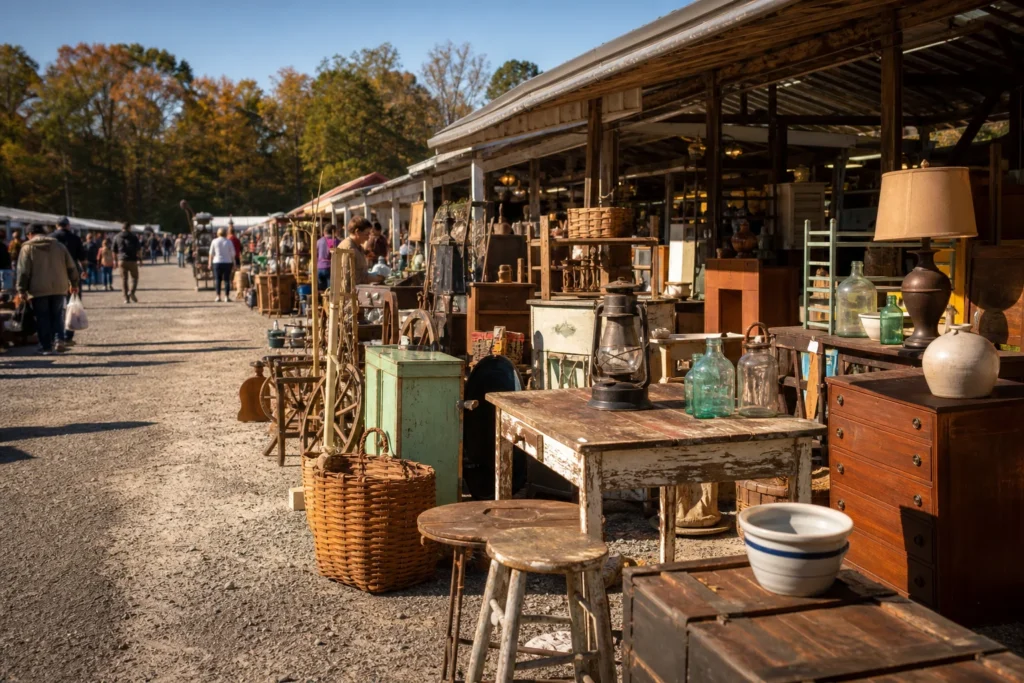
At its peak, this was a venue defined by sheer scale. Spread across 100 acres with roughly 67,000 square feet of indoor space dedicated to vintage goods, antiques and collectibles, the Virginia Bazaar operated at a size that set it apart from most markets in the region. That footprint was not incidental — it shaped everything about how a visit unfolded. Shoppers could spend hours moving through the space without doubling back, and the sense of discovery rarely let up.
The merchandise ranged widely, and that breadth was one of the market's practical strengths. At the core sat the antique and collectible dealers: vintage clothing, china, kitchenware, ornaments, records, musical instruments and artwork all found a home here. A separate gravitational pull came from the furniture stalls, where indoor and outdoor pieces filled the floor in a way that suited everyone from decorators to casual browsers. Beyond the collectibles, outdoor vendors sold fresh produce, which gave the market a secondary character — part flea market, part farmers' market — that made it more useful and more varied than a purely vintage operation.
The vendor community gave the market much of its personality. Many of the regular sellers had spent years curating their tables and knew their stock with genuine depth. A conversation with the right dealer could establish the provenance of a piece — its previous owners, its region of origin, its approximate age — far more reliably than a label ever could. For collectors trying to date or authenticate a find, that embedded expertise was often the most useful thing the market had to offer. Alongside those long-standing regulars, new sellers rotated through each weekend, which kept the floor feeling fresh even for habitual visitors. The combination of deep knowledge and constant turnover made repeat visits consistently worthwhile.
A central food court meant that hunger did not force anyone off-site. For a venue of this scale, that was a practical necessity as much as a convenience. Visitors could eat, rest and return to the floor without losing momentum or losing their place in a promising section. The size of the site also meant that crowds spread out naturally. Even on busy weekends, the pace tended to stay unhurried, and the atmosphere leaned relaxed rather than pressured.
What the Virginia Bazaar represented in the wider Virginia flea market landscape was a large-format venue where scale and substance reinforced each other. Many markets of comparable size traded on quantity alone. This one paired its enormous footprint with a vendor community that rewarded engagement, a merchandise range broad enough to appeal across collector types, and a layout that made full-day visits genuinely sustainable. That combination placed it in a specific and relatively rare category among American weekend markets — one where size was not a compromise but a genuine feature of the experience.
Frequently Asked Questions
Q: What kind of goods did the Virginia Bazaar specialise in?
A: The market was strongest in antiques and collectibles — vintage clothing, china, kitchenware, records, musical instruments and artwork formed the core. A large furniture section covered both indoor and outdoor pieces, and outdoor vendors added fresh produce, giving the site a farmers'-market dimension alongside its vintage character.
Q: How large was the Virginia Bazaar compared to other Virginia flea markets?
A: It was among the largest in the region. The site covered 100 acres, with around 67,000 square feet of indoor space dedicated to vintage goods and antiques — a footprint that set it apart from most comparable markets and made a full-day visit genuinely necessary to cover the floor.
Q: Was the vendor knowledge useful for collectors trying to authenticate pieces?
A: It was one of the market's most valued practical features. Many long-standing regulars had spent years with their stock and could speak to a piece's provenance, previous owners and approximate age — often more reliably than any label. For collectors trying to date or verify a find, a conversation with the right dealer was frequently the most useful tool available.
Q: Is the Virginia Bazaar still open?
A: The Virginia Bazaar is permanently closed. It is retained here as an editorial archive record of the venue and its character.
Marketplace Highlights







Add a review