

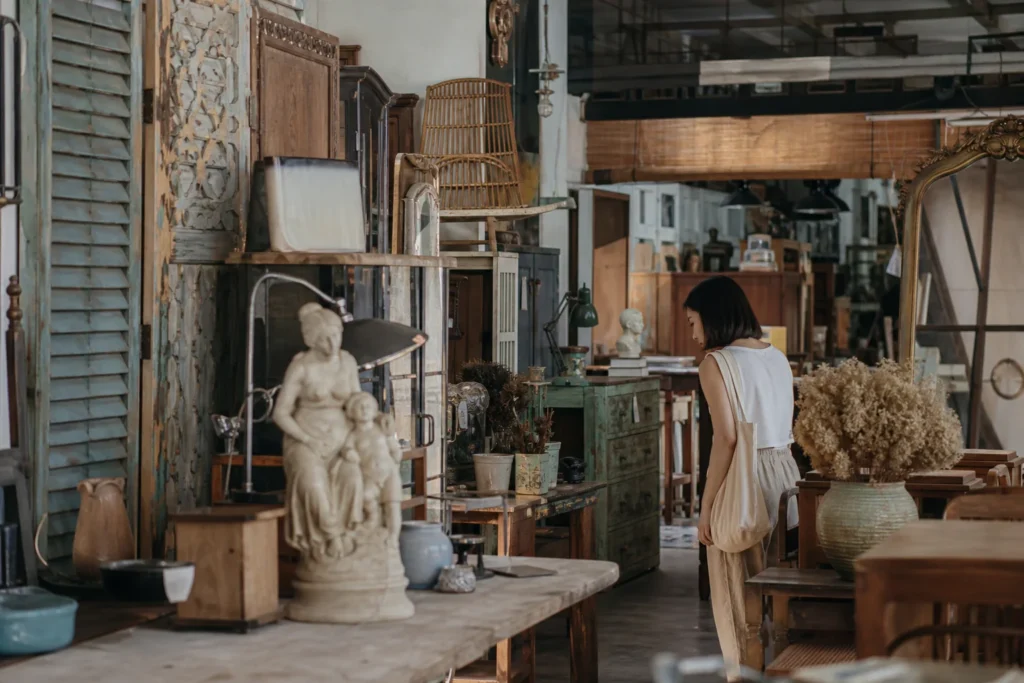

Things Your Mother Throw is permanently closed. The market is retained as an editorial archive of the venue and its distinctive character.
Things Your Mother Throw occupied a singular position in Singapore's vintage and antique design scene. It was founded as a creative collaboration between Studio Shermano and Envelope Architects, a practice known for bespoke residential design. From the outset, TYMT positioned itself not as a conventional dealer in old objects, but as a research laboratory — a space where past domestic cultures were studied, salvaged and given renewed purpose.
The shop's name carried its own quiet manifesto. Its founder described it as a tribute to the mothers who cleared homes to keep order, and to the fathers who quietly hoarded things in corners where children could hide. The phrase also winked at Singlish grammar, Singapore's richly layered vernacular English, and that tone carried through everything TYMT did — warm, knowing and rooted in ordinary domestic life rather than grand historical claims.
The design influences at TYMT reached across a wide arc of Southeast Asian history. British and Dutch furniture traditions from the colonial period in the Nusantara region sat alongside objects shaped by indigenous and migrant communities across the broader archipelago. The result was a collection that traced how ordinary people actually lived — the chairs they pulled up to the table, the sideboards they kept in the hall — rather than the furniture of elites or institutions. Salvaged and restored pieces anchored the collection. Handmade ceramic tiles in period colourways added colour and texture. Bespoke services extended the offer to clients who wanted a specific object or finish rather than whatever happened to be on the floor.
Spending time at TYMT felt closer to visiting a considered design studio than browsing a market stall. The architectural background of its founders shaped how objects were selected and arranged. Restored pieces were presented as arguments for continuity — evidence that the design instincts of the colonial and post-war mid-twentieth century still had something to offer contemporary interiors. There was nothing hurried or transactional about the atmosphere. Collectors, interior designers sourcing authentic period references and homeowners seeking restoration advice all found something useful there.
What distinguished TYMT most lastingly was the seriousness it brought to the concept of upcycling. The word had become fashionable, but TYMT applied it with genuine scholarly intent — tracing the lived experience of ordinary Southeast Asians through the furniture they sat on, the tiles beneath their feet and the domestic objects that shaped their daily routines. In doing so, it built a small but meaningful archive of material memory, connecting mid-century households to contemporary homes in Singapore and beyond.
Frequently Asked Questions
Q: What kind of shop was Things Your Mother Throw?
A: Rather than a conventional antiques dealer, Things Your Mother Throw operated as a creative and research laboratory — co-founded by Studio Shermano and Envelope Architects — where salvaged vintage and antique objects were studied, restored and presented as design arguments for contemporary interiors.
Q: What was the focus of the collection?
A: The collection centred on restored furniture shaped by British and Dutch colonial traditions in the Nusantara region, alongside influences from indigenous and migrant communities across Southeast Asia. Handmade ceramic tiles in period colourways and bespoke restoration services rounded out the offer.
Q: Who typically visited Things Your Mother Throw?
A: The shop attracted collectors of colonial and post-war mid-century pieces, interior designers sourcing authentic period references, and homeowners seeking bespoke restoration advice — all drawn by the considered, unhurried atmosphere that felt closer to a design studio than a market stall.
Q: Is Things Your Mother Throw still open?
A: Things Your Mother Throw is permanently closed. The market is retained as an editorial archive of the venue and its place in Singapore's vintage and antique design scene.
Marketplace Highlights










Add a review