

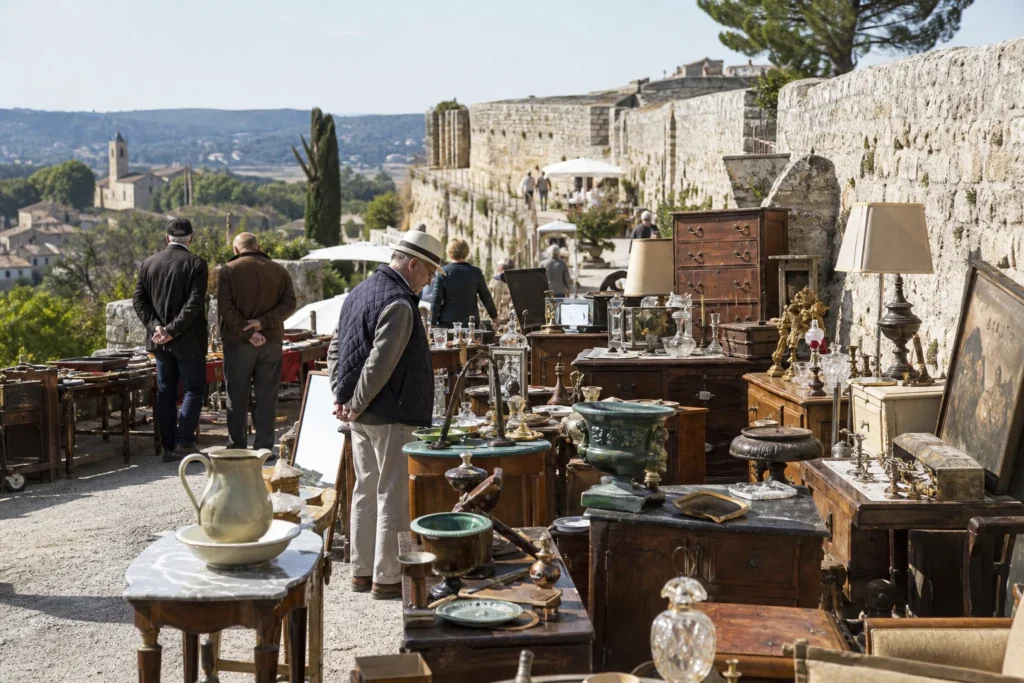

Every Saturday morning, stalls begin filling the square beside Fort St André from 08:00, and by the time most visitors arrive the dealers are already deep in conversation over a piece of faïence or a length of carved oak. The market runs until 14:00, which means six hours of browsing against one of the most dramatic backdrops in the Provence-Languedoc region. The medieval fortress rises above the whole scene, its towers giving the gathering a weight and theatricality that a warehouse venue simply cannot match.
This is not a casual jumble. Professional exhibitors know their stock and present it accordingly. The range spans decorative ceramics and faïence, cut crystal, glassware, silver and vintage toys. A second current of material runs deeper into regional life: wine barrels, barrel-making tools and Provençal rural artefacts that speak directly to the agricultural character of the Rhône valley. Furniture appears too, from small decorative finds to larger pieces that will demand some planning to transport home.
The market draws serious buyers from across Europe. Dealers travel from Spain, Italy, Belgium, Germany and Great Britain to source here, and collectors from further afield make the journey as well. That cross-border interest is a reliable quality signal. Prices are fair but rarely collapse without good reason, and vendors who know their customers expect to negotiate. Arrive early for the widest selection. As the market winds towards 14:00, sellers grow noticeably more flexible at the prospect of packing everything back up — both strategies have genuine merit depending on what you are after.
Twice a year, the setting hosts Brocante Passion, a dedicated specialist show that brings a more curated group of exhibitors to the same site in May and October. It has a tighter editorial character than the weekly Saturday market and attracts collectors who plan specifically around it. If your interests run to fine ceramics, regional antiques or high-quality decorative objects, it is worth building a trip around one of these dates.
November mornings here can be sharp when the Mistral arrives from the north. The most committed dealers still appear well before dawn, working through fresh stock before the public enters. Even outside the colder months, the six-hour window rewards early commitment — there is no substitute for arriving close to 08:00 if you are sourcing seriously.
Language is not a significant barrier. Most vendors are accustomed to international visitors and find ways to communicate. A few words of French help the atmosphere, but limited French should not put anyone off coming.
The town itself holds the day together. Cobblestone lanes, the views from the fort's upper ramparts, and the option of a long lunch beneath chestnut trees make a convincing case for staying well past the market's 14:00 close. Villeneuve-lès-Avignon sits just across the Rhône from Avignon and the two towns connect naturally into a full southern itinerary. The closest bus access is the Office de Tourisme stop, approximately 32 metres from the market, served by local bus routes. Most visitors arrive by car or cross from Avignon, which remains the practical hub for the wider area.
This market suits serious collectors and professional sourcers first. It also rewards the culturally curious traveller who wants a genuine regional experience rather than a tourist-facing imitation of one.
Frequently Asked Questions
Q: Is this a casual car-boot sale or a professional antiques market?
A: It is a professional brocante. Exhibitors are vetted dealers who bring genuine stock, and the market regularly draws serious buyers from across Europe and the United States. Expect real antiques and collectibles, not a general jumble.
Q: What kinds of goods can I expect to find?
A: The stock mix is broad and rooted in the region — antique pottery, faïence and ceramics, cut crystal and glassware, silver, toys, kitchenware, wine barrels and barrel-making tools, and furniture ranging from small decorative pieces to larger statement items.
Q: Is bargaining acceptable, and when is the best time to negotiate?
A: Bargaining is accepted and expected, but steep discounts are unlikely early in the day when fresh stock is still moving. Vendors tend to become noticeably more flexible toward the end of the market, when packing up focuses minds.
Q: Do I need to speak French to shop here?
A: Not fluently. Most vendors are accustomed to international visitors and will find ways to communicate. A few words of French are appreciated but limited language skills are not a barrier.
Q: What is Brocante Passion, and how does it differ from the weekly market?
A: Brocante Passion is a bi-annual antique show held twice a year at the same Fort St André setting. It draws a concentrated group of specialist exhibitors and has a tighter curatorial feel than the weekly brocante. Check the organizer's official page for current dates before planning your visit.








Charlotte Patterson
5th June 2015 at 19:45It’s been several years since we first visited this market, and it seems like there was more stuff back then, but it is still a fun agglomeration of French antiques and junk. Prices have gone up some in the last 20 years, though.
Nick Hamilton
8th August 2015 at 05:57We had visited the marché à la brocante a couple of years ago and remembered it as having a lot of original and high quality items. This time it seemed much more car boot cum flea market and even with the favorable euro/sterling exchange rate, there seemed to be very few bargains on offer. However, it made for a fun hour of perusing and there were still some things for sale you would not get at home in the UK.
Francis Hart
1st March 2016 at 20:30We visited the Brocante de Villeneuve-lès-Avignon last week. It is in a very handy location with easy parking. The items displayed of wide variety as expected. There was a lot of furniture, jewellery. We found some silver but not a lot there’s was some porcelain too. The prices were on the high side but I felt the quality was just average. I bought a French book about lavender I did not haggle and paid him the asking price.
Jean-Marc Génin
12th May 2016 at 17:12Ce marché est vraiment riche car on y trouve des objets et meubles de toutes époques et styles, A partir de Napoléon III. De plus les brocanteurs y pratiquent des tarifs convenables, et sont plutôt dans leur ensemble, sympathiques! Sur place on peut aussi déguster des huîtres à “la bonne franquette” pour un prix raisonnable! Somme toute, une brocante sympa avec une belle ambiance.