

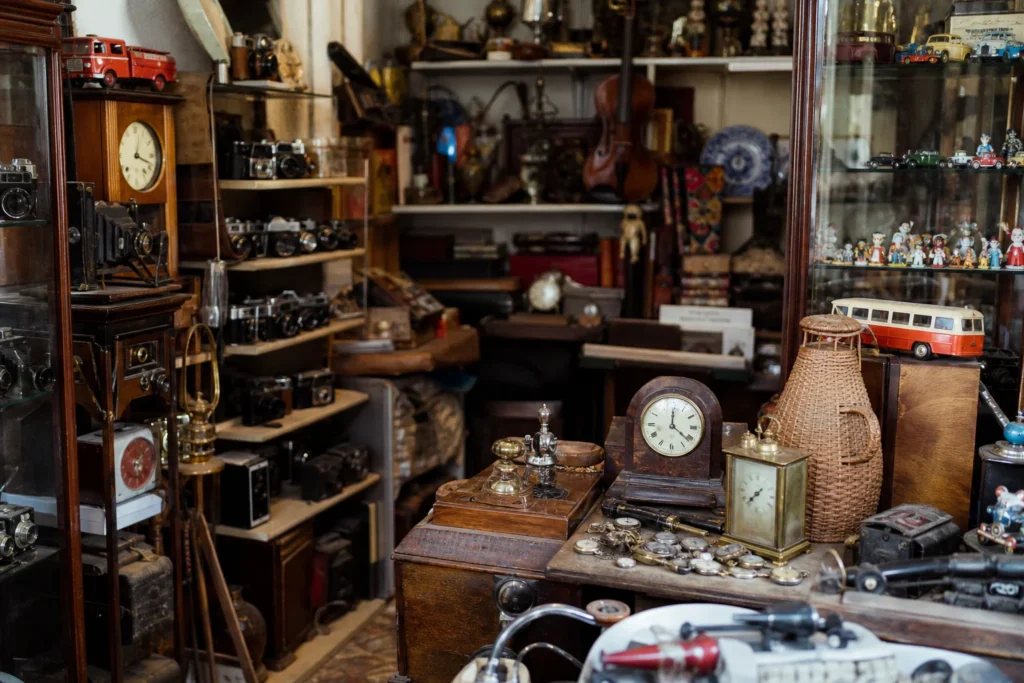

On Klauzál utca in Budapest's seventh district, a roughly seventy-square-metre room holds more objects than it probably should. Shelves lean under the weight of curios. Stacks press against the walls. Every surface holds something that demands a second look. This is Antik Bazar — a personal, densely packed antique shop where the inventory feels genuinely accumulated rather than arranged for effect.
The physical experience of browsing here is part of the point. Objects crowd into corners and pile on top of each other with a cheerful disregard for display logic. That slight sense of precariousness is not a flaw. It creates exactly the tension that keeps dedicated browsers moving slowly through the room, unsure what the next shelf might reveal. The shop rewards patience in a way that tidier, more curated spaces rarely do.
The inventory draws from decades of Hungarian domestic and cultural life. Mechanical and technological objects — vintage radios, ornate clocks, film cameras — sit alongside decorative and household pieces: framed artwork, glassware, ceramic vases, and old lighting fixtures. Personal history surfaces in medals and hat stands. Everyday vintage life fills the gaps: cutlery, old coffee presses, wind-up toys. These are not generic vintage props. They carry the specific texture of Central European households across the mid-twentieth century. The stock rotates as the owner acquires new pieces, so a second visit rarely feels identical to the first.
One practical advantage sets Antik Bazar apart from many comparable shops: nearly every item carries a visible price label. Browsers can move at their own pace without tracking down assistance for basic information. Prices are not always fixed, though. Negotiation is normal, and the owner engages with it willingly. Visitors who do not speak Hungarian report that clear enthusiasm and a phone translation app carry the conversation well enough.
The shop opens on weekday afternoons, Monday through Friday from 14:00 to 18:00, and closes at weekends. That schedule suits a city-break itinerary well — mornings free for the city's galleries or markets, afternoons reserved for an unhurried hour on Klauzál utca. It rewards planning rather than impulse. The best-fit visitors include collectors hunting Hungarian-made objects with genuine provenance, travellers who want souvenirs that carry real stories rather than mass-produced charm, and anyone who finds genuine pleasure in unhurried, layered spaces.
Budapest has plenty of antique dealers, but Antik Bazar occupies a particular niche. The owner's own collecting instincts shape the inventory visibly. That gives the shop a coherent character even amid the apparent disorder — something larger antique centres and multi-dealer spaces rarely manage to replicate. It functions as a dedicated stop, not a casual detour.
For access, Blaha Lujza tér M (Dohány utca) sits approximately 70 metres away, making it one of the most conveniently located antique shops in the district. Metro line M2 serves the stop directly, and trams 4 and 6 also run there. Visitors arriving from the south can use Rákóczi square, served by metro line M4, approximately 500 metres away. Astoria on metro line M2 offers another straightforward option at a similar distance.
Frequently Asked Questions
Q: When is Antik Bazar open?
A: The shop opens on weekday afternoons, Monday through Friday from 14:00 to 18:00, and is closed at weekends. It is worth confirming current hours before making a dedicated trip, as schedules can change.
Q: Are prices fixed, or is negotiation expected?
A: Nearly every item carries a visible price label, so you can browse without needing to ask. Those prices are not always firm, though — negotiation is normal and the owner engages with it willingly.
Q: What kind of objects does Antik Bazar typically stock?
A: The inventory draws from Hungarian domestic and cultural life across the mid-twentieth century: vintage radios, film cameras, ornate clocks, glassware, ceramics, lighting fixtures, framed artwork, medals, and everyday objects like old coffee presses and wind-up toys. Stock rotates as the owner acquires new pieces, so a return visit rarely feels identical.
Q: Do I need to speak Hungarian to shop here?
A: Not necessarily. Visitors who don't speak Hungarian report that clear enthusiasm and a phone translation app carry most conversations well enough.
Marketplace Highlights








Add a review