

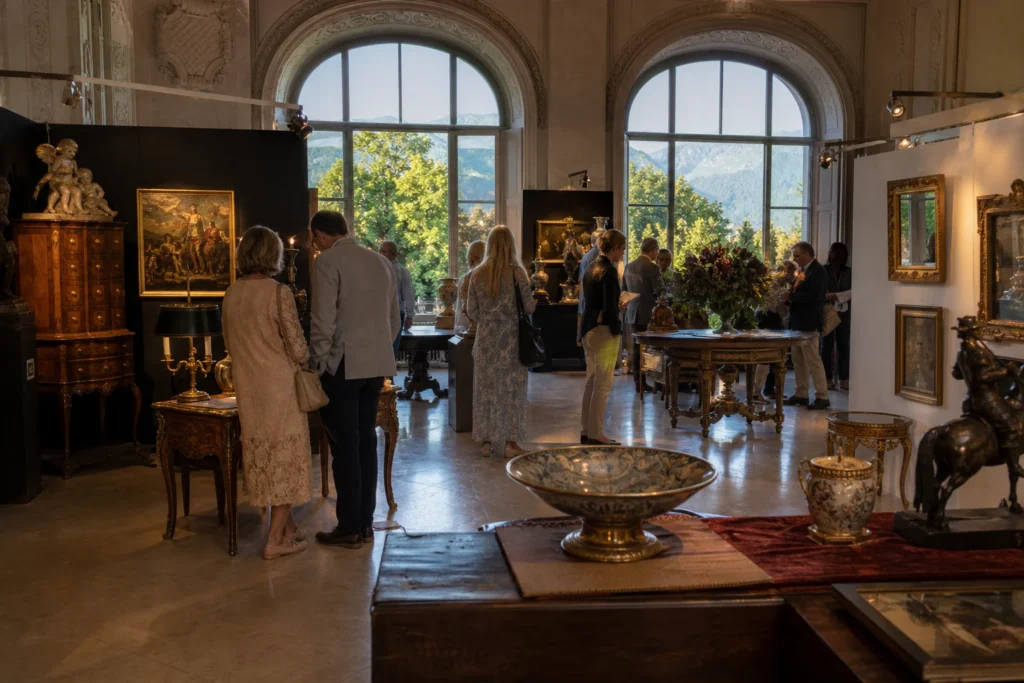

At Residenzplatz 1 in the centre of Salzburg, the Residenz zu Salzburg sets an immediate and unambiguous tone. This is one of the city's great baroque palace complexes, and it serves as the permanent home of Art & Antique Salzburg — an annual fair that runs for nine days each summer, opening its doors daily from 11:00 to 19:00. Few events in the central European art calendar can match its combination of setting and editorial discipline.
The fair operates on a deliberately tight model. Around twelve galleries earn a place each year, selected from Austria and beyond on the strength of what they bring to the floor. That controlled scale is a feature, not a limitation. It keeps quality consistent across every stand, and it means visitors can move through the entire fair in a single visit without a sense of having skimmed the surface. Everything here has been judged against a high standard before it arrives.
The works on show fall into two loose registers. The first is historical and material: Old Masters, antique furniture, fine jewellery, monumental sculpture, ceramics and graphic art. These pieces are the backbone of the fair. The second register is more decorative and transitional — art deco objects, photographs, and a measured selection of contemporary works that sit in conversation with the older material. Each gallery tends to present with the same care you would expect in a permanent museum collection. The overall floor has a consistent, unhurried register that suits the setting well.
That unhurried quality shapes how visitors move through the Residenz. The palace architecture does something to the pace. Visitors slow down, look more carefully, and engage with individual objects rather than covering ground. Rooms that frame baroque ceilings and parquet floors are not neutral containers — they add weight and occasion to whatever is placed inside them. The fair is aware of this, and the curation makes use of it.
The audience tends to reflect the fair's positioning. Dealers and collectors with specific briefs attend alongside curators acquiring on behalf of institutions. First-time visitors to this kind of event also find the fair approachable, partly because its compact footprint removes the pressure to navigate something vast. There is no overwhelming scale here, only depth.
Collectors building a central European itinerary should note that the organisers run a partner fair in Vienna during winter. Art & Antique Vienna operates along comparable lines, offering gallery-quality antiques and art in another strong architectural context. Together, the two fairs form a coherent circuit for anyone serious about this corner of the market. Salzburg itself remains the more atmospheric of the two settings — the Residenz in summer is hard to rival.
Getting to Residenzplatz is straightforward by public transport. The Rathaus bus stop sits approximately 230 metres away and is served by a dense cluster of city and regional bus lines including routes 17, 25, 27, 28, 120, 160, 170, 175, 270 and 840. The Festungsbahn Talstation, the funicular and train interchange at the base of Hohensalzburg fortress, lies roughly 220 metres from the venue and provides a convenient landmark for visitors arriving on foot from the old town. For those travelling regionally, the Salzburg Mülln-Altstadt S-Bahn station is approximately 1.4 kilometres away and connects via services including S2, S3, REX2 and REX21, making Art & Antique Salzburg reachable from across the wider region without a car.
Frequently Asked Questions
Q: When does Art & Antique Salzburg take place, and what are the opening hours?
A: The fair runs for nine days each summer at the Residenz zu Salzburg on Residenzplatz, opening daily from 11:00 to 19:00. Check the organiser's official page before you go to confirm the exact dates for the current year.
Q: How many galleries exhibit, and what kinds of works can visitors expect to find?
A: Around twelve galleries exhibit each year, drawn from Austria and beyond. The range spans Old Masters, antique furniture, fine jewellery, sculpture, ceramics and graphic art alongside a more decorative thread of art deco objects, photographs and a measured selection of contemporary works.
Q: Is the fair worth attending if you are new to buying antiques or art?
A: Yes. The compact footprint — roughly twelve galleries across the Residenz rooms — means first-time visitors can move through the entire fair comfortably in a single visit. The concentrated scale removes the pressure of navigating something vast, and the palace setting encourages a slower, more attentive pace.
Q: Does the organiser run any other comparable events for collectors on a broader itinerary?
A: A partner fair, Art & Antique Vienna, operates along comparable lines during winter, offering gallery-quality antiques and art in another strong architectural setting. The two fairs form a natural circuit for collectors serious about this corner of the central European market.
Marketplace Highlights








Add a review