

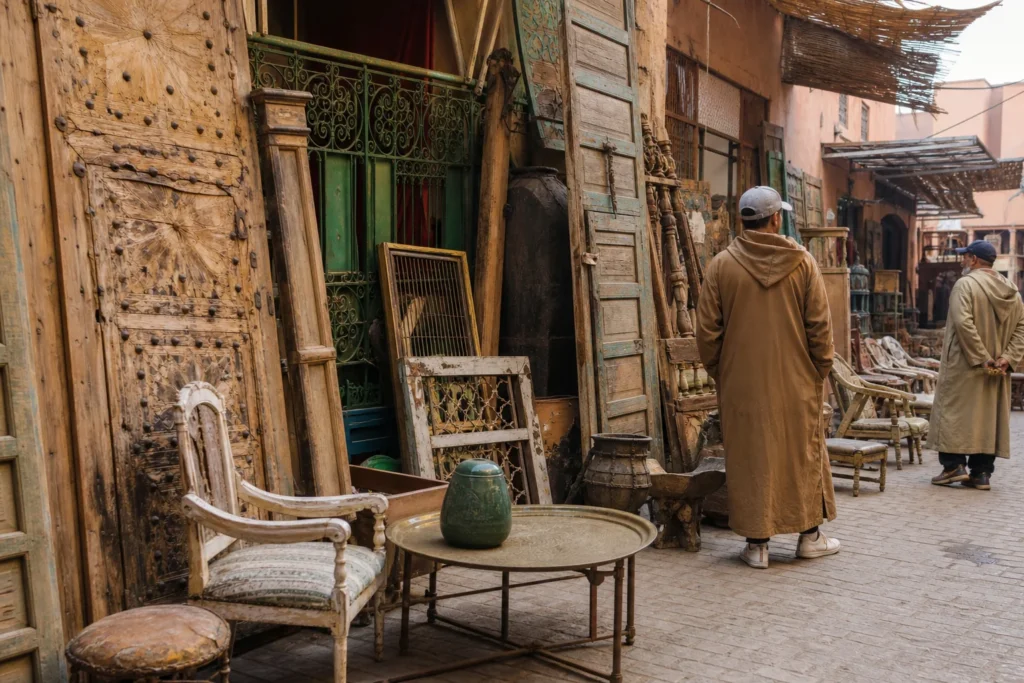

Somewhere north of the medina's main tourist drag, past the pink 12th-century ramparts, a city gate opens onto one of Marrakech's most distinctive antique markets. Bab el-Khemis — "Thursday's Door" in Arabic — sits on the northern edge of the old medina wall, and the souk that surrounds it has been drawing collectors, traders and architectural salvage hunters for generations. It feels little like the polished carpet shops and curated craft stalls closer to Jemaa el-Fna. This is a working market, dusty and purposeful, with specialist dealers who know exactly what they have.
The doors are the reason most collectors come. Bab el-Khemis holds what is probably the most concentrated collection of antique Moroccan doors anywhere in the country. Studded entrance doors and palatial brass gates lean against walls at one end of the market. Further in, carved wooden interior panels, mashrabiya screens and glazed double courtyard doors wait alongside rustic Berber pieces worn smooth by decades of use. Morocco's deep craft heritage makes the range extraordinary — no two doors carry the same history, and the ironwork alone rewards a slow look. Knockers, bolts and decorative handles fill entire stalls, each piece stripped from a riad, a hammam or a rural farmhouse.
The market's offer stretches well beyond architectural salvage. Bab el-Khemis delivers one of Marrakech's best concentrations of vintage and antique furniture, much of it French colonial and Art Deco in character. Lloyd-loom chairs, old sewing machines, exquisitely painted tables and window grilles compete for floor space with vintage mopeds, bicycles and rolls of antique carpets. Decorative arches, old kitchen sinks and ornate bathroom fittings turn up regularly. Serious shoppers circle back more than once.
Prices here are more honest than in the central souks, but Marrakech's haggling culture is fully intact. Dealers expect negotiation and reward persistence with genuinely fair deals. The specialist concentration means you can compare similar pieces across several stalls before committing. Interior designers sourcing for restoration projects treat the market as a first stop rather than a last resort.
The market opens six days a week — Monday through Thursday, then Saturday and Sunday, from 10:00 until 19:00. It closes on Fridays, in keeping with Morocco's traditional holy day rhythm. That six-day window makes a weekday visit perfectly practical for anyone spending more than a weekend in Marrakech.
Getting there takes a little effort, which partly explains why the crowds stay manageable. A taxi from central Marrakech or from Jemaa el-Fna is the most common approach for visitors. By bus, the Loada saidia stop is approximately 600 metres away, served by bus lines L7 and L9. An alternative stop, Dar dbagh, sits at a similar distance and also carries lines L7 and L9. Douar Fkhera is roughly 700 metres away for bus line L2. The slight remove from the tourist centre is precisely what keeps the market's character intact — it runs on local expertise and repeat trade rather than footfall.
Frequently Asked Questions
Q: What is Bab el-Khemis best known for, and is it worth the trip from central Marrakech?
A: It holds what is likely the most concentrated collection of antique Moroccan doors in the country — studded entrance doors, palatial brass gates, mashrabiya screens and rustic Berber pieces — alongside Art Deco furniture, vintage mopeds, antique carpets and decorative ironwork. Interior designers and serious collectors treat it as a first stop. The journey north from Jemaa el-Fna takes effort, which is exactly why the crowds stay manageable.
Q: When is Bab el-Khemis open, and which day should I avoid?
A: The market runs Monday through Thursday and Saturday through Sunday, 10:00 to 19:00. It closes on Fridays in keeping with Morocco's traditional holy day. A weekday visit works well for anyone spending more than a long weekend in Marrakech.
Q: How do I get there without a car?
A: A taxi from Jemaa el-Fna or central Marrakech is the most practical option for visitors. If you prefer the bus, the Loada saidia stop — served by lines L7 and L9 — is approximately 600 metres from the market.
Q: Are prices here better than in the central souks, and do I still need to haggle?
A: Prices are generally more honest than in the tourist-heavy souks closer to Jemaa el-Fna, and the concentration of specialist dealers lets you compare similar pieces across several stalls before committing. Haggling remains fully expected — dealers here know their stock well and reward genuine negotiation with fair deals.
Q: Is this suitable for visitors who are not serious collectors, or is it mainly a trade market?
A: Both audiences find it rewarding. Trade buyers and restoration specialists source architectural salvage here, but casual visitors browse freely. The knockers, bolts and decorative handles alone fill entire stalls and make accessible, easy-to-carry finds. The atmosphere is purposeful rather than performative — closer to a working market than a curated craft experience.
Marketplace Highlights








Add a review