

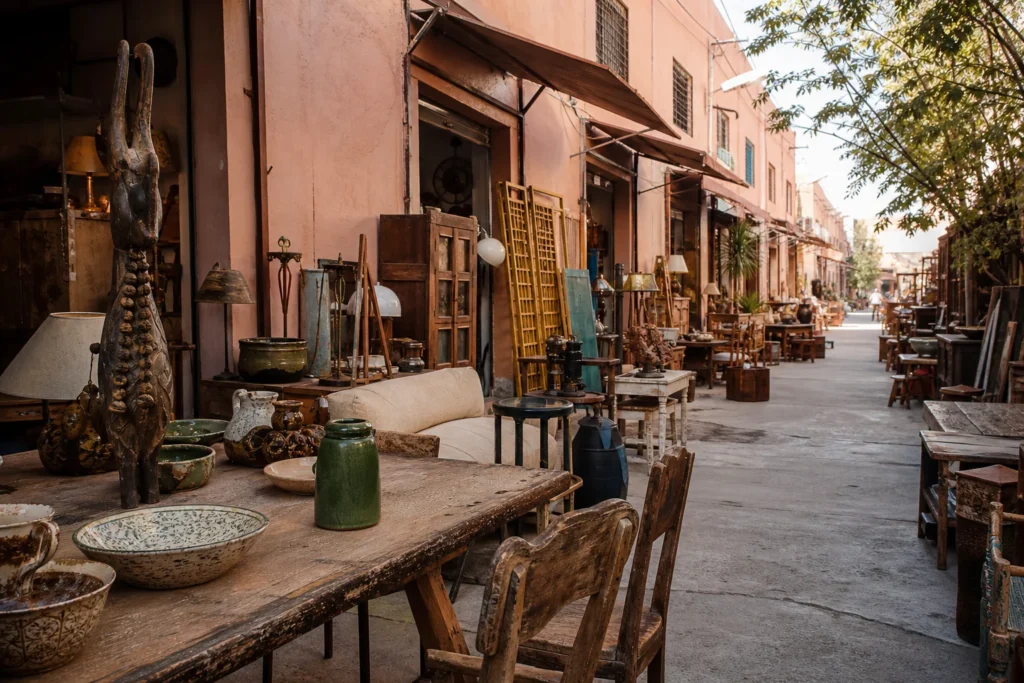
A 19th-century cast-iron garden bench sits beside a 1920s radio. A butterfly box rests on a school desk from the same era. This is the kind of scene that greets you inside Le Magasin Général, and it sets the tone for Sidi Ghanem's antique shops as a whole. The district opens Monday to Saturday, 08:30 to 18:30, and stays closed on Sundays.
Sidi Ghanem occupies what was once a plain industrial zone on the outskirts of Marrakech. Converted warehouses now hold showrooms, working studios and restoration ateliers. Prices are fixed, credit cards are widely accepted, and nobody pressures you to buy. The atmosphere feels closer to an European antique quarter than to the medina souqs.
Le Magasin Général, curated by Delphine Mottet, delivers the district's most theatrical browsing experience. Thonet armchairs face XXL Chesterfields. Art Deco desk lamps illuminate Gatti-style rattan chairs and period herbariums. The inventory shifts constantly, and a single visit rarely exhausts it. Nearby, Vintage Deco Marrakech takes a more disciplined approach: the shop sources antique furniture and decorative objects from local flea markets and European brocantes, restores each piece to its original condition, and sells every item with a provenance story. It also offers a home clearance service for those managing larger transitions.
Marrakech Antiquités occupies one of the district's largest showrooms, specialising in European and Asian works of art spanning the 16th to the 19th centuries. The scale rewards repeat visits. Atelier Balagan narrows the focus to 20th-century design, presenting mid-century modern and 1970s furniture, lighting and accessories with a clarity that suits both collectors and interior decorators hunting for statement pieces.
Two studios bring a maker's perspective to the district. Atelier Landon, founded by Laurence Landon, produces brass and ironwork by master craftsmen drawing on natural forms and the geometric language of designers such as Victor Vasarely and Frank Lloyd Wright. The pieces feel built to outlast trend cycles. Kader Oudania handcrafts lighting using traditional tools and machinery from the 1950s, repurposing vintage fixture elements into new lamps. His workshop blurs the line between repair culture and original design. Studio Lid and RetroPlus round out the offer: the former selects vintage and contemporary pieces for collectors and interior professionals, while the latter focuses on 20th-century designer furniture at accessible price points.
Sidi Ghanem works because serious operators cluster tightly enough to walk between them. A brocante-sourced restoration specialist, a colonial curiosity showroom, a fine art gallery and a mid-century lighting studio can all be visited in an afternoon. The fixed-price culture is the other key difference. Visitors expecting souq negotiation will find something closer to a gallery dynamic instead — which suits collectors and interior professionals who want to browse without the theatre.
The district is closest to the Centre police 13eme bus stop, approximately 150 metres away, served by bus lines L44 and L441. Bus line L441 also stops at Mosque Massar, roughly 350 metres from the district. Visitors arriving by rail can reach Sidi Ghanem from Marrakech station on the Al Atlas train line, approximately 5.8 km away; a taxi or onward bus covers the remaining distance. This combination of local bus access and rail connectivity makes the district straightforward to reach from most parts of the city.
Frequently Asked Questions
Q: How does shopping at Sidi Ghanem differ from buying antiques in the medina souqs?
A: Prices are fixed rather than negotiated, credit cards are widely accepted across the showrooms, and nobody pressures you to buy. The atmosphere is closer to a European antique quarter — browsing at your own pace through converted warehouse spaces without the hustle of the souqs.
Q: What days and hours are the Sidi Ghanem antique shops open?
A: The district operates Monday to Saturday, 08:30 to 18:30, and is closed on Sundays. Confirm individual shop hours directly before visiting, as studios and smaller ateliers may keep their own schedules.
Q: What periods and styles are best represented across the district's antique shops?
A: The range is unusually broad. Marrakech Antiquités covers European and Asian works of art from the 16th to the 19th centuries. Atelier Balagan focuses on mid-century modern and 1970s pieces. Le Magasin Général pulls together colonial-era curiosities — Thonet armchairs, Art Deco lamps, 1920s radios — while Vintage Deco Marrakech sources and restores brocante finds from local flea markets and European dealers.
Q: Is Sidi Ghanem worth visiting if I want handmade or studio pieces rather than antiques?
A: Yes. Working studios sit alongside the antique showrooms. Atelier Landon produces brass and ironwork by master craftsmen, and Kader Oudania handcrafts lighting using 1950s tools and repurposed vintage fixture elements. Studio Lid and RetroPlus cover contemporary design and 20th-century designer furniture, so the district rewards visitors who are not exclusively hunting period antiques.
Q: Can I realistically cover several shops in a single visit?
A: The district is compact enough that serious operators are within walking distance of each other. A half-day gives you time to move between a restoration specialist, a colonial curiosity showroom, a fine art gallery and a mid-century studio without rushing. Larger spaces like Marrakech Antiquités genuinely reward a second visit given the depth of their inventory.
Marketplace Highlights








Add a review