

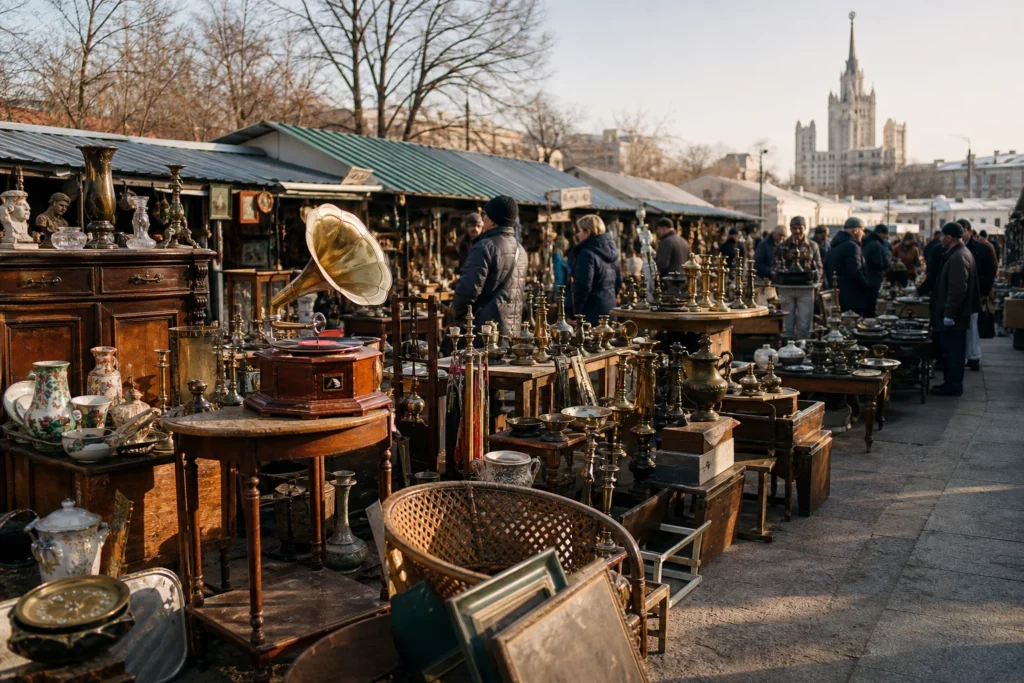

Five times a year, Bloshiny Rynok takes over Tishinskaya Square in Moscow and transforms it into one of the city's most serious antique markets. The format is a four-day run each time — Thursday through Sunday, 11:00 to 20:00 — held in March, May, September, October and December. That rhythm is not a limitation. It concentrates dealers who mean business and buyers who have planned their visit. The periodic schedule shapes everything about the experience.
Pre-revolutionary Russian material is what sets this market apart from the city's other secondhand venues. Vendors bring out chinaware, decorative fans, jewellery boxes, ornate teapots and furniture that predate the Soviet period entirely. These are not reproduction pieces or items produced for the tourist trade. Many pass through the hands of knowledgeable dealers who understand their provenance and can speak to it in detail. The density of genuine antiques on a single open site is rare by any standard.
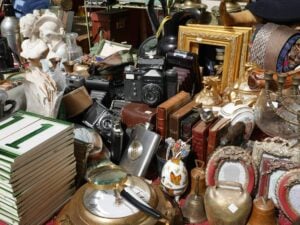
Soviet-era objects fill out the stalls alongside the older material. Cameras, binoculars, tools and domestic items from across the twentieth century appear in quantity and variety. The layout tends toward the dense and jumbled rather than the neatly arranged. That is exactly how the market works best. Digging through a packed stall is where unexpected finds surface. Some vendors play records on old gramophones, and certain corners of the square feel closer to a living archive than a conventional market. The unpredictability is the point.
A working knowledge of Russian helps more here than at most Moscow markets. Dealers carry detailed knowledge about their stock and share it freely when a conversation opens. Non-Russian speakers can browse and buy without difficulty — gestures and patience serve well enough — but even a few words unlock provenance discussions that change the visit entirely. Context matters with objects of this age, and the vendors are often the most reliable source for it. The market draws specialists hunting within a defined category and general enthusiasts willing to let the stalls decide. Jewellery, glassware, photographic equipment and period decorative objects all appear with regularity. Anyone seriously interested in Russian material culture — pre-revolutionary, Soviet or both — will find this market worth timing a trip around.
Belorusskaya metro station, served by subway lines 2 and 5, sits approximately 700 m from the market and offers the most direct public transport approach. Moscow Belorussky railway station, with a wide range of intercity and regional train services, is roughly 800 m away — a useful option for visitors arriving from elsewhere in Russia. Trams 5 and 7 stop at Белорусский вокзал, also around 800 m distant. The closest transit point is the local bus stop Тишинский рынок, approximately 100 m from the square, though no specific line numbers are recorded for it here. All distances are approximate straight-line distances.
Frequently Asked Questions
Q: How often does Bloshiny Rynok take place, and when does it run each year?
A: The market runs five times a year — in March, May, September, October and December — as a four-day event from Thursday to Sunday, 11:00 to 20:00 each day. Because the schedule changes year to year, check the official Bloshiny Rynok website or venue details at Tishinskaya Square before planning your visit.
Q: What kinds of antiques and collectibles can shoppers expect to find?
A: The strongest draw is pre-revolutionary-era Russian material — chinaware, ornate teapots, decorative fans, jewellery boxes and period furniture. Soviet-era objects fill out the stalls alongside these: cameras, binoculars, tools and domestic items from across the twentieth century. Glassware and photographic equipment also appear with regularity.
Q: Does the market suit buyers who don't speak Russian?
A: Non-Russian speakers can browse and buy without difficulty — gestures and patience go a long way. That said, even a few words of Russian open up provenance conversations with dealers who carry detailed knowledge about their stock, which can meaningfully change what you get from the visit.
Q: How do you get to Bloshiny Rynok by public transport?
A: Belorusskaya metro station, served by lines 2 and 5, is approximately 700 m from the market at Tishinskaya Square and is the most direct approach. Moscow Belorussky railway station is around 800 m away, useful for visitors arriving from elsewhere in Russia.
Marketplace Highlights








Add a review