


The journey itself sets the tone. Board a commuter train at Leningradsky Station, ride roughly 30 kilometres out of Moscow, and watch the city gradually give way to quieter suburban streets. By the time you step off near Novopodrezkovo, the shift is complete — you are well outside the tourist circuit, at a market that operates on entirely different terms from anything near the Kremlin. Levsha Flea Market opens every Saturday and Sunday from 07:00 to 20:00, and the early hours draw the sharpest collectors.
What makes Levsha distinct is who sells here and why. This is not an antique fair with appraised stock and printed price tags. Private individuals bring goods from their own homes — household clearances, inherited collections, objects pulled from attic shelves — and price them to move. That dynamic shapes everything about the atmosphere. Prices tend to run lower than at Moscow's more prominent markets, and the inventory feels genuinely unfiltered.
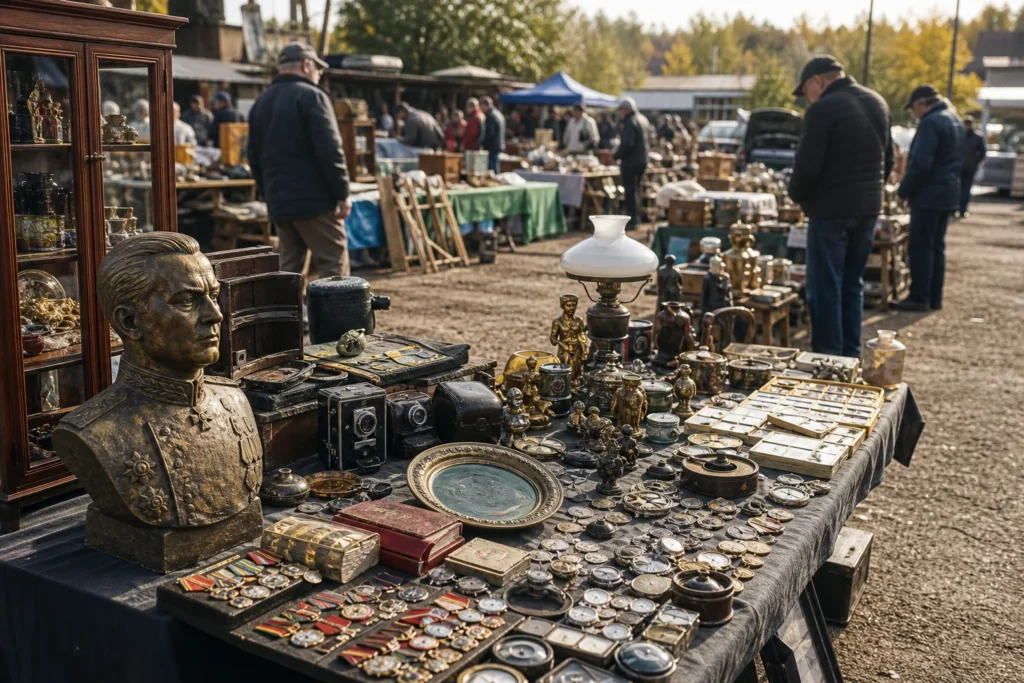
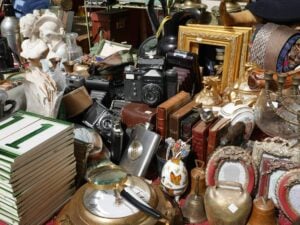
The merchandise skews decisively toward Soviet-era material culture. On the military side, Red Army badges, medals and wartime memorabilia surface regularly. The numismatic tables carry old coins and banknotes spanning several Soviet decades. Personal effects tell their own stories: vintage wristwatches, vinyl records, record players, musical instruments and everyday crockery all appear with frequency. Bronze busts of political figures and painted portraits of Lenin and Stalin add a distinct visual register to the scene. Fake amber jewellery and mass-produced matryoshka dolls are notably absent. The contrast with tourist-oriented markets like Vernisazh at Izmailovo is immediate and sharp.
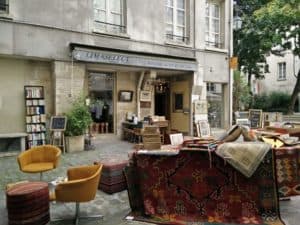
Push deeper into the site and the market becomes even less predictable. An informal ground-level section opens up where sellers spread carpets and arrange whatever they carried in that morning. This is the highest-variance part of the visit. Patience here pays off: genuinely collectable pieces appear among the clutter with satisfying regularity, and the sense of discovery feels unscripted in a way that polished flea markets rarely manage.
A few practical realities shape the visit. Arriving close to the 07:00 opening on a Saturday gives the best chance of finding stronger pieces before other collectors work through the stock. Very few vendors speak English. A Russian-speaking companion transforms the experience; without one, a phone translator becomes an essential tool. Half a day typically covers the full site comfortably.
Novopodrezkovo train station sits approximately 143 metres from the market. It serves the D3 line along with several intercity routes running toward Tver, Klin and other destinations, with trains departing from Leningradsky Station in Moscow. Buses 22 and 1873а stop at Станция МЦД «Новоподрезково», roughly 47 metres away, with a second stop, Верескино, on the same routes around 150 metres out. The station makes the market genuinely easy to reach without a car.
Levsha suits collectors focused on Soviet material culture, bargain hunters willing to dig, and travellers curious about how Russians trade in the objects of their own recent past. It rewards specific intent and a degree of linguistic resourcefulness. Come with both, and the market consistently delivers.
Frequently Asked Questions
Q: When does Levsha Flea Market open, and which day is best to visit?
A: The market runs every Saturday and Sunday from 07:00 to 20:00. Saturday morning, close to the 07:00 opening, gives the best chance of reaching stronger pieces before other collectors have worked through the stock.
Q: How do you get there from central Moscow?
A: Take a commuter train from Leningradsky Station toward Novopodrezkovo — roughly 30 kilometres from the city centre. The D3 line serves the route, and Novopodrezkovo station sits approximately 143 metres from the market entrance. Buses 22 and 1873а also stop nearby.
Q: What kind of items sell here, and is it worth it for Soviet-era collectors?
A: It is one of the more reliable Moscow stops for Soviet-era material. Red Army badges, medals, old coins and banknotes, vintage wristwatches, vinyl records, record players and painted political portraits all appear regularly. Private individuals sell from their own household clearances rather than curated dealer stock, so prices tend to run lower than at more prominent Moscow markets and the inventory feels genuinely unfiltered.
Q: Do vendors speak English?
A: Very few do. A Russian-speaking companion makes the experience considerably smoother. If you are visiting alone, a phone translator becomes an essential practical tool rather than a backup option.
Q: Is half a day enough time to see the whole market?
A: Half a day covers the full site comfortably, including the informal inner section where sellers spread goods on carpets at ground level. That deeper area rewards slower browsing, so budget time there if hunting for the less predictable finds.
Marketplace Highlights








Add a review