

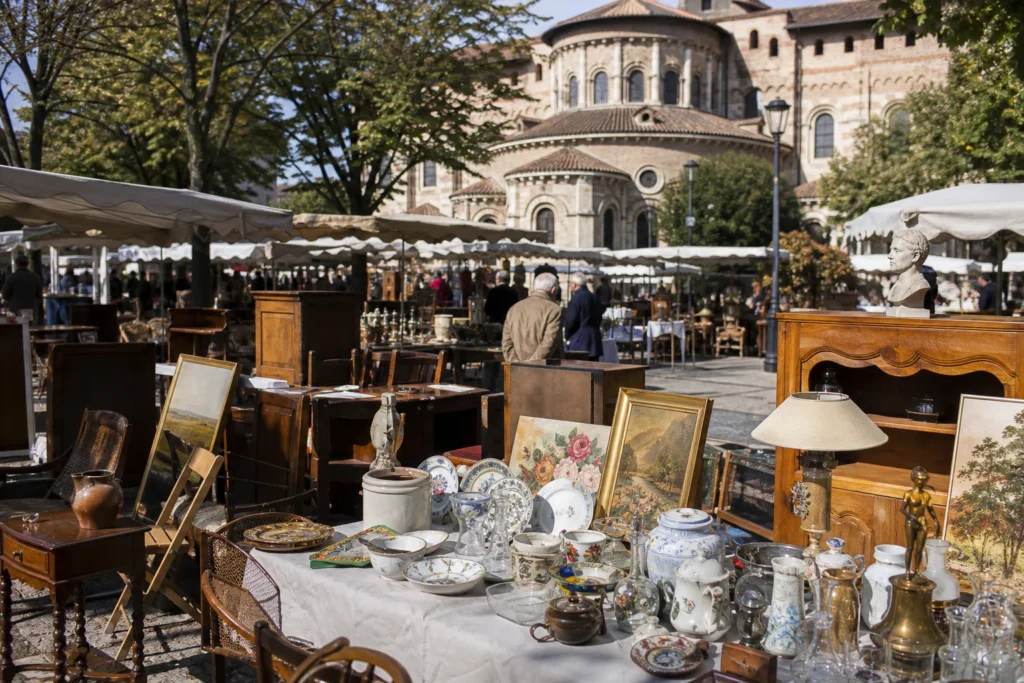

Every Saturday from 08:00 to 13:00, up to seventy professional dealers set up around the church of Saint-Aubin in central Toulouse. They bring with them one of the oldest and most characterful brocante markets in southwest France. This is not a car-boot sprawl. It is a curated weekly gathering with a consistent rhythm and a genuinely professional feel that draws collectors, dealers and curious visitors in equal measure.
The finds span roughly five decades of French domestic and decorative life. Printed matter and ephemera attract serious browsers — old books, maps, and original posters from the 1950s sit alongside stacked magazines and illustrated almanacs. Decorative and domestic pieces fill the gaps: old linen, crockery, ornaments and wrought ironwork. Larger furniture and art make up the backdrop — mid-century chairs, oil paintings, and small decorative pieces from the 1930s through to the 1980s. Older antiques from the nineteenth and early twentieth centuries surface regularly too.
Three things set the Brocante Saint Aubin apart from larger or more anonymous markets. The quality of stock is high, because the sellers are professionals who know what they carry. The atmosphere is convivial rather than competitive. And the prices, while fair, leave real room for negotiation — bargaining is a natural part of the transaction here, and the gap between asking price and final price can be significant compared to equivalent markets in Paris.
The market has not always gathered at Saint-Aubin. It originally ran along the parvis of the Saint-Sernin Basilica, one of the great surviving Romanesque buildings in Europe, a short distance away. Renovation works on the Saint-Sernin forecourt eventually forced a move. The Saint-Aubin parvis was a natural choice: the square already hosted its own open-air market on Sunday mornings and had the space and the atmosphere to absorb a Saturday brocante. The seventy-or-so regular dealers carried the tradition across without missing a beat.
Weekends attract genuine crowds, particularly on fine mornings when the whole neighbourhood seems to move through the market. Visitors with a low tolerance for close-packed stalls and slow-moving browsers may want to arrive early, around opening time, when the light is still low and the dealers are freshly laid out.
The market suits collectors of mid-century French decorative objects and printed ephemera especially well. It also rewards visitors who want to experience a long-running southern French brocante without paying capital-city prices for the privilege.
Getting to the market is straightforward. The François Verdier stop, served by Metro line B and bus lines L1, L8 and L9, sits approximately 300 metres away and connects the market to the wider city quickly. The Saint-Georges stop, also served by buses L1, L8 and L9, is roughly 200 metres from the market — the closest option for those arriving by bus. Visitors travelling from further afield can reach the area from Gare de Toulouse-Matabiau, approximately 800 metres away, either on foot or by catching Metro line B at the main interchange.
Frequently Asked Questions
Q: When does the Brocante Saint Aubin run, and what time should I arrive?
A: The market runs every Saturday from 08:00 to 13:00 around the parvis of the church of Saint-Aubin in central Toulouse. Arriving close to opening time is worth it — the stalls are freshly laid out, the crowd is thinner, and the best printed ephemera and decorative pieces tend to go early.
Q: What kinds of things will I find here?
A: The roughly seventy professional dealers bring a concentrated mix of French vintage and antique goods — old books, maps, and 1950s posters; domestic items like linen, crockery, and wrought ironwork; and larger pieces including mid-century furniture and oil paintings. The vintage range leans heavily toward the 1930s to 1980s, with older nineteenth and early twentieth-century antiques appearing regularly too.
Q: Is bargaining acceptable at this market?
A: Yes, and it is genuinely expected. The dealers are professionals who know the value of their stock, but the gap between asking price and final price can be meaningful — noticeably more so than at comparable markets in Paris. Come prepared to negotiate calmly rather than rush.
Q: How do I get there by public transport?
A: The François Verdier stop on Metro line B sits around 300 metres from the market. Bus lines L1, L8 and L9 also serve that stop. From the city centre, Metro line B is the quickest option.
Q: Why does the market sometimes appear under the name Brocante Saint Sernin?
A: The market originally ran on the parvis of the Saint-Sernin Basilica nearby. Renovation works on that forecourt forced a move to the current Saint-Aubin location, where it has continued under its original dealers without interruption. Both names refer to the same long-running weekly brocante.
Marketplace Highlights










Tiphaine Renou
9th October 2015 at 03:16Le marché aux puces de Saint Sernin est une véritable institution. On y trouve de tout , pour pas trop cher. Il faut avoir l’oeil bien ouvert pour dénicher parfois de véritables trésors!
Mélodie Toussaint
22nd June 2016 at 07:04Le Marché aux Puces de St Sernin est l’un de mes marchés préférés à Toulouse. D’une part, parce qu’on y allait souvent quand j’étais petite, et d’autre part parce que le marché à une ambiance fantastique qui fleure bon un autre temps!
Autour de la basilique il y a deux rangées de stands, et on y trouve de tout ! Des gadgets comme au téléachat, des bijoux, des trucs à chines, de la déco et même des accessoires. Alors, oui, c’est un marché aux puces, donc c’est assez rare de tomber sur quelque chose qu’on a envie de ramener chez soi, mais c’est vraiment à voir !