

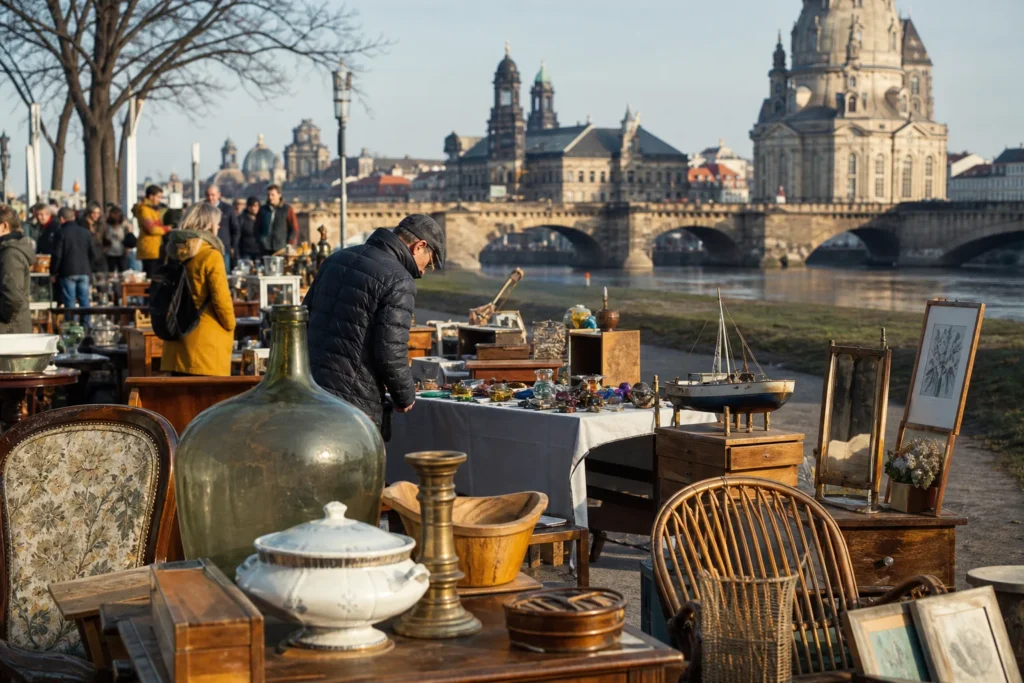

Every Saturday morning, the banks of the Elbe come alive with one of Dresden's most distinctive open-air markets. The Elbeflohmarkt — also known as the Albertbrücke Flohmarkt or Dresden Elbemarkt — runs from 09:00 to 14:00 each Saturday, drawing sellers and browsers to the riverbank near the Käthe-Kollwitz-Ufer. Active in this spot since at least 2005, it has grown into one of the oldest and most-visited flea markets in the city.
One rule sets this market apart immediately: no new goods. Every stall must carry second-hand, vintage or antique stock. That single restriction changes the atmosphere completely. Combined with a walk-up seller policy — no prior reservation required, space available to anyone who shows up — it keeps the inventory genuinely unpredictable from one Saturday to the next.
The seller mix reflects that open-door approach. Private families clearing out a grandparent's attic stand alongside more seasoned dealers with curated tables. On any given morning, the stalls reportedly attract upwards of 500 sellers. Everyday vintage items sit at one end of the spectrum: clothing, retro home appliances, vinyl records, and toys from past decades. Higher up the scale, collectors will find porcelain, paintings, jewellery, old books and decorative objects with real age behind them.
Many pieces carry at least half a century of history, and sellers often share that history willingly when asked. A casual question about a ceramic dish or a framed print can open into a longer conversation about provenance, family, or regional craft traditions. Those exchanges give the Elbeflohmarkt a texture that purely commercial markets rarely produce. Lingering at a stall longer than planned is not unusual here.
The Elbe setting earns its place in the visit, not just as backdrop but as part of the rhythm. The Albertbrücke frames one edge of the market; the old town sits nearby on the opposite bank. A five-hour Saturday window, fresh air, and a river view naturally slow the pace. This is a market suited to unhurried browsing rather than a quick pass-through.
The Elbeflohmarkt suits collectors hunting estate finds from Dresden and Saxony, visitors wanting a genuinely local Saturday activity, and anyone who prefers the randomness of private-seller stock over the predictability of commercial market chains. It rewards curiosity and conversation in roughly equal measure.
Getting here is straightforward. Bus line 62 stops at Hertelstraße, approximately 150 metres from the market — the closest public transport option. Tram line 6 serves Trinitatisplatz roughly 700 metres away, connecting to Dresden's wider network. For a more memorable approach, ferry line F17 docks at Fähre Johannstadt-Neustadt, approximately 450 metres from the stalls — arriving along the Elbe to a riverside market makes for a fittingly unhurried start to a Saturday morning.
Frequently Asked Questions
Q: Is the Elbeflohmarkt open on Sundays as well as Saturdays?
A: The market runs on Saturday mornings, 09:00 to 14:00. Check the organizer's official page before you go to confirm current operating days, as schedules can vary seasonally.
Q: Can anyone set up a stall, or do sellers need to book in advance?
A: No prior reservation is required. The market operates on a walk-up basis, meaning private individuals and families can arrive and trade alongside more established dealers. This open-door approach is a key reason the stock stays unpredictable from one Saturday to the next.
Q: Are there genuine antiques and vintage finds here, or mostly general bric-a-brac?
A: Both, which is part of the appeal. New goods are prohibited entirely, so every stall carries second-hand, vintage or antique stock. Everyday items — records, retro appliances, clothing, old toys — sit alongside higher-end finds such as porcelain, paintings, jewellery and old books. Many pieces reportedly carry at least half a century of history, and sellers are often happy to share what they know about a piece when asked.
Q: How do I get to the Elbeflohmarkt by public transport?
A: Bus 62 stops at Hertelstraße, around 150 metres from the market, making it the closest stop. Tram 6 serves Trinitatisplatz roughly 700 metres away. For a more scenic approach, ferry line F17 docks at Fähre Johannstadt-Neustadt, approximately 450 metres from the stalls.
Q: How long should I allow for a visit?
A: The market runs for five hours (09:00–14:00), and the open riverbank setting alongside the Albertbrücke encourages a slower pace than a covered market. Arriving early gives you the widest choice of stock; lingering at individual stalls to talk with sellers is genuinely part of the experience here.
Marketplace Highlights









Ben Teicher
24th February 2016 at 00:31Der Flohmarkt an der Elbe in Dresden ist ein Anziehungspunkt für viele Gäste und Einheimische. Wenn man eine Ader für Nostalgie hat, ist man hier richtig. Ich Frage mich nur immer, wo haben die Leute nur die tollen Sachen nur her. Keine Auskunft heißt es dann immer. Es ist schön,daß es sowas gibt.
Jonas Breitner
7th April 2016 at 10:59von kindersachen über möbelstücke aller art bis hin zu omas wecker. selbst fahrräder oder alte instrumente gibt es hier. ganz nach dem motto es gibt nichts was es nicht gibt. und meist lässt sich dabei noch ein schnäppchen machen. bei halbwegs gutem wetter ein super flair an den elbwiesen. gute anbindung durch die straba am sachsenplatz & auch für das leibliche wohl ist gesorgt. für einen bummel immer zu empfehlen!