

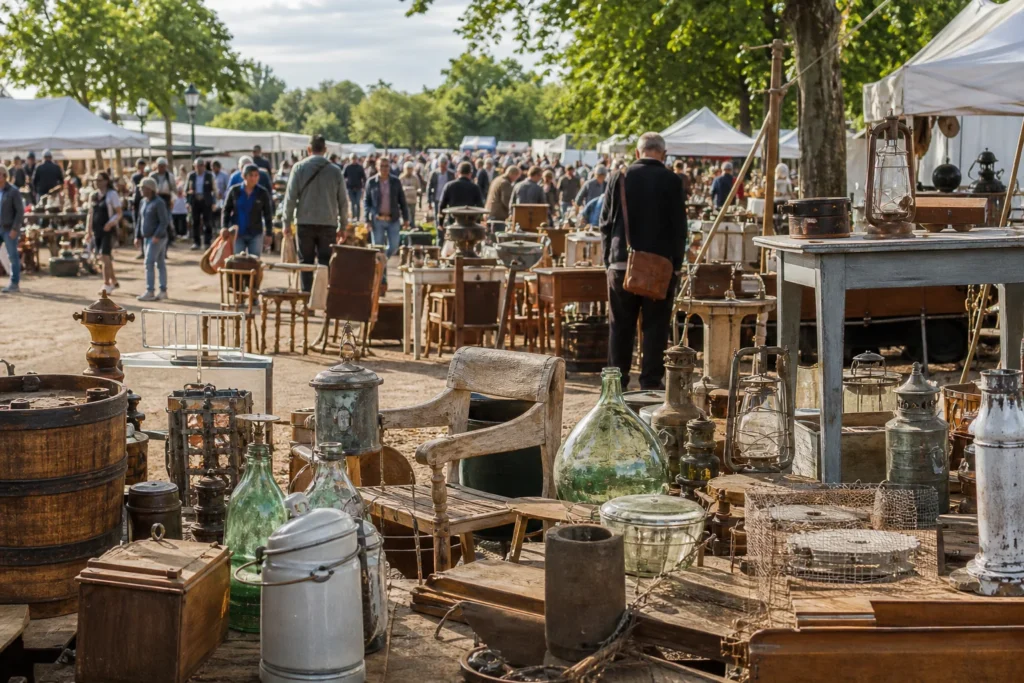

For a single August Sunday each year, a small commune in the Ain département became the unlikely centre of France's outdoor antique world. The Farfouille de Leyment, held in Leyment between Lyon and Geneva, once spread across 20 km² of exhibition ground, drawing 1,700 vendors and more than 70,000 visitors to one of the country's most remarkable flea market events. That era is now over. The fair was suspended in 2015, did not return in 2016 or 2017, and was confirmed permanently cancelled in 2018. The market stands as an archival record.
The Farfouille launched in 1982 and grew steadily into France's second largest flea market event, ranked behind only the Grande Braderie de Lille. For over three decades it occupied a single Sunday in late August, running from early morning at 07:00 through to 19:00. The scale was genuinely extraordinary for a commune of this size. What began as a regional gathering evolved into a fixture on the international brocante calendar, with collectors travelling from Switzerland, Italy, Germany, Belgium, the Netherlands and Austria to attend.
That international pull made the Farfouille something qualitatively different from a local vide-grenier. At this volume of sellers and visitors, serious collectors and casual wanderers moved through the same aisles. Dealers with professional expertise set up beside sellers clearing attic finds. The browsing experience was unpredictable in the best sense.
The merchandise reflected that mix. Paper and print collectors hunted through postcards, stamps, old books and vinyl records. Those chasing decorative pieces found pottery, trinkets, lighting and decorative objects in considerable variety. At the larger end, old furniture and paintings moved through the stalls alongside smaller antiques. No single category dominated. The fair rewarded both focused collectors and those wandering without a shopping list.
The atmosphere mattered as much as the merchandise. Many visitors arrived with no particular purchase in mind. The scale of the event gave it a festive energy — part brocante, part community occasion, part annual ritual for families who returned year after year. Finding something, or finding nothing, was almost secondary to the experience of being there.
The gap the Farfouille left in the late-August French flea market calendar has not been quietly filled. Events of this scale and outdoor character remain rare in France. For collectors who attended across those three decades, the fair occupies a specific place in the memory of the French brocante scene. For researchers mapping the history of major French outdoor antique events, the Farfouille de Leyment belongs in any serious account — a fair of implausible scale for its setting, sustained for more than thirty years, and now gone.
Frequently Asked Questions
Q: Is the Farfouille de Leyment still running?
A: No. The fair was suspended in 2015 and did not return in 2016 or 2017. Its permanent cancellation was confirmed in 2018. The Farfouille de Leyment no longer takes place.
Q: What kind of fair was this, and how large did it get?
A: At its peak the Farfouille was France's second largest flea market event after the Grande Braderie de Lille. Held on a single Sunday each August in the small Ain commune of Leyment, it drew around 1,700 vendors across 20 km² of exhibition ground and attracted more than 70,000 visitors, including collectors travelling from Switzerland, Italy, Germany, Belgium, the Netherlands and Austria.
Q: What could collectors expect to find across the stalls?
A: The fair mixed professional dealers with casual sellers clearing attic finds, which made the browsing genuinely varied. Paper and print hunters found postcards, stamps, old books and vinyl records. Those after decorative pieces browsed pottery, lighting, trinkets and decorative objects. At the larger end, old furniture and paintings circulated alongside smaller antiques. No single category dominated, and the unpredictability was part of the appeal.
Q: Did visitors need to be experienced antique hunters to enjoy it?
A: Not at all. Many of the 70,000 annual visitors arrived without a shopping list, drawn as much by the festive atmosphere and the scale of the event as by any specific hunt. Families returned year after year as much for the occasion itself as for what they might bring home.
Marketplace Highlights







Paolo Piergiovanni
30th August 2019 at 11:14Peccato che sia stata abolita una iniziativa così interessante.
Io ci sono stato due volte (nel 2013 e nel 2014); ci tornerei tutti gli anni se fosse riattivata.
Mi auguro che qualche persona di buona volontà e le condizioni di sicurezza consentano di poterlo riattivare.
Buona fortuna,
Paolo (da Italia)