

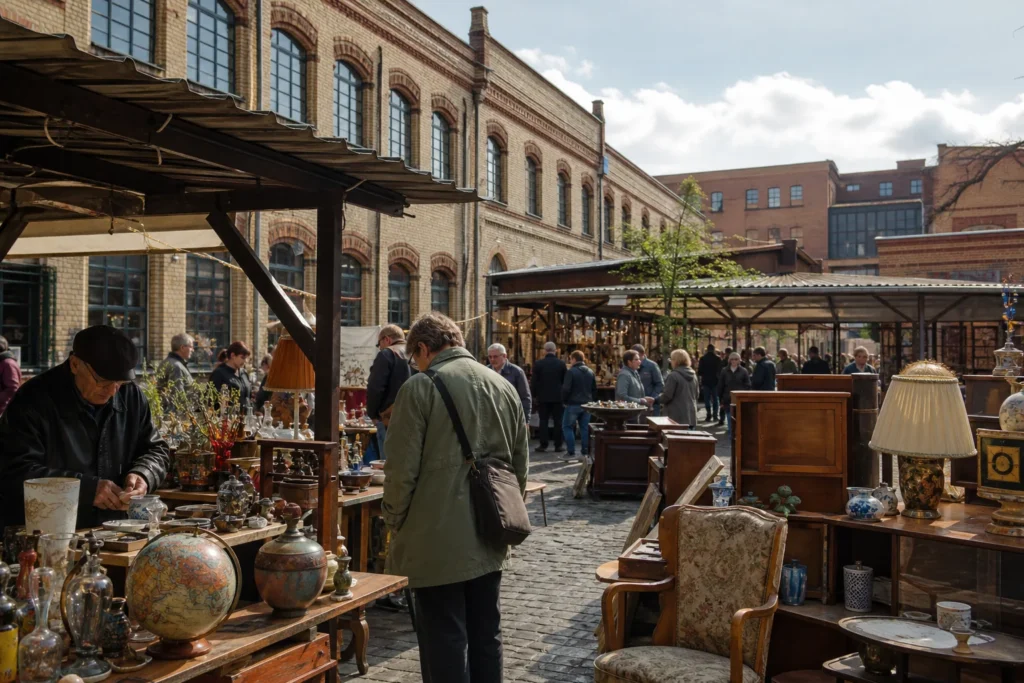

On the first Saturday of each month between April and November, a former factory courtyard in Leipzig's Südvorstadt quietly fills with stalls. The Feinkost Flohmarkt opens at 10:00 and runs until 16:00, occupying a site that has carried very different purposes over the past century. A brewery stood here first, then a food and canning operation moved in during the 1920s. The worn brick facades and the generous open courtyard still carry that industrial scale — nothing about the space feels purpose-built for a weekend fair, and that is precisely the point.
Above the entrance, the Löffelfamilie neon sign — the iconic spoon family emblem of the former VEB Feinkost Leipzig — continues to glow. Declared a cultural monument in 1993, it is the last surviving symbol of the factory era. Visitors who know its history look up; those who don't still look up. Either way, it frames the whole visit before you reach the first stall.
Around thirty covered stalls spread across the courtyard, which means weather rarely shuts the market down. The merchandise runs wide rather than deep. Pocket watches and stacks of vinyl sit close to vintage kitchen ceramics, GDR-era bric-a-brac and second-hand toys. Art prints lean against crates. Nothing is rigidly organised, and that's the draw for browsers who prefer a find over a purchase plan. Specialist dealers looking for a tightly curated fair will leave disappointed; everyone else tends to stay longer than expected.
Karl-Liebknecht-Straße — the Karli, to locals — sets the pace here. Saturday afternoons on this stretch of Südvorstadt move without urgency. Conversations between buyers and dealers drift and pause. Food stalls nearby give visitors somewhere to stand with something warm while they decide whether that pocket watch is worth a second look. The market doesn't perform its atmosphere; it simply has one, borrowed from the neighbourhood around it.
When the stalls are done, the Feinkost site itself continues. The Kunst- und Gewerbeverein Feinkost eG has developed the former factory into a working creative quarter. Independent shops, small restaurants and co-working spaces occupy parts of the grounds, giving the visit a natural extension — particularly useful on colder April or November Saturdays. Cultural programming, including theatre and seasonal cinema, also runs on the site, though schedules vary.
Getting there is straightforward. The Südplatz stop is the closest local option, roughly 180 m from the site, served by trams 11, 11E and N10 along with bus lines N9 and SEV. Visitors arriving from the city centre or connecting via the S-Bahn network will find Leipzig Bayerischer Bahnhof convenient — approximately 660 m away and served by S-Bahn trains S1, S2, S3, S4 and S5 as well as the S5X. Both options make the market accessible without needing a car.
The Feinkost Flohmarkt suits a specific kind of visitor well. Those drawn to East German design history or GDR material culture will find genuine context here, not just the objects but the setting that produced them. Weekend browsers without a fixed list tend to do well too. So do travellers who want a market embedded in actual neighbourhood life — the Karli is a real street with a real rhythm, and this courtyard is part of it rather than an interruption to it. The covered format and the seasonal schedule add reliability. The Löffelfamilie neon does the rest.
Frequently Asked Questions
Q: When does the Feinkost Flohmarkt take place?
A: The market runs on the first Saturday of each month between April and November, opening at 10:00 and closing at 16:00.
Q: What kinds of things can you find at the stalls?
A: Around thirty stalls spread across the courtyard with a genuinely mixed spread — pocket watches, vinyl records, art prints, vintage kitchen ceramics, GDR-era bric-a-brac and second-hand toys. The range is eclectic rather than curated, so it rewards browsing more than targeted hunting.
Q: Does rain cancel or affect the market?
A: The stalls are covered, so the market runs in almost any weather. The broader Feinkost site also has independent shops and small restaurants on the grounds if you need somewhere to warm up.
Q: How do you get there by public transport?
A: The closest stop is Südplatz, roughly 180 m from the site, served by trams 11, 11E and N10 plus bus lines N9 and SEV. Leipzig Bayerischer Bahnhof, about 660 m away, connects via S-Bahn lines S1–S5 and S5X for those coming from further afield.
Q: Is there anything else to see or do on the Feinkost site beyond the flea market?
A: The former factory grounds have been developed into a creative quarter by the Kunst- und Gewerbeverein Feinkost eG, with independent shops, small restaurants and co-working spaces. Cultural programming including theatre and seasonal cinema also runs on site, though schedules vary — check the organizer's official page for current events.
Marketplace Highlights








Add a review