


Region
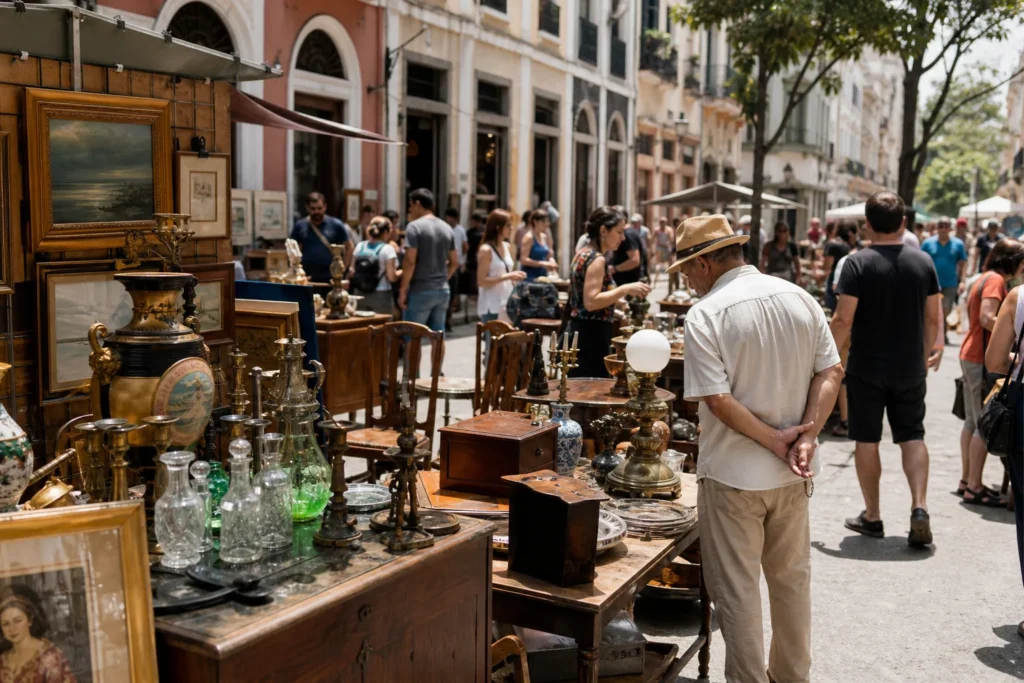
Rua do Lavradio sits quietly on most days, its faded colonial facades lining a street that once housed antique dealers and workshops in the heart of Lapa. On the first Saturday of each month, from 10:00 until 19:00, it becomes something else entirely. Stalls spread across the cobblestones, music drifts from open doorways, and the Feira do Lavradio — also known as the Feira do Rio Antigo — takes over one of Rio de Janeiro's most architecturally distinctive streetscapes.
The market dates back to around 2004, when organisers chose this historically significant but then-underused street as the setting for a monthly fair. The intention was to return cultural energy to Rua do Lavradio, and the setting proved ideal. Tall nineteenth-century shopfronts in warm ochre and dusty terracotta frame the stalls, giving the whole event the feeling of a market that grew up inside the city rather than being staged on top of it.
Serious collectors know to arrive early. The antique offer is genuinely varied: heavy wooden furniture, decorative objects, porcelain, framed prints, hand-drawn maps and the kind of vintage ephemera that rewards a sharp eye and some patience. Dedicated buyers reportedly show up before the crowds, working through stalls methodically. The early hours suit anyone who has a specific piece in mind.
As the morning opens out, so does the character of the market. Vintage and handmade clothing fills the racks alongside jewellery and accessories. Artisan stalls offer hand-sewn bags, wooden sandals and handcrafted objects that feel genuinely local rather than mass-produced for tourist consumption. The craft selection has a specificity that separates it from generic souvenir markets — the makers and the neighbourhood inform each other.
Colonial-era shopfronts along the street house additional dealers and boutiques that extend the market's footprint beyond the open stalls. Cafés and refreshment stops appear at intervals, giving visitors a natural reason to pause. The atmosphere feels unhurried and social, with locals and out-of-towners mixing easily across the length of the street.
The market carries a dual character that makes it unusually satisfying to visit. It functions as a serious collector's fair in the morning and a neighbourhood celebration by afternoon. That combination — antiques and artisan goods set inside a living piece of old Rio — gives the Feira do Lavradio a depth that most market days in the city simply don't match.
Getting to Rua do Lavradio is straightforward. Carioca station, served by metro lines 1 and 2, sits approximately 600 m from the market and is the most practical access point for visitors arriving from across the city. Tiradentes tram stop, with tram lines 2 and 4, is roughly 300 m away and offers a useful alternative. The Praça Tiradentes bus hub is the closest option at approximately 250 m, connecting the area to a range of bus routes across Rio.
Frequently Asked Questions
Q: When does the Feira do Lavradio take place?
A: The market runs on the first Saturday of each month, from 10:00 to 19:00, along Rua do Lavradio in the Lapa neighbourhood of Rio de Janeiro. Confirm the date before you travel, as occasional exceptions can apply.
Q: Is it worth arriving early, or is the afternoon just as good for browsing?
A: It depends on what you're after. Serious collectors tend to arrive close to opening to work through the antique stalls — furniture, porcelain, framed maps, prints and vintage ephemera — before the street fills up. By mid-morning the atmosphere shifts and the crowd broadens, which suits browsing for handmade clothing, jewellery and artisan goods at a more relaxed pace.
Q: How do I get to Rua do Lavradio by public transport?
A: Carioca metro station, on lines 1 and 2, is around 600 m away and is the most practical option for visitors coming from across the city. Tiradentes tram stop, served by lines 2 and 4, is roughly 300 m from the market and offers a useful alternative. The Praça Tiradentes bus hub is also within easy walking distance.
Q: Does the market only run in the open street, or are there indoor shops too?
A: Both. Open stalls spread across the cobblestones of Rua do Lavradio, but colonial-era shopfronts along the street house additional dealers and boutiques, extending the browsing area beyond the outdoor market footprint. Cafés and refreshment stops are available at intervals along the street.
Marketplace Highlights









Add a review