

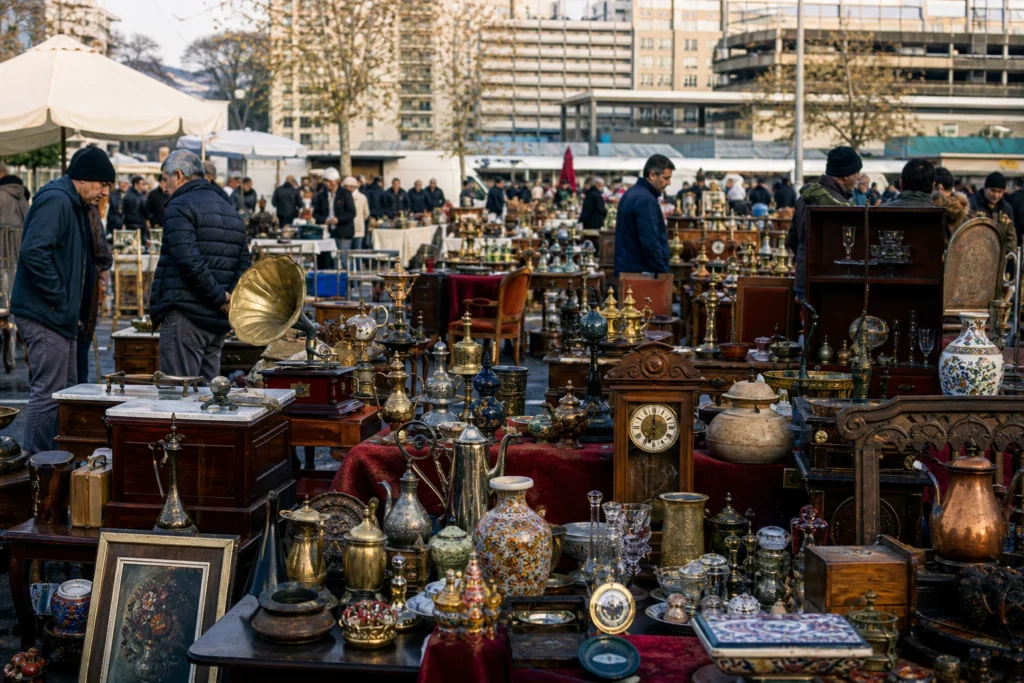

Every Sunday, a former parking lot in Şişli becomes one of Istanbul's most rewarding antiques destinations. Feriköy Antiques Market runs from 9am to 6pm, giving visitors a full day to cover ground. The site is open-air and sprawling, and there is a notable contrast between the unremarkable setting and the quality of what fills it each week. This is not a curated vintage fair or a tourist-oriented bazaar. It is a working antiques market with local traders who know their stock.
The goods here trace Istanbul's layered history rather than any single collecting tradition. Ottoman-era household objects, antique coins and traditional weaponry surface regularly, carrying the kind of provenance that more polished markets rarely offer. Alongside this historically rooted material, shoppers find vintage jewellery, textiles and clothing — wearable pieces that sit comfortably alongside purely decorative finds. Furniture hunters also do well at Feriköy. Antique furnishings and larger household items appear in genuine variety, and the open site makes it easier to assess a piece than a cramped indoor stall ever would. Vendors are local and tend to carry real knowledge of what they sell. Asking about the background of an item is often the start of a useful conversation, not just a sales pitch.
Timing shapes the experience here more than at most markets. The 9am opening is when stock is at its fullest and the pace is at its calmest. Dealers and serious collectors arrive early, and the better pieces rarely last until mid-morning. By then the crowd builds and the browsing rhythm shifts from deliberate to competitive. Arriving close to opening time is not just a tip — it is a genuine difference in what the visit feels like.
Feriköy rewards collectors with specific targets. Those chasing Ottoman material, coins or antique weaponry will find the depth of specialist knowledge here more useful than anything available on the tourist circuit. Casual browsers looking for something different from the Grand Bazaar experience will also find it. The market has its own texture — local, unhurried in the early hours, and genuinely varied in what it offers from one Sunday to the next.
Getting there is straightforward by public transport. Osmanbey station on metro line M2 is the most direct approach, approximately 765 metres from the market. For those coming by bus, the Ortanca stop — served by lines 70FE and 70FY — sits roughly 290 metres away, making it the closest local option. The Bomonti-tünel bus stop, about 440 metres out and served by lines 48T, 50L and 50T, provides a useful alternative from other parts of the city. All distances are approximate straight-line figures.
Frequently Asked Questions
Q: What time should I arrive at Feriköy Antiques Market?
A: Aim to arrive at or close to the 9am opening. Stock is at its fullest in the first hour, the pace is unhurried, and better pieces — particularly Ottoman-era items, coins and antique weaponry — rarely last past mid-morning. By then the crowd builds and browsing becomes more competitive.
Q: What kinds of antiques and vintage goods can I expect to find?
A: The market covers a wide range: Ottoman household objects, antique coins and traditional weaponry form a historically rooted core, while vintage jewellery, textiles and clothing give wearable options alongside purely decorative pieces. Furniture hunters do well here too, with antique furnishings easier to assess in the open-air setting than in cramped indoor stalls.
Q: How do I get there by public transport?
A: Osmanbey station on metro line M2 is the most direct approach, around 765 metres away. If you're coming by bus, the Ortanca stop (lines 70FE and 70FY) is the closest at roughly 290 metres, and the Bomonti-tünel stop (lines 48T, 50L and 50T) is a useful alternative at around 440 metres. All distances are approximate.
Q: Is Feriköy worth visiting if I'm not a serious collector?
A: Yes. The market suits both focused collectors chasing specific categories and casual browsers wanting something different from the Grand Bazaar circuit. The open-air setting, local vendors with genuine knowledge of their stock, and the variety of goods from week to week give it a texture that rewards curiosity as much as expertise.
Marketplace Highlights








Add a review