

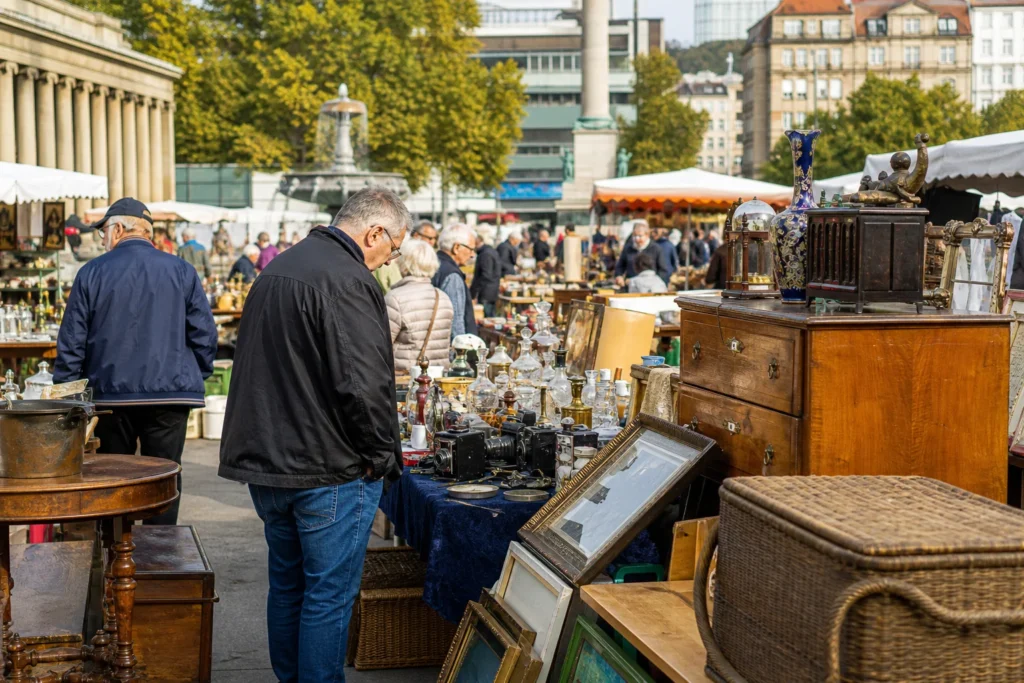

On a Saturday morning, Karlsplatz fills up fast. Stalls crowd the square well before nine, vendors arrange their wares with practised ease, and early arrivals already have bags in hand by the time latecomers arrive. This is Flohmarkt Karlsplatz, a Stuttgart institution with roots stretching back to 1983 and a reputation built on four decades of consistent turnout. It sits close to Königstraße, central enough to anchor an entire Saturday rather than just a detour.
What makes the market feel different from a standard weekend boot sale is the density of genuine collecting material. Biedermeier furniture turns up here — the real thing, not reproductions — alongside mid-century pieces that reward a second look. Antique cameras appear with some regularity, often without price stickers, which is itself an invitation to ask. Coins, traditional German beer steins, crystalware, silverware and ornate crockery fill the gaps between larger pieces. The occasional 1950s wine crate surfaces, raw and unlabelled, the kind of object that suits a collector or a display stylist equally well.
The seller mix sharpens the overall experience. Seasoned dealers bring curated stock and years of provenance knowledge. Private sellers arrive with house-clearance finds — objects that have not been priced by the market yet, in every sense. Both types reward patience, and the contrast between a tightly edited table and a sprawling blanket layout keeps each visit unpredictable in the best way. Typically more than a hundred stalls fill the square on a busy Saturday, which gives the browsing a genuine sense of scale.
Beyond the specialist material, plenty of stalls carry the broader flea market mix: clothing, books, household goods and the kind of curio that defies easy categorisation. Vendors across the market tend toward engagement rather than hard sell. A direct question about an unmarked piece usually gets a thoughtful answer — many sellers have held these objects for years and can place them in context. Prices move with polite negotiation, and refreshments are available on site to sustain a long morning. The market runs from 08:00 to 16:00 on Saturdays, giving visitors a comfortable window to work through the stalls without rushing.
Getting there is straightforward. Charlottenplatz sits approximately 100 metres away and serves as the natural arrival point, with U-Bahn lines U2, U4, U5, U6, U7, U11, U12, U14 and U15, tram 23, and buses 42, 43, 44 and 47 all stopping there. Visitors coming from other parts of the city can also use Schlossplatz, roughly 300 metres away, reached by U-Bahn lines U5, U6, U7, U12 and U15 or tram 23.
Flohmarkt Karlsplatz suits collectors who take German antiques seriously — furniture hunters, postwar-militaria specialists, camera enthusiasts and ceramics pickers who prefer depth over volume. It also works well for unhurried browsers who simply want a well-established market with enough stock to stay interesting for a full morning. The square, the history and the calibre of the finds give this one a weight that generic secondhand markets rarely match.
Frequently Asked Questions
Q: What time does Flohmarkt Karlsplatz run, and which day of the week does it take place?
A: The market runs on Saturdays from 08:00 to 16:00. Arriving early is worthwhile — stalls fill the square well before nine, and the best finds among dealers and house-clearance sellers tend to go quickly.
Q: What kinds of things can collectors expect to find here?
A: Flohmarkt Karlsplatz has genuine specialist depth. Biedermeier and mid-century furniture, antique cameras, WW2 militaria, coins, traditional beer steins, crystalware, silverware and ornate crockery all appear with regularity. Private sellers clearing family homes add unpredictability — unmarked pieces without market pricing are common, and vendors often have years of background knowledge on what they're selling.
Q: Is there room to negotiate on prices?
A: Yes. Negotiation is a normal part of buying here. Vendors across the market tend toward straightforward conversation rather than a hard sell, and a direct question about an unmarked or unfamiliar piece usually gets a useful answer rather than a brush-off.
Q: How do I get to Karlsplatz by public transport?
A: Charlottenplatz is the closest stop, roughly 100 metres away, served by U-Bahn lines U2, U4, U5, U6, U7, U11, U12, U14 and U15, tram 23, and buses 42, 43, 44 and 47. Schlossplatz is an alternative about 300 metres away, reachable on U5, U6, U7, U12, U15 and tram 23.
Marketplace Highlights








Add a review