

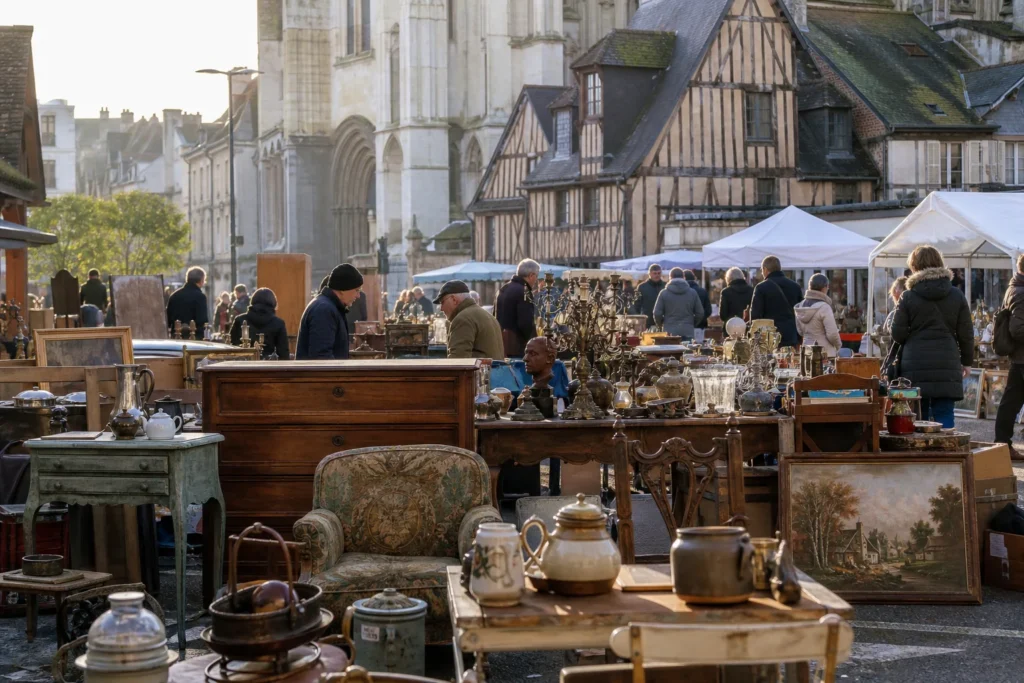

Once a year, on the third Sunday of November, Lisieux transforms. Around 800 vendors spread across the town centre from 05:00, filling medieval streets with everything from carved oak armoires to wartime ephemera. The Grande Brocante de Lisieux is one of the largest single-day antique fairs in Normandy, and it closes the French brocante season with real ambition.
The earliest arrivals come before first light. There is a particular quality to a November market at that hour — torches sweeping across stall fronts, breath visible in the cold air, the quiet urgency of collectors who know the best pieces move fast. By mid-morning the crowds thicken and the mood shifts into something more relaxed and social. The fair runs until 17:00, leaving plenty of time for a thorough circuit.
Two collector interests stand out here more than anywhere else in the region. The first is religious antiques. Lisieux carries deep Catholic significance as the home of the Basilica of Sainte-Thérèse, and that identity seeps into what vendors bring. Carved madonnas, devotional prints, brass crucifixes, vestments and altar objects appear with a consistency you rarely find at secular fairs. The second is war memorabilia. Normandy's Second World War history is woven into the local fabric, and the Grande Brocante reliably surfaces militaria, documents, insignia and personal objects that collectors travel specifically to find.
Beyond those two threads, the market offers a broad cross-section of French provincial antiques. Vendors arrive with oil paintings, decorative ceramics, vintage books, architectural salvage and the kind of large rural furniture — dressers, armoires, farmhouse tables — that estate clearances in the Pays d'Auge tend to produce. This is orchard and hedgerow country, and the goods often carry the quiet character of old Norman domestic life.
Vendors here tend to know their stock. If you are tracking down something specific, it is worth asking directly — conversations about provenance and context are part of the market's rhythm. Sellers are used to informed buyers, and that makes for a different experience than a tourist-facing vide-grenier.
Lisieux itself rewards a slower visit. The town has real medieval weight, and the surrounding Pays d'Auge — with its timber-framed farmhouses, cider orchards and winding lanes — makes for a satisfying day out well beyond the market. Local restaurants serve proper Norman cooking: rich, warming and well-suited to a long November outing.
The Grande Brocante suits committed collectors most of all, but it is also an excellent choice for any antique-hunter who wants genuine regional depth rather than a curated fair. Come early, stay unhurried and leave room in the car.
For public transport access, the train station Le Grand Jardin — served by the Proxi line running between Trouville-Deauville and Lisieux — sits approximately 500 metres from the market area. Closer still, the Victor Hugo stop serves bus line Nav at roughly 70 metres, and the Porte de Paris stop for bus line 1 is approximately 100 metres away. Both bus stops offer very easy access to the town centre on the day.
Frequently Asked Questions
Q: When does the Grande Brocante de Lisieux take place?
A: The fair is held on the third Sunday of November, running from 05:00 to 17:00. Check the organizer's official channels before you go to confirm the date for the year you plan to visit.
Q: What kinds of antiques and collectibles does the market specialise in?
A: Two categories stand out: religious antiques — carved madonnas, crucifixes, vestments and devotional objects — which appear in unusual concentrations given Lisieux's association with the Basilica of Sainte-Thérèse, and Second World War militaria and ephemera rooted in Normandy's wartime history. Alongside these, expect French provincial furniture, oil paintings, architectural salvage, vintage books and decorative ceramics from local Pays d'Auge estate clearances.
Q: Is it worth arriving early?
A: Very much so. Stalls open from 05:00, and the first hours — torch-lit, quieter, purposeful — are when serious pieces move. By mid-morning the atmosphere is more relaxed and social, but the strongest stock has usually already changed hands.
Q: How large is the event?
A: With reportedly around 800 vendors spreading through the medieval town centre, this is one of the largest single-day antique fairs in Normandy. The scale means genuine variety, and the vendor quality tends to be high — sellers here are accustomed to informed buyers and can usually speak to provenance.
Q: Can I reach Lisieux by public transport?
A: Lisieux has a train station with rail connections to the region. Confirm current timetables and service frequency before your visit, particularly for a very early Sunday morning arrival.
Marketplace Highlights








Add a review