

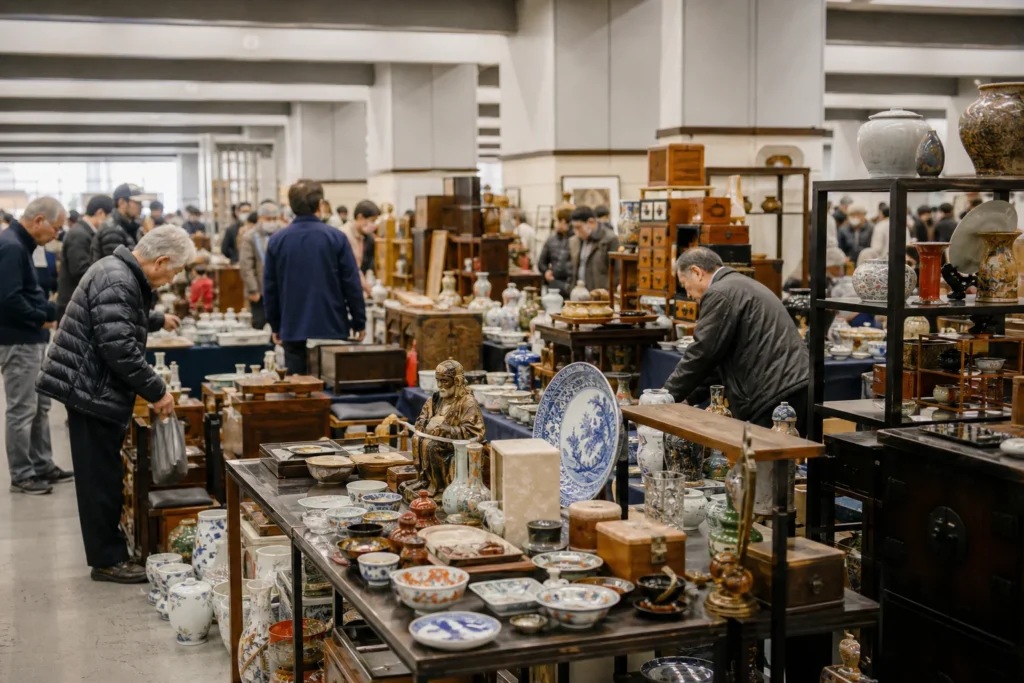

Few antique fairs in Japan carry the same depth of history as the one held at the Tokyo Ryutsu Center in Ota-ku. The Heiwajima Antique Fair has been running since 1978, making it one of the country's longest-established events of its kind. It gathers more than 280 dealers across three days, five times a year, with editions in March, May, June, September and December. Each day opens at 10:00 and runs until 17:00, with the final day closing an hour earlier at 16:00.
The indoor setting at the Ryutsu Center defines the fair's character. Unlike Tokyo's open-air weekend markets, everything here takes place under one roof. The result is an organized, weather-proof environment where dealers can lay out their stock properly and buyers can browse without distraction. Vendors do factor in rental costs, so prices tend to sit a step above what you might find at an outdoor stall — but the range and quality of goods justify the difference.
The merchandise spans Japanese, Asian and Western antiques, and the breadth is genuinely impressive. Decorative and applied arts form the core: lacquerware, ceramics and tea ceremony sets appear in abundance, many of them difficult to source outside specialist auction houses. Textile collectors find an equally strong showing — kimonos, obis and woven fabrics attract both serious collectors and sewers looking for exceptional material. A separate pleasure comes from the smaller objects: kokeshi and netsuke draw dedicated enthusiasts, Hakata dolls surface alongside cloth figures, and trays of old postcards, coins and stamps reward the patient browser.
Arriving on the first morning of any edition gives a real advantage. The most sought-after pieces move fast, and dealers are often freshest and most willing to talk on day one. Bargaining is a normal part of the transaction here — it is expected and welcomed. For larger purchases, many dealers offer delivery or help arrange it, which removes the practical difficulty of transporting furniture or heavy ceramics across Tokyo.
The fair suits serious collectors of Japanese and Asian antiques, dealers sourcing stock, and anyone drawn to the structured indoor alternative that Heiwajima offers. It also works well for visitors who want a focused, single-destination experience rather than the scattered effort of multiple weekend markets.
Getting there is straightforward. Ryutsu Center station, served by train and public transport, sits approximately 300 metres from the venue and makes it the natural arrival point for most visitors. For those coming by bus, the stop at 仲之島橋 (Nakanoshimabashi) is roughly 150 metres away and is served by bus lines 平和54, 森31, 森36, 森41 and 森45.
The Heiwajima Antique Fair rewards preparation and early arrival. Its combination of indoor scale, genuine bargaining culture and historical depth gives it a distinct standing in Tokyo's antique calendar — a fair that serious collectors tend to mark months in advance.
Frequently Asked Questions
Q: When does the Heiwajima Antique Fair take place, and what are the opening hours?
A: The fair runs five times a year, with editions in March, May, June, September and December. Each edition lasts three days, opening at 10:00 and closing at 17:00, except on the final day when it closes an hour earlier at 16:00. Check the organizer's official page before you go to confirm exact dates for the edition you plan to attend.
Q: What kinds of antiques and collectibles can I expect to find?
A: The fair spans Japanese, Asian and Western antiques across more than 280 dealers. Strong categories include lacquerware, ceramics, tea ceremony sets, kimonos, obis, and woven textiles. Smaller collectibles — kokeshi, netsuke, Hakata dolls, old postcards, coins and stamps — also appear in good quantity, making it worthwhile for specialist collectors and casual browsers alike.
Q: Is bargaining acceptable, and when is the best time to arrive?
A: Bargaining is a normal and expected part of transactions at Heiwajima — dealers anticipate it. Arriving on the first morning of any edition gives you the strongest advantage, as the most sought-after pieces tend to move quickly and dealers are freshest and most engaged early on.
Q: How do I get to the Tokyo Ryutsu Center by public transport?
A: Ryutsu Center station sits approximately 300 metres from the venue and is the most straightforward arrival point. By bus, the stop at 仲之島橋 (Nakanoshimabashi) is roughly 150 metres away, served by lines 平和54, 森31, 森36, 森41 and 森45.
Q: Can dealers help with delivery if I buy something large or heavy?
A: Many dealers at the fair offer delivery or can help arrange it for larger purchases such as furniture or heavy ceramics, which removes one of the more practical obstacles to buying bulky pieces at an indoor fair in Tokyo. Confirm arrangements directly with the individual dealer at the time of purchase.
Marketplace Highlights









Jay Levine
25th November 2017 at 04:25I went to this show in Sept, 2017 and there were a lot of sellers and many interesting things to see and buy. Prices ran from very reasonable to very high value items. Enough English spoken so language was not a problem.
Transportation was easy as the building is at a stop on the route to the airport.
Refreshments also available in the building.
And you can bargin.