


Region
In 1934, a young engineer named Guillermo González Camarena was reportedly wandering the second-hand stalls of La Lagunilla, hunting for spare parts to build his first video camera. That device, the story goes, set him on the path to developing colour television. Whether every detail of the anecdote holds up, the image itself rings true: this is a market that has always drawn resourceful, curious people. For generations, Mexico City residents have said, almost as a reflex, that they found something extraordinary — or simply useful — at La Lagunilla.
The market runs every Sunday from 08:00 to 18:00 in the historic centre of Mexico City. It occupies a sprawling patch of the city near the Lagunilla neighbourhood, and it has two quite distinct characters. Understanding both before you arrive saves time and sets realistic expectations.
The street bazaar side of La Lagunilla is emphatically informal. Vendors spread leather belts, cheap jewellery, tin figurines, glassware, toys, guitars and street food across tables, crates and plastic sheets. The atmosphere is dense and social — vendors call out, children weave through crowds, and the smell of ice cream and tacos drifts between the stalls. It is the kind of market that defies organisation, and that is largely the point. Browsing here rewards patience and an appetite for the unexpected.
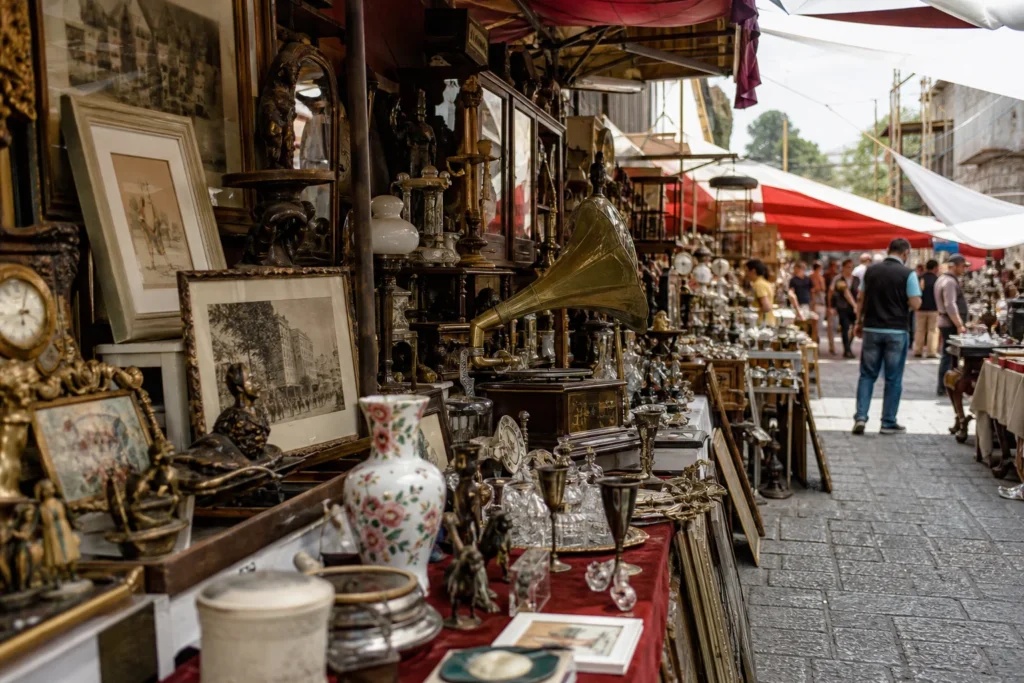
The antique corridor on calle de Rayón, running between Allende and Comonfort, operates at an entirely different register. This is where serious collectors and dealers set up, and the inventory reflects it. Spanish, French and English porcelain sits alongside silver and bronze candlesticks. Furniture ranges from Louis XV and Colonial to Chippendale. Elsewhere along the street you might turn up vintage phonographs, old radios, Bakelite telephones, apothecary jars, fountain pens, antique coins and banknotes, ironwork spurs and stirrups, and glass paperweights. The variety and quality here genuinely surprises first-time visitors expecting a typical street market. Antique dealers and collectors drive demand, but tourists and curious browsers are equally welcome.
La Lagunilla belongs to the whole city in a way few markets do. Neighbourhood regulars come out of habit. Collectors arrive with specific lists. Tourists wander in on a Sunday morning and stay far longer than planned. The market draws people, as one long-held observation about it puts it, whether by necessity or eccentricity — and that mix is exactly what makes it feel alive rather than staged. It rewards an unhurried Sunday and at least one return visit.
Getting to La Lagunilla is straightforward from most parts of central Mexico City. The Garibaldi/Lagunilla metro station — served by subway lines 8 and B — sits approximately 330 metres from the market, making it the most direct public transit option. The Ecobus - Express stop is the closest boarding point overall, at roughly 220 metres away. Bus line L4 stops at República de Chile, approximately 385 metres distant, and offers a useful alternative from different parts of the city. All three options connect the market comfortably to the broader transit network, so arriving without a car is easy.
Frequently Asked Questions
Q: What are the two main sections of La Lagunilla, and how do they differ?
A: La Lagunilla has two distinct sides. The main street bazaar is a dense, informal sprawl selling leather goods, jewellery, toys, glassware, instruments and street food — chaotic and social by nature. The antique corridor along calle de Rayón, between Allende and Comonfort, is a different experience entirely: dealers here specialise in porcelain, silver, furniture, vintage radios and phonographs, old coins, fountain pens and similar collectibles. Most serious collectors head straight for Rayón; casual browsers tend to enjoy both.
Q: What kinds of antiques and collectibles can be found on calle de Rayón?
A: The corridor draws a wide range of inventory: Spanish, French and English porcelain; silver and bronze candlesticks; furniture in Louis XV, Colonial and Chippendale styles; vintage phonographs, radios and Bakelite telephones; apothecary jars and old tools; fountain pens; antique coins and banknotes; and ironwork including spurs and stirrups. The variety and quality tend to surprise first-time visitors expecting a typical street market.
Q: How do I get to La Lagunilla by metro?
A: The closest station is Garibaldi/Lagunilla, served by metro lines 8 and B, approximately 330 metres from the market.
Q: Is La Lagunilla worth visiting if I'm not a serious collector?
A: Yes. The market has always drawn a broad mix — neighbourhood regulars, curious tourists and seasoned dealers alike. The street bazaar side rewards unhurried browsing and the atmosphere is lively, with street food and vendors throughout. Even first-time visitors without a shopping list often stay longer than planned.
Q: When does La Lagunilla take place?
A: La Lagunilla runs on Sundays. Check the market's official channels before visiting to confirm current hours, as schedules can shift around Mexican public holidays.
Marketplace Highlights









Santiago Pelayo
30th October 2015 at 14:50La Lagunilla market is a fantastic place for those looking for furniture, clothing, toys, records, books, and accessories from the Twentieth century. Since La Lagunilla is surrounded by Mexico City’s dodgiest neighborhoods, unless you are a punk, DO NOT do this on your own if you do not speak Spanish.
Another thing you need to know: you can’t expect a taxi driver to know what you are looking for. La Lagunilla is a huge area and there are many markets known as La Lagunilla Markets there. I strongly recommend you take the metro, but if you want to go by taxi (make sure you call a taxi company and don’t take one from the street), you want to go to ‘Mercado de Antiguedades’ (Antiques Market). This is very important or you will be dropped somewhere else. Corner of Francisco González Bocanegra and Paseo de la Reforma Norte, Mexico DF
Evan Carroll
6th November 2015 at 14:45Looking for a shopping adventure? Come here. Street vendors overtake the city over an expansive area. For hours I walked by street vendors along sidewalks selling just about everything. One major section contains a maze of market stalls under plastic tarps; the place is so expansive that I was lost here for an hour. I had a lot of fun.
Geraldo Aguas
21st January 2016 at 14:43Hay muchísimas cosas y lugares que ver, los precios son súper accesibles.
Se encuentran los mercados de ropa, donde venden trajes, conjuntos, ropa para eventos religiosos, disfraces, vestidos de 15 años; el mercado de varios por otra parte cuenta con artículos de decoración, antigüedades, pinturas, esculturas, lámparas, tiendas de todo para el bebé, muebles y un sinfín de artículos para el hogar y más; sin contar con que es el centro del mueble de la ciudad por excelencia, donde se pueden encontrar marcas reconocidas como: San Remo, El
Mueble Perfecto, La Michoacana, Beledi, Antigua Galeria, Nasser y muchas marcas más…
Andres Sotomayor
25th April 2016 at 14:46Aight’ for all the tourist who don’t do ’em homework when traveling…. The Lagunilla is hood with plenty of markets, just like it’s next door hood Tepito. This is the main market where you’ll find mostly food, there’s three other markets where they sell wedding dresses, furniture and shoes. The “antique” street market is put on only on Sundays from 10 am till 6 pm depending on the weather. You’ll find from antiques, micheladas, clothing and lots more in a young chilled atmosphere.
Winston Thompson
7th July 2016 at 14:48I recently returned to La Lagunilla Flea / Antique market after more than a decade and I’m happy to say it was just as fascinating. There’s a very open, safe, neighbourhood feeling to the scene. I found wonderful things at very good prices. I bought furniture and the seller was most co-operative in delivering it to my friend’s home in Mexico City. I also took away jewellery, vintage Mexican ceramics and a name-brand leather handbag. The sellers are generally knowledgeable about their wares but like any open-air market, revise products carefully. There is something totally authentic about this experience, not another exclusively tourist destination. I’ll be back on my next visit to Mexico City.