



Featured
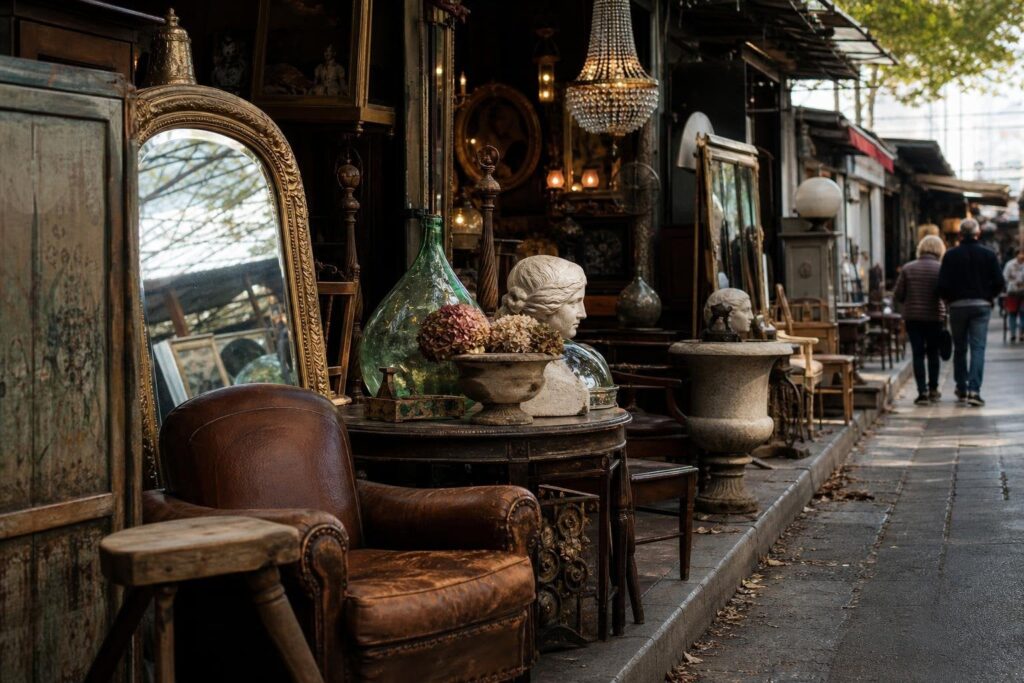
A 1930s chandelier appears in a corner booth you nearly walked past. That moment — half surprise, half instinct — is exactly what Les Puces de Saint-Ouen is built for. Sitting just north of Paris's 18th arrondissement in the commune of Saint-Ouen, this is the city's largest and most storied flea market. It spreads across roughly seven hectares of covered halls, open alleys and winding passages, and it rewards visitors who are happy to lose their bearings.
Rue des Rosiers is the market's main artery, and the atmosphere hits you within the first few steps. Café tables spill onto the lane. Stalls crowd the pavement edges. Dealers unpack things with no obvious category. The whole place feels closer to a living neighbourhood than a conventional market, and that quality is the point.
The market runs Friday through Monday, with each day carrying its own rhythm. Friday is a shorter, early-morning session — the market opens at 08:00 and closes at 12:00, making it the most trade-oriented slot of the week, when serious buyers move quickly. Saturday is the main public day, open from 09:00 to 18:00; early arrivals reach the best pieces before crowds thicken and quick sellers disappear. Sunday opens slightly later at 10:00 and runs until 18:00, carrying a more relaxed pace that suits unhurried browsing. Monday is the quietest day, running from 11:00 to 17:00, with some dealers absent entirely — but it suits anyone who prefers space to think.
Each of the market's distinct halls has its own identity, and knowing the differences helps you navigate. Marché Biron sits at the refined end of the spectrum, with high-quality antique furniture, silverware and works on paper from dealers who know their provenance. Serpette draws collectors of twentieth-century design — mid-century lighting, Scandinavian chairs, art deco objects and postwar curiosities. Vernaison is the oldest section and arguably the most atmospheric, its narrow lanes twisting past vintage textiles, old frames and enamelware stacked floor to ceiling. Marché Dauphine, covered by a dramatic glass roof, pulls in book dealers, vintage print sellers and curiosity merchants. Paul Bert stretches across open alleys and remains a favourite with experienced pickers hunting solid mid-range antiques and decorative finds.
The best discoveries rarely happen on a straight path. A set of porcelain cups turns up behind a stack of old trunk lids. Dealers range from polished antiquarians with deep provenance knowledge to fellow hunters who arrived straight from a storeroom. Ask about condition, history and repair. Dealers often respond by opening a back drawer or pointing to a shelf you would never have found alone.
Crowds build steadily after midday. Alleys narrow, conversations overlap, and the whole place becomes wonderfully, exhaustingly alive. When you need a break, café tables line Rue des Rosiers and small bistros operate inside some of the covered halls. Watching a restorer polish a frame or a shopper weigh an object gives the market a texture no gallery ever quite matches.
Getting here by public transport is straightforward. The nearest Metro station is Garibaldi on line 13, approximately 500 metres from Rue des Rosiers and the most direct approach from central Paris. Bus line 85 stops at Eugène Lumeau – Les Écoles, essentially on the doorstep of the market entrance — the most convenient option if you are already in the northern arrondissements. Tram T3b at Angélique Compoint – Porte de Montmartre stops approximately 700 metres away and offers a useful alternative for visitors arriving from the eastern or western edges of the city. All three connections put you well within reach of the main halls without the difficulty of parking on busy market days.
What you take home might be a piece of vintage silverware, a faded textile or a cracked mirror whose patina feels earned. It might be nothing at all — just a conversation with a dealer who explained exactly how a particular piece was made. Saint-Ouen does not reward efficiency. It rewards the willingness to double back, follow an unexpected doorway and trust that the next booth holds something worth stopping for.
Frequently Asked Questions
Q: When is the best time to arrive at Les Puces de Saint-Ouen?
A: Saturday morning is the most competitive session — early arrivals reach the best pieces before crowds build and quick sellers disappear. Sunday opens at a slightly later, more relaxed pace. Monday is the quietest day, with some dealers absent, but suits unhurried browsers.
Q: How do the different halls compare, and where should a first-time visitor start?
A: Each hall has a distinct character. Biron leans toward refined antique furniture and silverware; Serpette draws mid-century design and art deco collectors; Vernaison is the oldest and most labyrinthine, with textiles, frames and bric-à-brac; Dauphine has books, vintage prints and curiosities under a glass roof; Paul Bert suits experienced pickers after solid decorative antiques. A first visit rewards wandering rather than planning a fixed route.
Q: Is it worth talking to the dealers, or are prices fixed?
A: Conversation is part of the experience here. Dealers range from polished antiquarians with deep provenance knowledge to sellers who feel like fellow pickers. Asking about condition, history and repair often prompts a dealer to open a back drawer or show you something off the main display. Approach with curiosity rather than purely transactional intent.
Q: How large is the market, and how long should I allow?
A: The market covers roughly seven hectares across covered halls, open alleys and winding passages. A single hall can absorb an hour easily. Allow at least a half day; a full day is realistic if you intend to move between several halls and stop for a break along Rue des Rosiers.
Q: Are there places to eat or rest inside the market?
A: Café tables line Rue des Rosiers, the main artery through the market, and small bistros operate inside some of the covered halls. Crowds and noise build steadily after midday, so a mid-morning or early-afternoon break is a practical way to pace a longer visit.
Marketplace Highlights

Flea Market Trip Planner
Visiting Marché aux Puces de Saint Ouen? Build your full flea market itinerary
Plan your route by date, distance and market type






Maureen Marsh
30th October 2015 at 17:19The next time you look at an interior design magazine and read that certain items came from the Paris Flea Market, know that they were not cheap little creative finds. They probably cost in the hundreds of Euros. But talk about truly cool stuff! The most amazing designer costume jewelry, art deco silver coffee sets, full sets of Christofle silver, sets of china, artisanal majolica, old furs, skin handbags, antique toys, mid-century clothes, and antique linens galore. Laces, christening caps, copper ware and all kinds of other stuff.
Lila Nguyen
1st December 2015 at 21:35I have been there on a Saturday afternoon and I have deeply appreciated the atmosphere you can breathe there. the market is wide and full of original vintage pieces at reasonable prices even though in some corners you may find proper shops with nice vintage clothes for unreasonably very expensive prices. Anyway it definitely is worth a visit !
Scott Sanders
9th February 2016 at 23:43I really enjoyed finally visiting this “Bucket List” attraction. I am an experienced “market” shopper for all types of French markets all over this wonderful country. This particular market lends itself well to bigger ticket items such as furnishings, art and expensive collectibles. There are many areas that make-up this market. So it’s worth planning where to start and where to finish ahead of time. Don’t plan to find a bargain at this market. But you could find a French treasure that you never expected to discover! A “must see” for any true lover of French markets.
Chelsea Stokes
14th April 2016 at 07:38If you like antiques or poking around markets and second hand shops this is the one to go to. A huge variety of stalls selling everything from buttons and antique light switches to fantastic furniture from old properties. It is difficult to get around and cover as there are so many areas. We focused on Marché Vernaison as I was looking for lace and old linens. I saw some amazing pieces worth a lot of money but exchange rates prevented me getting carried away and I was careful to only buy what I couldn’t get at home and for a reasonable price… I found a few nice pieces and happy to take away a little Paris with me!
Priscilla Carr
23rd April 2016 at 17:04We had a perfectly sublime Sunday wandering around all of the different “markets”. After reading tons of mixed reviews, I was a bit sketchy as to whether I even wanted to go check this out. SO glad we did as there are just tons of beautiful antiques and “second hand items” as well. You won’t find the deal of the century most likely, but you will find something cool, I guarantee it. We decided to forgo the metro and just took an uber in and out. If you do take the metro, just have a map and know where you’re headed. Make a bee line for Rue des Rosiers and you’re in the thick of the good stuff without all the pushy ‘outside’ vendors that all the other reviews mention…all of that garbage is on the fringe, get to the middle and stay in the markets for the most part. We found a few mid century bargains for 10 euros each, and had some great food at the gastronomic pub in one of the markets. More mid century modern stuff than I’ve ever seen in any one place and tons of beautiful, original antiques. We did more looking than buying, but if you like antiquing, thrifting, picking, etc…you’ll love this. We spent 6 hours there and probably saw half of the markets. Didn’t feel crowded or cramped and didn’t see any sketchy pickpockets or anything like that, but I could see how that might be an issue on the “fringe”. Enjoy!!
Donna Palmer
10th June 2016 at 00:22A fascinating mixture of absolutely worthless kitsch and expensive and (presumably) genuine antiques. We traveled with had luggage only, otherwise I might have been tempted to buy some lovely art deco lamps…. The dealers will reduce their prices, so haggling is ok, as long as you’re realistic and polite. A MUST for Paris visitors!
Joel Chapman
4th August 2016 at 17:18Although it is quite fun to visit don’t come here expecting to find any good deals or realistic prices. There are various markets located on the Rue des Rosiers where you can find anything from vintage and curiosity to heavy antiques. However, they all have one thing in common and that is the next-to-insane pricing. First we were wondering if they had switched currencies because some of them were just plain ridiculous. We even found an Ikea chair which someone tried to sell as vintage!
I think there are many places where you can find better quality for more realistic prices if you are into vintage furniture and stuff (as a matter of facts, when in Amsterdam make sure to visit the IJ-hallen markets). Also the neighborhood was a bit rough, when you walk to the rue des rosiers you first pass a market filled with cheap imitation clothing en touts trying to sell cheap sunglasses. Just ignore them however and you’ll be fine.