

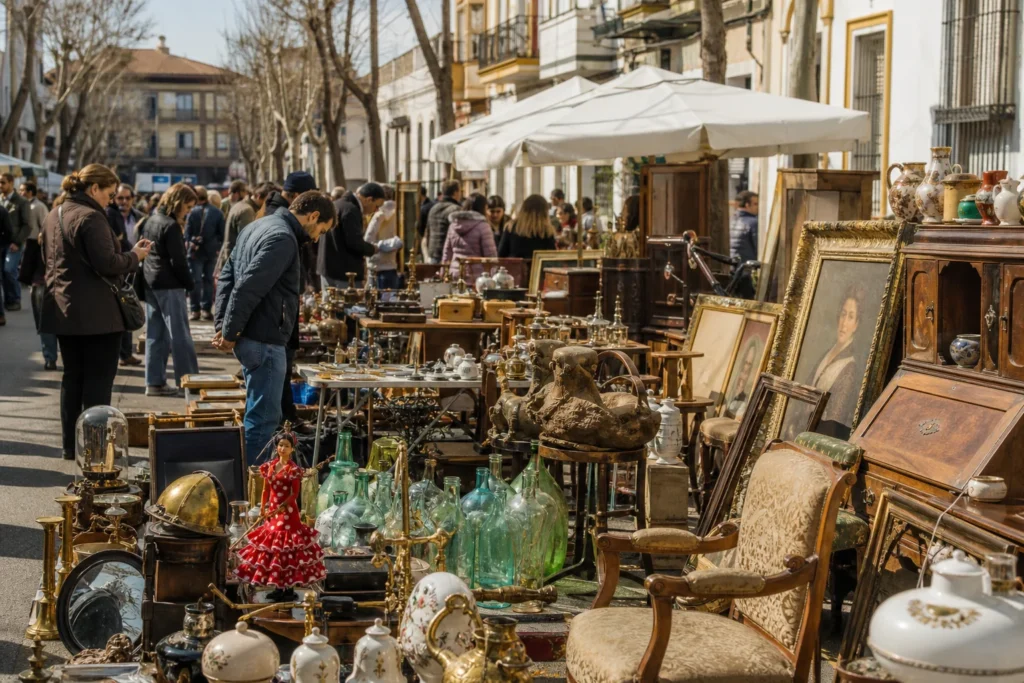

A barber's chair sits at the edge of a stall on Calle Feria, angled toward the pavement as if waiting for a customer who never quite arrived. Beside it, a crate of vinyl leans against a birdcage, and a sewing machine occupies a fold-out table next to a rack of flamenco dresses. This is Mercadillo El Jueves, Seville's long-running weekly flea market, and it opens every Thursday from 08:00 in the city's old Macarena district.
The name simply means Thursday in Spanish. No further branding is needed. The market draws a steady crowd of local collectors, committed rummagers and curious visitors who share the same easy, unhurried pace that the stalls themselves seem to set. Traders chat across the narrow gaps between tables. Nobody rushes.
The merchandise splits naturally into a few loose territories. Furniture and fixtures draw the eye first — decorative ironwork, old tools, vintage lamps and domestic hardware that has clearly served previous lives well. A second cluster covers ceramics, religious figurines, ornamental curiosities and the occasional potted plant sharing space with a lava lamp. Print and sound occupy the gaps: dog-eared novels, vinyl records, old toys and fashion pieces that drift between costume and collector territory. A painting might lean against an iron railing next to a discarded computer console. The stall mix shifts from week to week, which is part of the point. What was absent last Thursday may be stacked on a table this one, and regulars treat the market accordingly — as a standing appointment rather than a one-off event.
Local tradition claims that trading on this street predates the Castilian conquest of Seville in 1248, though the exact lineage is contested. Whether or not the 13th-century origin holds precisely, El Jueves carries a reputation across Spain as one of the oldest markets of its kind. That age shows not in ceremony but in ease. The market does not perform or pitch. It simply opens, fills the street and does what it has always done.
The market runs until 15:00, but the morning hours reward the earliest arrivals. The prime browsing window is before midday, when stalls are fully set and the street feels most alive. The afternoon pace is quieter, and traders begin to pack down as the close approaches.
Getting here is straightforward. The Feria (Cruz Verde) bus stop is roughly 75 metres away, served by bus lines 13 and 14, which makes it the most convenient option for those already on the bus network. La Macarena subway station sits approximately 600 metres distant and connects the market to the broader city. The Macarena neighbourhood itself is worth time after the market winds down — its basilica, old city walls and quieter backstreets give the morning a natural extension for anyone not ready to leave.
El Jueves suits collectors chasing ceramics, vintage fixtures or secondhand print. It also works well for visitors who simply want a genuinely Sevillano Thursday morning, somewhere well outside the usual tourist circuit.
Frequently Asked Questions
Q: When does Mercadillo El Jueves take place, and what are the hours?
A: The market runs every Thursday on Calle Feria in Seville's Macarena district, opening at 08:00 and running until 15:00. Morning is the prime window — stalls are fully set and the street is at its most active before midday. Traders begin packing down as closing approaches.
Q: What kind of things can you expect to find at El Jueves?
A: The stall mix covers three broad territories: furniture and fixtures (barbers' chairs, sewing machines, decorative ironwork, old tools), decorative and domestic objects (ceramics, religious figurines, vintage ornaments, lava lamps), and print, sound and fashion (vinyl, dog-eared novels, flamenco dresses, old toys). The mix shifts week to week, so regulars treat it as a standing Thursday appointment rather than a one-off visit.
Q: How do I get to Mercadillo El Jueves by public transport?
A: The Feria (Cruz Verde) bus stop is approximately 75 metres away, served by lines 13 and 14 — the most convenient option if you're already on the bus network. La Macarena subway station is around 600 metres distant and connects to the broader city. Check current service details before travelling.
Q: Is El Jueves worth visiting even if you're not planning to buy anything?
A: Genuinely, yes. The market has an unhurried pace that is itself a draw — traders chat across stalls, browsers linger without pressure, and the street has a particular rhythm on Thursday mornings that is difficult to replicate elsewhere in Seville. The surrounding Macarena neighbourhood, with its basilica and old city walls, gives the morning a natural extension after the market winds down.
Q: How old is El Jueves, and why does its reputation matter for collectors?
A: Local tradition claims that trading on Calle Feria predates the Castilian conquest of Seville in 1248, though the exact lineage is contested. What is well established is El Jueves's reputation across Spain as one of the oldest markets of its kind. For collectors, that history translates into a depth of stock — ceramics, vintage fixtures and decorative ironwork appear regularly enough to justify return visits.
Marketplace Highlights







Add a review