

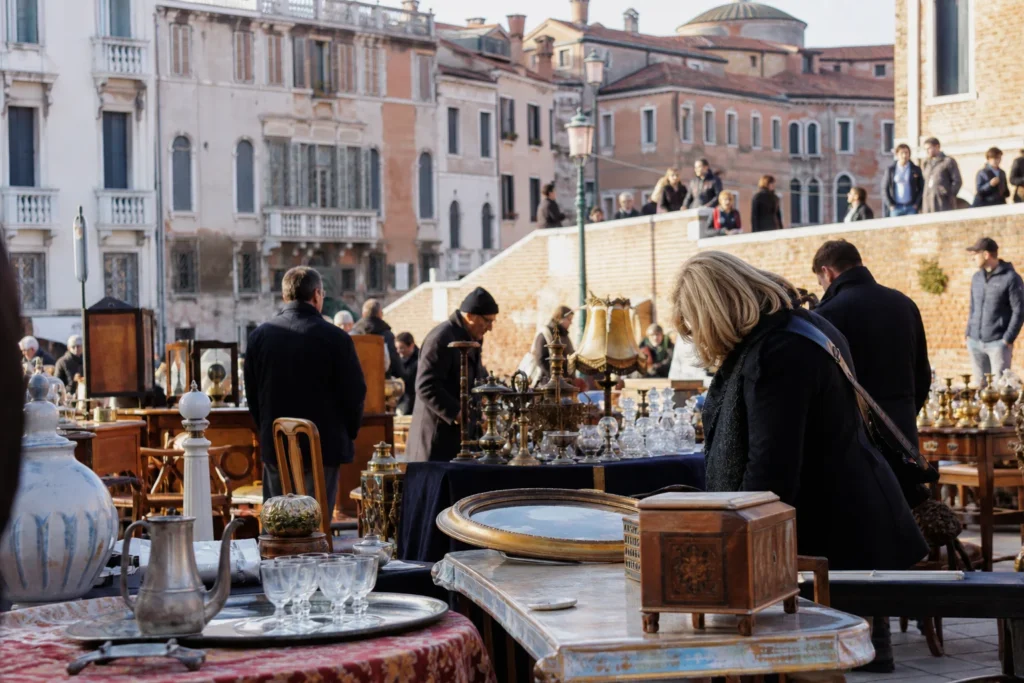

Campo San Maurizio sits quietly in the San Marco sestiere, its proportions generous by Venetian standards. The church of San Maurizio faces the square directly, while Palazzo Bellavite and the Gothic Revival Palazzo Molin close the campo on either side. Into this setting, five times a year, the Mercatino Antiquariato Campo San Maurizio unfolds across the stone — one of Italy's most architecturally distinguished antiquarian markets, and one of the few that genuinely earns that description.
Five editions a year gives the market an event-like energy that weekly or monthly fairs rarely sustain. Events run in April, May, September, October and December, with trading from 09:00 to 19:00. Each edition draws vendors who arrive with purpose, and collectors who plan their Venice visits around the calendar. The scarcity of editions concentrates the atmosphere: stalls open promptly, serious buyers circulate early, and the square feels alive in a way that has nothing to do with ordinary tourist Venice.
The stock spans roughly three centuries of European decorative arts, anchored in the 17th to 20th centuries. Venetian glass and Murano pieces thread through the stalls alongside silverware, decorative ceramics and quality household objects. This is a specialist market, not a general bric-a-brac affair. Vendors tend to know precisely what they carry, and the range suits collectors with defined tastes — period glass hunters, silverware specialists, or those tracking a particular ceramic tradition — more naturally than it suits casual browsers hunting cheap finds.
Pricing reflects that specialist character honestly. Sellers here understand the value of their stock, and genuine bargains are uncommon. The goods generally justify the asking prices, and shoppers who arrive with a clear category in mind typically leave satisfied. Arriving with some knowledge of the period or medium you want to pursue improves the experience considerably.
The campo's wider neighbourhood rewards a longer visit. Campo Santo Stefano lies a short distance away, and the Grand Canal is close enough to feel present without overwhelming the square's quieter mood. Trattorias, wine bars and bacari dot the surrounding calli, making it easy to take a break mid-morning and return with fresh attention. A market day here slots naturally into a broader San Marco afternoon.
Getting to Campo San Maurizio by water is the most direct option for most visitors. The Giglio ferry stop, served by lines 1 and A, sits approximately 200 metres away. The Accademia stops — Accademia "A" and Accademia "B" — are around 275 to 280 metres distant and offer ferry lines 1, 2 and N. All of central Venice is pedestrian-only beyond the waterways, so arrivals by vaporetto and a short walk on foot is simply part of how the city moves.
The Mercatino Antiquariato Campo San Maurizio rewards collectors and culturally engaged visitors who plan ahead. Its five-edition calendar, specialist inventory and a setting among Venice's finest palaces make it worth organising a trip around rather than simply stumbling upon. Check the schedule before you book — when the dates align, this market belongs near the top of any serious Italian antique itinerary.
Frequently Asked Questions
Q: When does the Mercatino Antiquariato Campo San Maurizio take place?
A: The market runs five times a year, with editions in April, May, September, October and December. Trading hours are 09:00 to 19:00. Because the calendar is limited, it is worth checking the current schedule before building a Venice trip around it.
Q: What kind of goods will I find at the market?
A: Campo San Maurizio is a specialist antiquarian market rather than a general bric-a-brac fair. Expect Murano and period glass, silverware, decorative ceramics and quality household objects, broadly spanning the 17th to 20th centuries. Collectors with a defined category in mind — period glass, decorative ceramics, silverware — tend to get the most from a visit.
Q: Should I expect to find bargains here?
A: Sharp bargains are the exception rather than the rule. Vendors know the value of their stock, and pricing reflects that honestly. The goods on offer generally justify the asking prices, so arriving with some background knowledge of your area of interest is more useful than arriving in hope of a deal.
Q: How do I reach Campo San Maurizio by vaporetto?
A: The Giglio stop, served by lines 1 and A, is approximately 200 metres from the campo. The Accademia stops are around 275 to 280 metres away and are served by lines 1, 2 and N. From either landing, the walk through the San Marco sestiere is short and straightforward.
Q: Is there anything else to do nearby on a market day?
A: The campo sits close to Campo Santo Stefano and within easy reach of the Grand Canal. Trattorias, wine bars and bacari are scattered through the surrounding calli, making it natural to step away for a break mid-morning and return for a second circuit of the stalls.
Marketplace Highlights









Add a review