

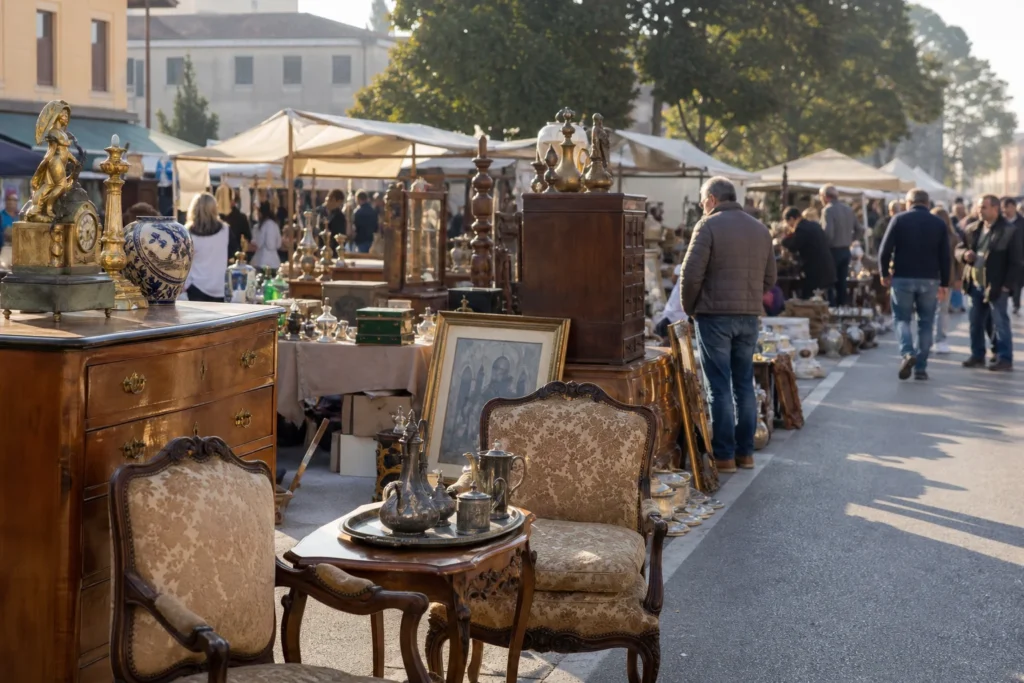

Since 1988, the Mercatino dell'antiquariato a Godega di Sant'Urbano has built a reputation well beyond its modest Veneto address. Via Roma, the main street of this small town in the Treviso hinterland, hosts around 230 dealers across roughly 7,500 square metres of street and covered space. For a settlement of Godega's size, that scale is striking. The market has drawn serious buyers from across Italy and beyond for nearly four decades, placing it firmly among the most established periodic antique fairs in the northeast.
The stock earns that status. At the higher end, dealers bring 17th-century woodwork, Bohemian crystal glasses and carafes, chandeliers, copper pots and German tankards. These sit alongside a more eclectic layer of stock — vintage tin toys, automobile memorabilia, coin and stamp collections, and antique lace. Oriental and ethnic antiques add an unexpected dimension, giving the market a broader collecting range than most provincial fairs manage. The furniture section rewards systematic browsing, with chests, cabinets and framed artwork surfacing regularly across the stalls.
The book stalls are among the market's quieter pleasures. Dealers here surface titles that rarely appear at larger urban fairs — the kind of find that makes a collector's morning. Cutlery specialists and lamp dealers are also well represented, and most are willing to discuss provenance and condition in detail. That depth of specialist knowledge is one of the market's clearest strengths.
Around 2,000 square metres of the total space sits under cover. This section tends to house the more delicate or higher-value pieces and provides useful shelter when the weather turns. The mix of professional dealers and passionate amateurs gives the atmosphere a purposeful quality — less of a weekend browse, more of a serious trading day with room for discovery.
The market runs on the third Sunday of each month, from 08:30 to 18:30, closing in July and August. On a busy date, visitor numbers climb well into the thousands. Arriving early gives the clearest run at fresh stock before the morning crowd thickens. Anyone planning a trip around it should confirm the current schedule in advance, particularly around public holidays.
For visitors arriving by public transport, the nearest bus stop is Godega Centro, approximately 225 metres from the market site, served by bus lines 145 and 153. A second stop, Godega — Case Operaie, lies roughly 400 metres away on the same two routes. Both stops connect the town to the wider Treviso provincial network, making the market reachable without a car for those willing to check local timetables.
Godega di Sant'Urbano sits in a part of northeast Italy with a long culture of periodic fairs and brocantes. This market fits that tradition while operating at a scale that puts it in a different category from most monthly village events. Collectors with a defined focus — furniture, glass, books, decorative metalware — tend to get the most from the day. The longevity, the specialist density, and the breadth of the stock make it well worth factoring into a Veneto itinerary.
Frequently Asked Questions
Q: When does the Mercatino dell'antiquariato a Godega di Sant'Urbano take place?
A: The market runs on the third Sunday of each month, from 08:30 to 18:30. It closes in July and August, so check the current schedule before planning a trip, especially around public holidays.
Q: How big is the market, and what kind of stock can buyers expect to find?
A: Around 230 dealers spread across roughly 7,500 square metres of street and covered space. Stock ranges from 17th-century woodwork, Bohemian crystal and chandeliers through to vintage tin toys, automobile memorabilia, coins, stamps, antique lace and Oriental pieces — an unusually broad range for a provincial fair.
Q: Is there a covered section, and does it matter which part of the market you visit?
A: Around 2,000 square metres of the total space is under cover. This section tends to house more delicate and higher-value pieces and provides useful shelter if the weather turns. Cutlery and lamp specialists are well represented throughout, and most dealers are willing to discuss provenance and condition in detail.
Q: Is it worth arriving early, and how busy does it get?
A: Arriving by 08:30 gives the clearest run at fresh stock before the morning crowd thickens. The market draws serious buyers from across Italy and beyond — on a busy date, visitor numbers climb well into the thousands.
Q: Can I reach Godega di Sant'Urbano by public transport?
A: The nearest bus stop, Godega Centro, is approximately 225 metres from the market and is served by lines 145 and 153. A second stop, Godega — Case Operaie, is around 400 metres away on the same routes. Both connect to the wider Treviso provincial network; check local timetables before travelling.
Marketplace Highlights









Add a review