

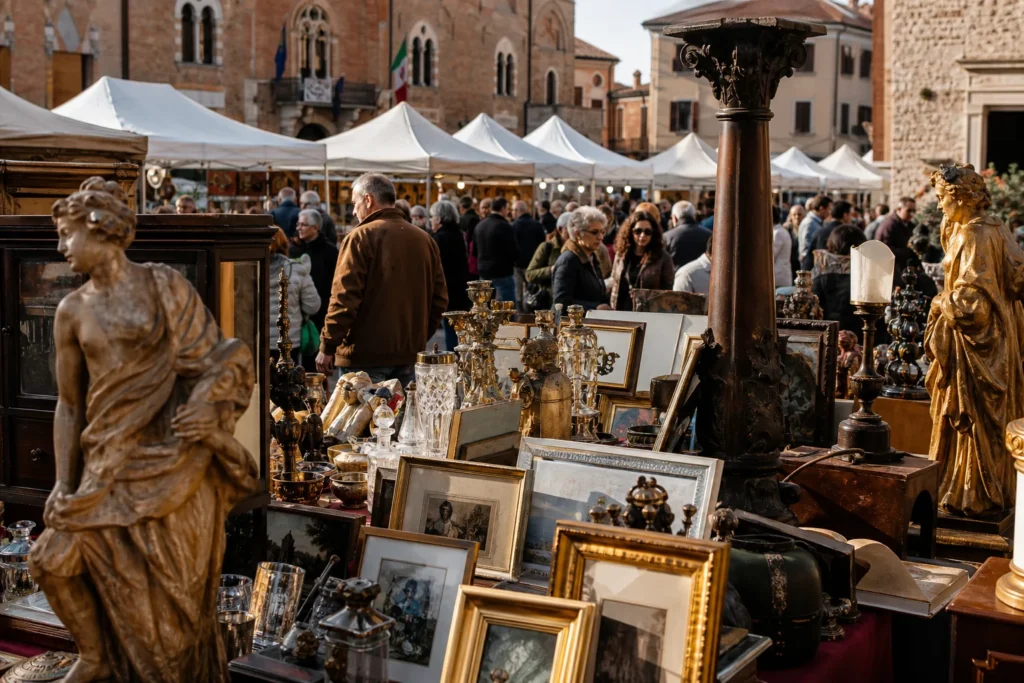

On the second Sunday of each month, Piazza Vittorio Emanuele II in Portobuffolè wakes up early. By 08:00 the stalls are already filling the square, and by mid-morning the cobblestone lanes radiating off it are busy with vendors, collectors and curious day-trippers. The Mercatino Antiquariato e Usato di Portobuffolè runs until 18:00, giving browsers a full day to work through the stock. The market skips August entirely, and in April it shifts to Easter Monday rather than the usual second Sunday — worth checking before you travel.
The goods here span enough ground to keep any collector occupied. Decorative and sculptural pieces form one strong thread: Baroque wooden sculptures, antique mirrors propped against stone walls, crystal chandeliers, and porcelain figurines. A second current runs through printed matter and recorded sound — antique prints, illustrated books, stacks of vinyl and old comics. Smaller finds fill the gaps: brass ornaments, glass objects, vintage fabrics, antique jewellery and old tools. Pieces of furniture, compact enough to move by hand, turn up throughout. The range is wide, but the overall character leans toward the serious rather than the touristy.
Most vendors come from the province of Treviso and the broader Veneto region. Their stock reflects that provenance genuinely. A conversation with a stallholder often reveals local history alongside the price. With reportedly over two hundred vendors at each edition, and a rotating selection that refreshes every month, there is real reason to return. A piece passed over one month is unlikely to survive to the next.
The market's layout rewards wandering rather than efficiency. Stalls spread from the main piazza into surrounding lanes that twist and double back on themselves. New stalls appear around almost every corner. The Borgo Medievale and the Ponte Friuli frame the whole scene, and the combination of medieval stone overhead and antique goods underfoot gives the market an atmosphere that modern settings simply cannot manufacture. Food and drink points are dotted around the site, making it easy to refuel without losing momentum. The market has sustained this draw consistently since its founding in 1994.
For visitors arriving by public transport, the nearest stop is Portobuffolè Centro, approximately 150 metres from the market, served by bus lines 140 and 154. The stops Borgo Servi and Portobuffolè Villa Giustinian, both on the same two lines, sit within roughly 300 metres. Portobuffolè is a small Veneto town, and most visitors arrive by car — but the bus connections do exist for those coming from nearby towns on the regional network.
This market suits collectors with a focused interest in Veneto decorative arts, furniture and printed matter, as well as visitors pairing a market morning with a proper walk around the town itself. More than thirty years of continuous monthly editions say something real about its consistency and appeal. For anyone spending time in the Treviso area or passing through the Veneto, a second Sunday here makes for an exceptionally well-spent day.
Frequently Asked Questions
Q: When does the Mercatino Antiquariato e Usato di Portobuffolè take place, and are there any exceptions to the regular schedule?
A: The market runs on the second Sunday of each month, from 08:00 to 18:00, in Piazza Vittorio Emanuele II and the surrounding lanes. August is skipped entirely, and in April the market moves to Easter Monday rather than the usual second Sunday. Check ahead before making a special trip.
Q: What kinds of antiques and collectables can shoppers expect to find?
A: The range is genuinely broad. Decorative and sculptural pieces — Baroque wooden sculptures, antique mirrors, crystal chandeliers and porcelain figurines — sit alongside printed matter and recorded sound: antique prints, illustrated books, vinyl records and old comics. Smaller finds include brass ornaments, glass objects, antique jewellery, vintage fabrics and old tools, with occasional small furniture pieces throughout.
Q: Is the stock here distinctly regional, or does it reflect a generic European fair circuit?
A: Most vendors come from the province of Treviso and the wider Veneto region, and their stock reflects that provenance directly. Pieces here tend to carry genuine local material history rather than the interchangeable goods common to larger pan-European fairs. Conversations with stallholders often add useful context about a piece's origins.
Q: Can visitors reach the market by public transport?
A: Bus lines 140 and 154 serve the town. The closest stop, Portobuffolè Centro, is approximately 150 metres from the market; Borgo Servi and Portobuffolè Villa Giustinian are both within roughly 300 metres. Most visitors arrive by car, but the bus connection is a practical option from nearby towns on the regional network.
Q: Is it worth returning to the market across multiple months?
A: Yes. With reportedly over two hundred vendors per edition and a monthly cycle, the stock turns over substantially. A piece passed over one month is unlikely to reappear the next, which gives regular visitors genuine reason to return rather than simply browsing the same inventory on repeat.
Marketplace Highlights









Add a review