


Region
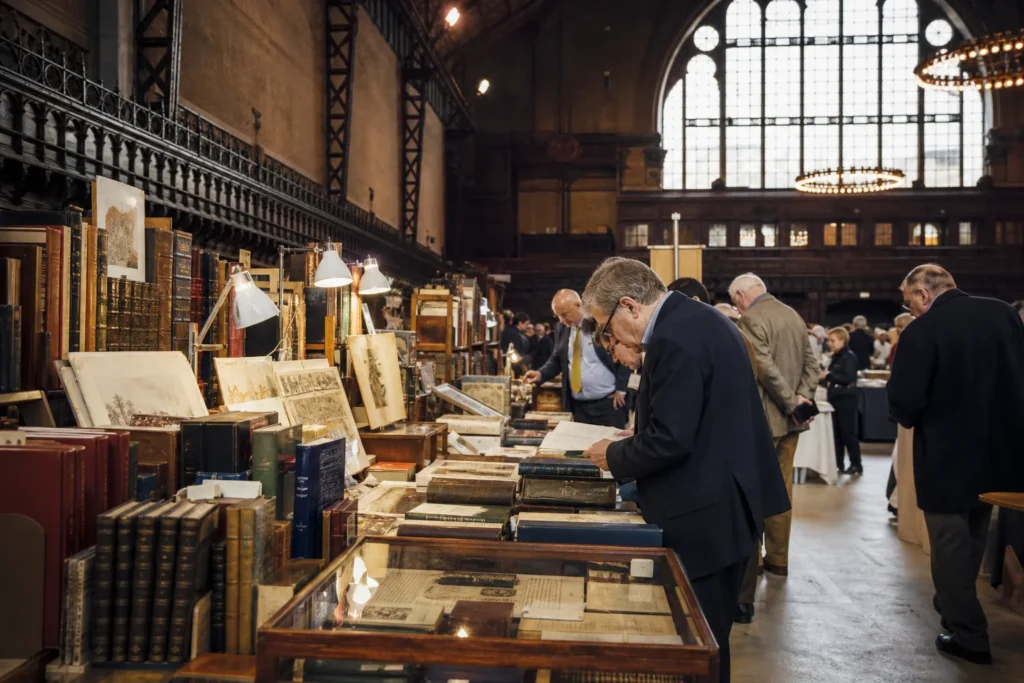
Imagine picking up a letter written in the eighteenth century, or turning the pages of a scientific treatise that helped reshape how humans understood the natural world. At the New York Antiquarian Book Fair, that kind of encounter is routine. Held once a year in spring — typically across four days in March or April — the fair draws close to 200 professional dealers from around the world into one of Manhattan's most commanding spaces.
The Park Avenue Armory's vast 1880s drill hall gives the event a setting unlike any conventional trade fair. The space has been compared to the great European railway termini in its scale and structural drama. When dealers dress their stands across roughly 55,000 square feet of largely unobstructed floor, the hall shifts into something between a historic gallery and a living archive. The atmosphere, despite the scale, stays unhurried and genuinely personal.
The range of material on offer is difficult to summarise without underselling it. First editions and rare Americana share the floor with works on science, medicine, gastronomy, and philosophy. Art prints and illustrated books sit alongside children's literature and fashion history. Some of what changes hands here dates back to the medieval period. These are not display-case artefacts — many items are available to handle and examine directly, which gives the browsing experience an immediacy that no museum visit can replicate.
Every dealer at the fair holds membership with the Antiquarian Booksellers' Association of America. That affiliation carries real weight. All material undergoes authentication review before it reaches the floor, so buyers encounter dealers who know their stock thoroughly and engage with questions from experts and newcomers alike. The ABAA oversight transforms what might otherwise feel like a high-stakes gamble into a genuinely lower-risk environment, especially for collectors approaching the field for the first time.
The fair has run in some form since the 1960s, making it one of the longer-running events of its kind in North America. That longevity shows in the culture around it. Established collectors arrive with want-lists and longstanding dealer relationships. The fair's consistency has made it a fixed point in the collecting calendar rather than an annual novelty.
The Park Avenue Armory location places the event firmly in the Upper East Side, a neighbourhood dense with galleries, auction rooms, and specialist dealers. It functions naturally as an anchor for a wider day of antiquarian exploration across this part of the city.
The fair suits collectors who want authenticated material and expert guidance over open-market uncertainty. It also suits the dedicated first-timer drawn by the spectacle of the hall and the rare chance to handle centuries-old material in a professionally curated setting.
Frequently Asked Questions
Q: Is the New York Antiquarian Book Fair open to the general public, or is it trade-only?
A: The fair is open to the public. Experienced collectors arrive with want-lists and established dealer relationships, but first-time visitors are equally welcome, and dealers are known for engaging genuinely with newcomers rather than steering conversations toward known buyers only.
Q: How can buyers be confident that material at the fair is authentic?
A: Every dealer at the fair holds membership with the Antiquarian Booksellers' Association of America, and all material undergoes authentication review before it reaches the floor. That oversight makes this a more reliable entry point for collectors than open-market buying, particularly for anyone approaching rare books and documents for the first time.
Q: What kinds of material can visitors expect to find?
A: The range is broad: first editions, rare Americana, exploration literature, works on science, medicine, philosophy, and gastronomy sit alongside illustrated books, fashion history, and children's literature. Some printed and manuscript material dates back to the medieval period. Many items are available to handle directly rather than view behind glass.
Q: When does the fair take place and where is it held?
A: The fair is held annually in spring, typically across four days in March or April, at the Park Avenue Armory on Manhattan's Upper East Side. Check the organizer's official page before you go to confirm the exact dates for the current year.
Q: Is the Park Avenue Armory a practical venue to spend a full day at?
A: The main drill hall is a vast 1880s space said to span around 55,000 square feet, and with close to 200 dealer stands the fair rewards unhurried browsing rather than a quick pass. The Upper East Side location also places it within easy reach of galleries, auction rooms, and specialist dealers in the surrounding blocks, making it straightforward to extend the visit into a broader day of antiquarian exploration.
Marketplace Highlights









Add a review