

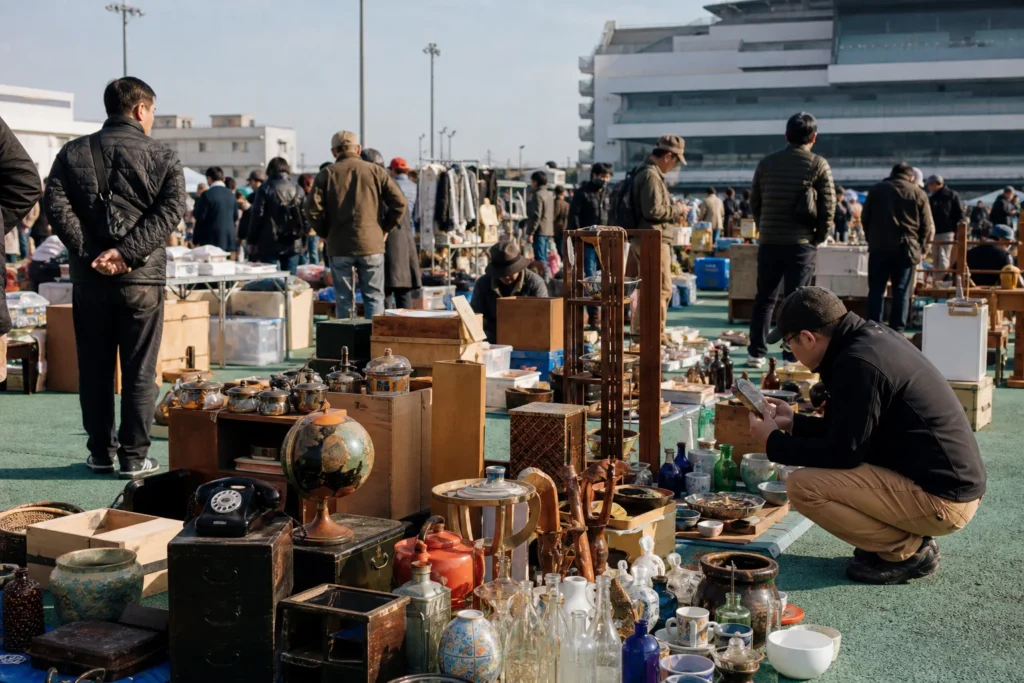

On most weekends in Shinagawa, a working horseracing venue transforms into something else entirely. Ohi Keibajo (大井競馬場) — also known as the Tokyo City Flea Market — takes over the racecourse grounds with around 600 stalls, making it the largest regularly scheduled flea market in Tokyo. Organised by the Tokyo Citizens Recycling Society, it runs almost every Saturday and Sunday, giving it a rhythm and scale that no shrine or temple market in the city can match.
The format here is closer to a British car boot sale than a traditional Japanese antiques fair. Visitors expecting lacquerware, vintage kimono or Meiji-era ceramics will need to look elsewhere. What Ohi Keibajo offers instead is a frank, unpretentious slice of Japanese everyday life — the kind of material culture that fills apartments, garages and recycling boxes across the city.
Merchandise spans three broad worlds. The first is the household and practical: cookware, kitchenware, worn bric-a-brac, old tools showing honest rust, and the kind of small domestic objects that accumulate over decades. The second is media and pop culture — shelves of paperbacks, stacks of DVDs, video games across multiple generations, anime figures and manga volumes. The third covers wearables and accessories: second-hand clothes, bags, watches, and assorted knick-knacks at prices that start as low as ¥100 for many items.
That entry price point matters in Tokyo, a city not known for its generosity to budget shoppers. For first-time visitors curious about everyday Japanese consumer culture — the domestic, informal version rather than the curated department-store version — Ohi Keibajo is genuinely revealing. The market feels like a live documentary of what people actually own, use and eventually let go. Pop-culture browsers, thrift hunters and anyone who appreciates the randomness of a well-stocked car boot sale will find it rewarding.
The racecourse setting gives the market an open, unhurried quality. Stalls spread across real space rather than pressing in on narrow temple paths. Hours shift with the seasons: from October to March the market runs roughly 08:30 to 14:30, while April through September it opens around 09:00 and closes at 15:00. Arriving in the morning gives you the best spread before the crowd thins the best finds.
Getting to the market is straightforward from several directions. The bus stop 大井競馬場, served by bus lines 井20, 品93乙 and 品93甲, sits approximately 150 metres from the grounds and is the most convenient local option for many visitors. Oikeibajo-Mae train station is approximately 400 metres away and serves as the primary rail access point. Tachiaigawa station — on subway line Al and train line KK — provides a useful alternative at around 700 metres. The market address is 2-1-2 Katsushima, Shinagawa-ku, Tokyo.
Ohi Keibajo suits visitors who want to see Tokyo from the inside out. It is not a showcase market. It is the real thing — sprawling, affordable, occasionally strange, and entirely its own.
Frequently Asked Questions
Q: Is Ohi Keibajo a good market for finding traditional Japanese antiques?
A: Not really — and that's worth knowing before you go. This market runs closer to a car boot sale than a shrine antiques fair. The strength here is everyday Japanese material culture: cookware, old tools, media and pop culture items, second-hand clothes and bags. Visitors hunting lacquerware or vintage kimono should look to specialist antique markets elsewhere in Tokyo.
Q: How large is the market, and how often does it run?
A: Around 600 stalls spread across the racecourse grounds, running on most Saturdays and Sundays throughout the year. That scale and frequency make it the largest regularly scheduled flea market in Tokyo — quite different from the occasional shrine markets that dot the city's calendar.
Q: What are the opening hours, and when is the best time to arrive?
A: Hours shift seasonally. From October to March the market runs roughly 08:30 to 14:30; April through September it opens around 09:00 and closes at 15:00. Morning arrivals get the widest selection before the best finds move on. Check the organiser's official page before travelling, as individual dates can vary.
Q: How do I get there by public transport?
A: The bus stop 大井競馬場 — served by lines 井20, 品93乙 and 品93甲 — sits approximately 150 metres from the grounds and is often the most convenient option. Oikeibajo-Mae train station is the primary rail access point at around 400 metres. Tachiaigawa station (subway line Al, train line KK) is a useful alternative at approximately 700 metres. The address is 2-1-2 Katsushima, Shinagawa-ku, Tokyo.
Q: What kind of budget do I need for shopping here?
A: Prices start as low as ¥100 for many items, which is genuinely rare for Tokyo. The market skews affordable across the board — it's a practical option for thrift shoppers, pop-culture browsers and anyone who wants to spend time browsing without financial pressure.
Marketplace Highlights








Matt Jensen
29th June 2015 at 12:07As a big fan of the British ‘car boot sale’ when I came to Japan in 2014 I had to try out a flea market! So I did! The flea market itself is fantastic: so many stalls you lose count, with people selling all sorts from cookware, anime toys, clothes, video games, books, dvds, videos, most wanting as little as ¥100 for anything, it really puts all that shopping around Tokyo for thousands of yen into perspective! You’ll also find various food vendors in the flea market, whilst the hot food was tempting, we couldn’t say no to some Kakigori in a variety of tasty flavors!
Everyone is very polite and no one was forceful at the flea market unlike some people at car boot sales, and as foreigners they would always try and tell us how much they were telling us in English, and we didn’t feel as though anyone was driving up the price because we were foreigners!
Marsha Ward
31st May 2016 at 19:36I was so looking forward to checking out a flea market in Tokyo. We hauled all the way across town on Sunday morning with hope of finding even one cool, unusual thing. There seemed to be a few true collectors mostly selling toys–the rest was a jumbled heap of old, worn out bric-a-brac, rusty tools, piles of clothes, and useless old electronics. There was one vendor selling some interesting natural history items, but I was skeptical about my ability to import them along with the feeling that the bear claws had probably been procured under less than ideal circumstances. There were sellers with piles of old kimono for only 200JPY, but they smelled strongly of mothballs, and I had little confidence I’d be able to get the smell out.
Overall, I’d give it a pass–there’s nothing else out that way in the event of a bust, so it’s basically a waste of three hours.
NIK
5th March 2017 at 11:48I went there yesterday, I like it.
There are food stalls too, kebab, curry, yakitori, etc… delicious!!