

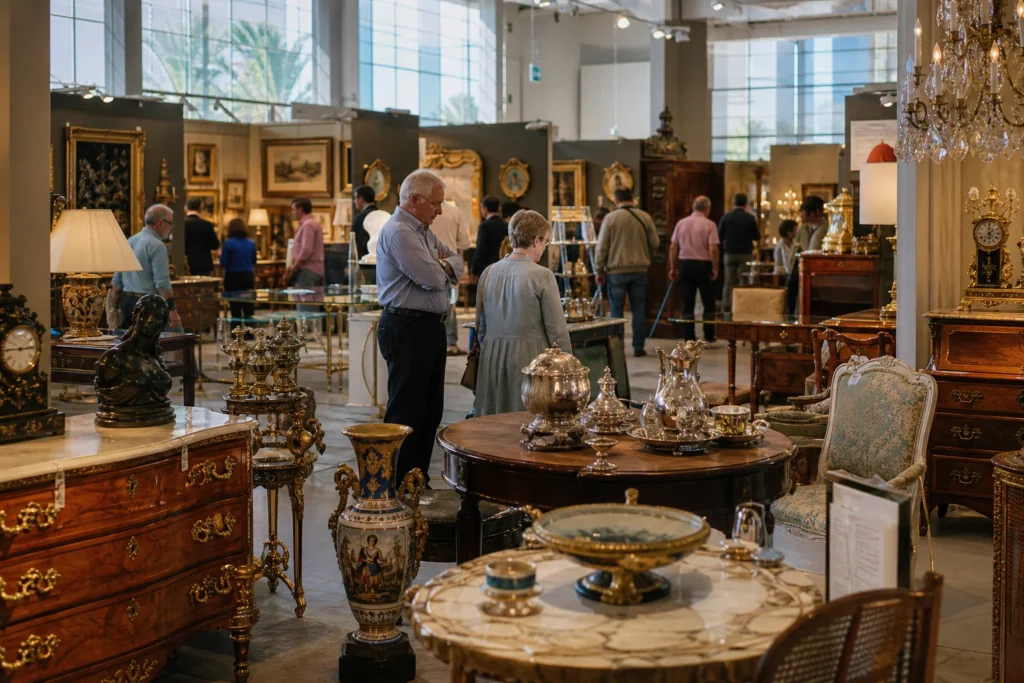

Every January, the Miami Beach Convention Center transforms into something that feels closer to a European grand fair than a typical American antique show. Dealers arrive from dozens of countries. The floor fills with objects you genuinely cannot find concentrated in one room anywhere else on the American calendar.
The Convention Center's main exhibition hall gives the show unusual room. Dealers build proper displays here, not just folding-table arrangements. Visitors move through at their own pace, and the scale rewards unhurried browsing rather than a single sweeping pass. Despite hundreds of dealers filling the floor, the layout rarely feels overwhelming.
The international character of the dealer mix defines the experience. You might step from a French brocante stand stacked with gilded mirrors directly into a gallery specialising in East Asian ceramics, then find yourself pausing at a case of signed Cartier jewellery. Georgian silver, Renaissance bronzes, Art Deco furniture, and Victorian textiles all share the same floor. The breadth is real, not decorative.
Jewellery and watches draw serious collector attention at this event. Named pieces at the calibre of Patek Philippe, Rolex, and Tiffany have appeared here alongside independent specialists and European dealers. Competition between vendors benefits buyers. Sculpture, fine glasswork, decorative ceramics, and vintage luxury accessories round out a floor plan with genuine range across collecting categories and budgets.
The show's institutional partnerships reinforce its standing in the trade. Sotheby's involvement places the event firmly at the upper end of the market. A connection with Mercanteinfiera, the major antique fair held at Parma's exhibition centre in Italy, draws European dealers who treat Miami Beach as a serious international stop rather than a peripheral event.
One day during the five-day run dedicates itself to complimentary appraisals open to the public. Visitors bring items from home and sit with qualified appraisers to learn what they actually own. Guided tours trace collecting through specific historical periods. Seminars run across the week and cover subjects useful to first-time collectors and trade professionals alike. These programmes lift the show well above a standard antique fair.
The event runs once a year in January, with daily hours approximately 10:00 to 16:00. Check the official show website for current dates and ticketing before you plan your trip.
The Miami Beach Convention Center sits well served by Miami-Dade Transit buses on 17th Street. The stop at 17th Street and Washington Avenue, approximately 280 metres away, connects bus lines 103, 112, 113, and 119. An alternative stop at 17th Street and Convention Center Drive, at a similar distance, serves lines 112, 113, 115, and 119. Miami Beach has no nearby metro or commuter rail; buses are the practical public transport route to the venue.
The show suits a genuinely wide range of visitors, but it rewards those who arrive with a specific intention. Interior designers come to source one-of-a-kind statement pieces. Serious collectors treat the five-day window as a rare luxury — enough time to revisit a stand, negotiate properly, and leave with something significant. First-timers drawn by the appraisal days often find the structured tours give them a useful introduction to the floor. January in Miami Beach adds a natural incentive to build a longer trip around the event.
Frequently Asked Questions
Q: What kind of dealers and objects should I expect to find at the Original Miami Beach Antique Show?
A: The dealer roster runs into the hundreds and spans dozens of countries, which makes the floor unusually varied. You might move from a French brocante stand stacked with gilded mirrors to a specialist in East Asian ceramics, then on to fine jewellery and watches at the level of Cartier, Patek Philippe, and Tiffany. Georgian silver, Renaissance bronzes, Art Deco furniture, Victorian textiles, sculpture, and decorative glasswork all share the same floor. The breadth rewards collectors working across categories and budgets.
Q: Is the show worthwhile if I am new to collecting antiques?
A: Yes. One full day during the five-day run is dedicated to complimentary appraisals, where members of the public can bring items from home and sit with qualified appraisers. Guided tours trace collecting through specific historical periods, and seminars run across the week covering topics useful to first-timers as well as seasoned trade professionals. That programming makes the show considerably more accessible than a standard antique fair.
Q: When does the show take place and how long does it run?
A: The Original Miami Beach Antique Show runs for five days each January at the Miami Beach Convention Center, with daily hours approximately 10:00 to 16:00. Check the official show website for current dates and ticketing before you plan your visit, as specifics can vary year to year.
Q: Can I get to the Miami Beach Convention Center by public transit?
A: Yes. Miami-Dade Transit buses serve the Convention Center well. The stop at 17th Street and Washington Avenue, roughly 280 metres from the venue, is served by lines 103, 112, 113, and 119. An alternative stop at 17th Street and Convention Center Drive is at a similar walking distance.
Q: What gives this show its reputation among serious collectors and dealers?
A: Two institutional connections stand out. Sotheby's involvement places the event firmly at the upper end of the trade, signalling strong authentication standards. A partnership with Mercanteinfiera — the major antique fair held in Parma, Italy — draws European dealers who treat Miami Beach as a genuine stop on the international circuit rather than a peripheral American event. That combination of American and European trade presence is rare on the North American calendar.
Marketplace Highlights









Add a review