

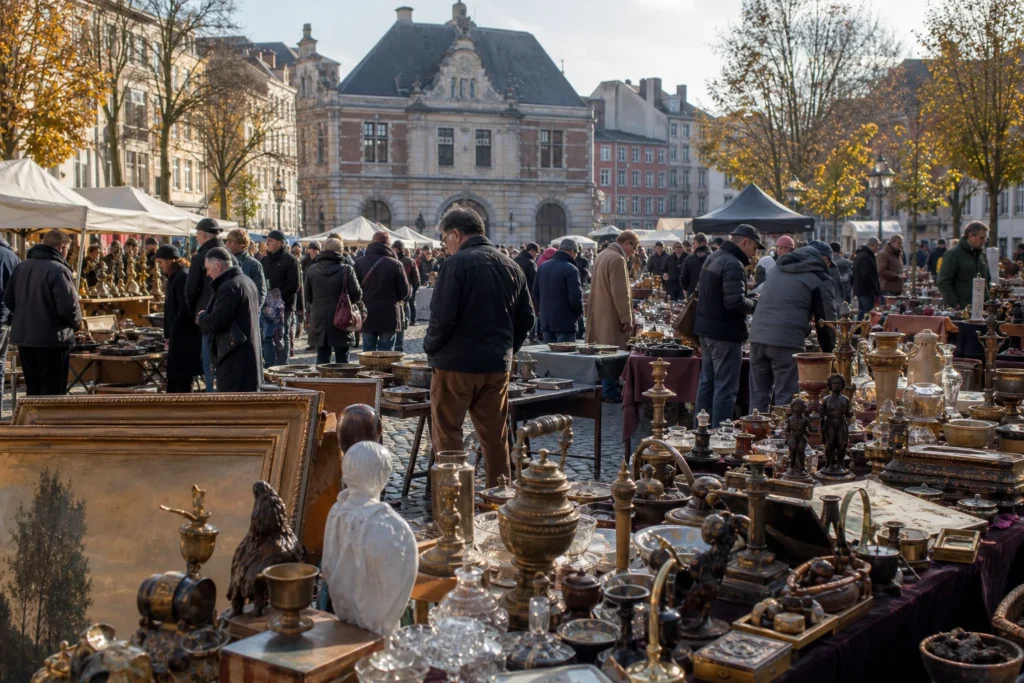

Every morning of the year, Place du Jeu de Balle wakes up to the sound of boxes being opened on cobblestones. Around 450 professional dealers set out their stalls across this broad Marolles square before eight o'clock, seven days a week. Locals call it the Vieux Marché. In the old Brussels dialect it carries an older name still — den â met, meaning simply "the old market." Neither label oversells it. This is one of Europe's genuinely working daily flea markets, not a weekend tourist fair dressed up for Instagram.
The square has been here since 1853, originally laid out as a playing field for balle pelote — a forerunner of tennis that Brusselers took seriously in the nineteenth century. The market itself arrived in 1873, when the city council voted to relocate the junk and old-clothes trade from Anneessens square. A local councillor had complained that the stalls were damaging the appearance of the new central boulevards. The Marolles absorbed them without complaint, and they never left.
What the market offers today spans a wide range of registers. Genuine antique furniture and decorative objects sit alongside racks of second-hand clothing, chipped ceramics, old tools, vinyl records and the kind of unclassifiable bric-a-brac that only surfaces at this kind of market. Because the sellers are professionals, quality items appear regularly — but they are priced accordingly. Bargaining is part of the culture here, yet it has its limits. Experienced visitors know that a good piece holds its price, and pushing too hard rarely works in your favour.
Timing your visit rewards a little thought. Regulars tend to favour Thursdays and Fridays for the steadiest selection. Weekends draw more browsers and occasionally surface rarer or more specialist pieces that dealers hold back for the higher-traffic days. Whatever day you choose, arrive early. Dealers unpack from around eight in the morning, and the best finds rarely wait until mid-morning.
The market opens at 08:00 daily. On weekdays it runs until 14:00; on Saturdays and Sundays it extends to 15:00, giving weekend visitors a little more time to work the stalls and still catch nearby streets before lunch crowds thin out.
Place du Jeu de Balle makes most sense as the first stop on a longer Marolles antiques circuit. Rue Blaes runs immediately adjacent and carries a dense strip of antique and second-hand shops worth exploring after the market. Place du Grand Sablon, a short walk north, lifts the register into higher-end antique dealers and weekend specialist markets. For something more personal, the dealer Stef Antiek on Place Saint Catherine ranks among the more surprising junk shops in the city — worth the detour for collectors who enjoy the unpredictable.
Getting here is straightforward. The bus stop Jeu de Balle – Vossenplein sits approximately 100 metres from the square, served by bus lines 48, 52 and the night bus N12 — useful for anyone coming directly from the city centre. Porte de Hal – Hallepoort, roughly 350 metres away, offers metro lines 2 and 6, tram lines 4 and 10, and additional bus routes including 48, 52 and 123. Visitors arriving by rail can use Brussels-Chapel station, approximately 500 metres away, served by train line S1.
Place du Jeu de Balle suits the patient collector who moves through a market methodically, and equally the casual visitor who just wants to spend a Brussels morning doing something that feels nothing like a shopping mall. The combination of daily access, professional stock and a genuinely characterful neighbourhood makes it worth building a whole morning around.
Frequently Asked Questions
Q: Is Place du Jeu de Balle open every day, or only at weekends?
A: The market runs every single day of the year, including public holidays. Around 450 professional dealers set up across the square from 08:00. On weekdays the market closes at 14:00; on Saturdays and Sundays it stays open until 15:00.
Q: When is the best time to arrive if you're looking for something specific?
A: Early. Dealers begin unpacking before 08:00, and desirable pieces rarely last until mid-morning. For the steadiest overall selection, regulars tend to favour Thursdays and Fridays. Weekend visits occasionally turn up rarer or more specialist items, but the square is busier with browsers.
Q: Is bargaining expected, and how hard can you push on price?
A: Bargaining is part of the culture here, but the sellers are professionals and quality pieces are priced to reflect that. A modest negotiation is normal; pushing aggressively on a good item rarely works in your favour. If a price holds firm, it usually means the dealer knows what they have.
Q: What kind of things can you actually find at this market?
A: The range is genuinely wide — antique furniture and decorative objects, vintage clothing, vinyl records, old tools, ceramics and pure bric-a-brac all appear regularly. Because sellers are professionals, the floor quality is relatively consistent, though so are the prices on better pieces.
Q: Is there anything worth visiting nearby once the market closes?
A: Rue Blaes, immediately adjacent to the square, carries a dense strip of antique and second-hand shops that extend the morning well. Place du Grand Sablon, a short walk north, offers higher-end antique dealers and a specialist weekend market. Collectors who enjoy unpredictable finds often add Stef Antiek on Place Saint Catherine to the circuit.
Marketplace Highlights








Romuald Crépin
10th July 2015 at 22:50Très tôt le matin et, en particulier le mardi et le jeudi, vous pouvez faire de magnifiques découvertes. En plein quartier de marolles, la place du jeu de balle est le rendez-vous des brocanteurs professionnels.
Là, se côtoient brocanteurs et antiquaires en quête d’une bonne affaire.
Les vendeurs sont tous des professionnels de la brocante et des vides-greniers.
Bien discuter les prix. Attention aux arnaques. Beaucoup de copies vendues comme des originaux. Néanmoins, un oeil averti peut découvrir de belles choses.
Ouvert tous les jours, mais je recommande d’éviter d’y aller les samedis et dimanches.
Mathew Mills
29th September 2015 at 06:55The Place du Jeu de Balle is a daily event, starting about 6am and running to lunchtime. It is a kaleidoscope of junk and stuff, from piles of clothes, scarves, to books, yesterdays and tomorrows antiques with very colorful characters doing the bidding.
Be prepared to haggle or die, and go during the week (prices are lower than on the weekend where there is the tourist premium). Caveat Emptor is the rule: so have a good look before you part with your money; It maybe the last you see of it. Also around are some great antique shops, reasonably priced compared to Paris.
Erin Armstrong
8th December 2015 at 16:12If you enjoy flea markets, this is one for you. People there were open and very diverse! Saw people from lots of different cultures and they’re were all selling personal stuff which printed a nice atmosphere in the place.
Bianca Cluysen
9th February 2016 at 06:45This is a fantastic flea market. The best day to visit it is Sunday morning. The rest of the week is not as lively. The square is large and surrounded by red brick buildings including a church. On Sundays the bars and cafes around it liven up and there is good jazz music live, Belgian beer and simple food.
Leslie Nelson
18th June 2016 at 06:25There are over 100 stall laid out on the ground and tables. Haggling is suggested for the prices. Small restaurants are along the edge of the place. Things for sale change every day – so go back.