

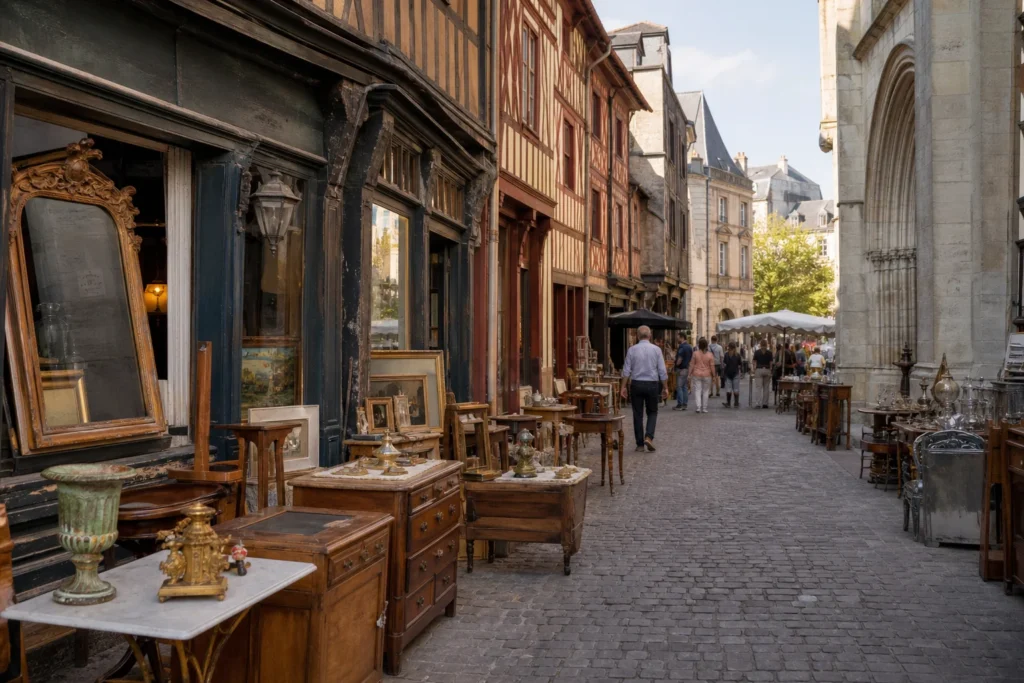

Step onto Rue Damiette on a Tuesday morning and the street announces itself immediately. Timber-framed houses lean forward above the pavement, their upper storeys almost touching across the narrow lane. Shop windows catch the northern light — gilded mirror frames, stacked faience, the dark silhouette of an armoire pressed against old glass. This is the spine of Rouen's Quartier des Antiquaires, and almost everything worth knowing about the place declares itself in that first view.
The street runs between two medieval churches, with the Abbatiale Saint-Ouen at one end and the Église Saint-Maclou at the other. Both anchor the district with genuine architectural weight, and neither is simply backdrop. Browsers who drift too far from the shop fronts and step inside either church find themselves rewarded. The district's character sits in that combination — accumulated centuries of objects and architecture pressing against each other with very little gap between them.
Dealers here cover a wide range without becoming diffuse. At one end of the spectrum, specialist boutiques carry French provincial furniture, decorative arts and carefully sourced objects with provenance. In the middle ground, generalist antique shops offer the satisfying uncertainty of ceramics, old tools, lamps, prints and the kind of miscellany that serious collectors circle back to after telling themselves they won't. Bric-à-brac sellers complete the picture, their shelves patient enough to reward a slow look. A handful of shops lean toward handcraft and upcycled pieces, giving the quarter a creative undercurrent that sits alongside rather than displacing its collector core.
Serious buyers will find specialist knowledge available in several boutiques, particularly for French regional furniture and decorative objects from the seventeenth to the nineteenth centuries. Casual visitors, with no fixed agenda, tend to discover that the range spanning centuries and price points keeps them on the street longer than planned. Art galleries interspersed among the antique shops deepen the offer further, making this a place worth a longer visit than a single shopping errand might suggest.
Most shops open Tuesday through Saturday, roughly 10:00 to 18:00, though individual hours vary by dealer. Both Monday and Sunday are generally quiet, with most shutters down. Planning around a midweek or Saturday morning visit gives the best access to the full spread of traders.
Rouen's Gothic cathedral sits within easy reach, and the broader city centre wraps around the quarter closely enough that a morning among the dealers connects naturally to the rest of a day in the city. The quarter suits collectors hunting specific periods, design-curious travellers drawn by the Norman streetscape, and Paris-based visitors making the day trip north — Rouen Rive-Droite station, approximately one kilometre away, receives direct trains from Paris Saint-Lazare and connects to tram line M. For those arriving locally, bus stop Saint-Nicolas is virtually at the quarter's door, served by bus lines 11, F1, F7 and N. Tram line M also stops at Palais de Justice – Gisèle Halimi, roughly 600 metres away, and at Théâtre des Arts around the same distance, with buses 27, 33, F5, F9, T1, T2 and T3 also serving that stop.
What makes the Quartier des Antiquaires genuinely difficult to replicate elsewhere in Normandy is the density. The specialist depth, the medieval frame and the compressed geography of it all — the sense that five centuries of objects have simply been gathering here, waiting — combine into something that functions as both a market destination and an encounter with Rouen's particular grain. That combination is harder to find than it sounds.
Frequently Asked Questions
Q: What days and hours are best for visiting the Quartier des Antiquaires?
A: Most dealers along Rue Damiette open Tuesday through Saturday, roughly 10:00 to 18:00. Monday and Sunday are generally quiet, with the majority of shops closed. A midweek morning or Saturday visit gives the widest access to the full spread of traders, though individual shop hours do vary — it's worth checking with specific boutiques if you're travelling for a particular dealer.
Q: What kinds of antiques and objects are the dealers here known for?
A: The quarter covers a wide range without losing focus. Specialist boutiques concentrate on French provincial furniture and decorative arts, often from the seventeenth to nineteenth centuries, with genuine provenance knowledge available. Generalist shops offer ceramics, prints, lamps, old tools and satisfying miscellany. Bric-à-brac sellers reward a slower look, and a handful of handcraft and upcycled shops add a creative edge alongside the collector core.
Q: Is this a good destination for serious collectors as well as casual browsers?
A: Both find the quarter worthwhile. Collectors hunting a specific period or style will find specialist knowledge in several boutiques, particularly for Norman and French regional pieces. Casual visitors tend to stay longer than planned — the range of objects spanning centuries and price points, combined with the architecture and interspersed art galleries, makes it genuinely absorbing rather than a quick errand.
Q: How does the Quartier des Antiquaires fit into a broader day in Rouen?
A: The quarter sits within easy walking distance of Rouen's city centre, the Gothic cathedral and the churches of Saint-Ouen and Saint-Maclou, which anchor either end of Rue Damiette itself. A morning among the dealers connects naturally to the rest of the city, and Rouen is accessible by rail from Paris, making it a practical day trip for visitors based in the capital.
Marketplace Highlights








Add a review